Industry Insights
Plastic Pallet GMP Release Records
Use a documented QA release check before plastic pallets enter pharmaceutical, ingredient, packaging, or GMP-controlled warehouse areas.
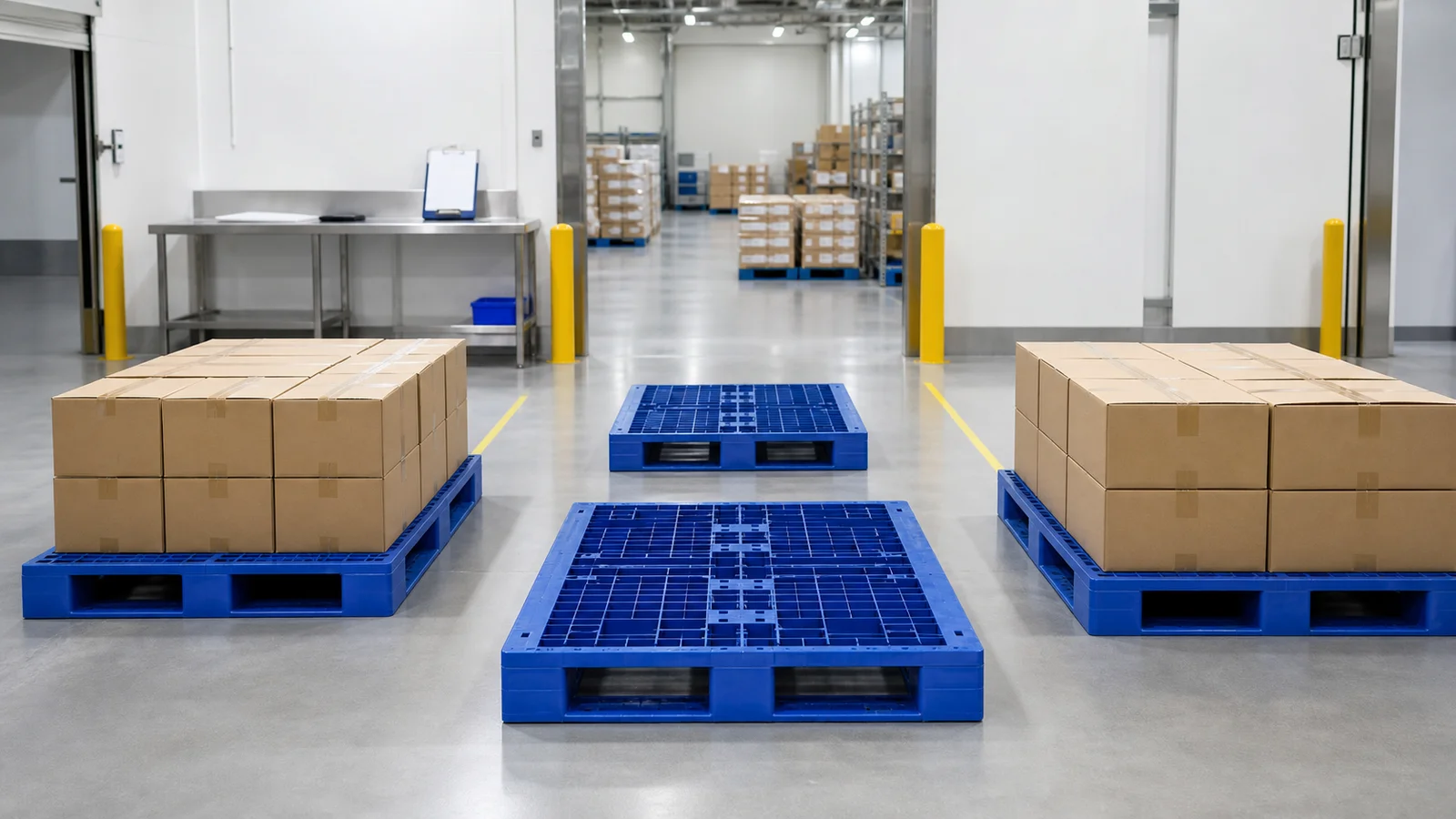
A plastic pallet should enter a pharmaceutical, ingredient, packaging, or GMP-controlled warehouse area only when the site can explain its status. The practical question is not “is this pallet GMP certified?” A better question is: can quality, warehouse, and procurement teams document why this pallet is acceptable for this area, this material, this cleaning state, and this handling route?
Use this guide when a buyer is approving new plastic pallets, replacing wood pallets near controlled materials, receiving returned pallets, or deciding whether a pallet can move from a general warehouse into a GMP-controlled area. The output is a short release record: accepted for the defined use, held for confirmation, or rejected from the controlled route.
This is preliminary operating guidance. It does not replace a site quality system, local law, customer quality agreement, supplier declaration, validation protocol, or regulatory advice.
Why a release record matters
Pharmaceutical and medical-product storage controls are built around clean conditions, documented procedures, contamination prevention, and status control. 21 CFR 211.56 addresses clean and sanitary buildings, written sanitation procedures, cleaning methods, cleaning materials, and prevention of contamination. 21 CFR 211.80 requires written procedures for receipt, identification, storage, handling, approval, and rejection of components and drug product containers and closures; it also addresses contamination prevention and status identification.
Those rules do not approve a plastic pallet model. They do show why a pallet used near controlled materials cannot be treated as an ordinary warehouse item. If its prior use, cleaning state, material identity, damage condition, or route status is unknown, the pallet can weaken the site’s ability to prove that controlled materials were stored and handled under the right conditions.
The WHO good storage and distribution practices for medical products also frames storage and distribution as supply-chain activities where medical products face risks during purchasing, storage, repackaging, relabelling, transport, and distribution. A pallet release record is a small local control inside that larger risk picture.
For general receiving controls, connect this page to the plastic pallet incoming inspection plan . For cleaning execution, use the plastic pallet sanitation SOP guide only after quality has confirmed that the method, chemistry, residue limits, and records fit the pharmaceutical route.
Define the route before approving the pallet
Start by naming where the pallet may go. “Pharma warehouse” is too broad. A release record should define the route tightly enough that operators can enforce it.
| Route question | Why it matters |
|---|---|
| Material near the pallet | APIs, excipients, printed packaging, labels, finished packs, rejects, and returns can carry different quality controls. |
| Zone boundary | General warehouse, quarantine, sampling, packaging material storage, clean support area, and production-adjacent staging are not the same decision. |
| Product contact possibility | A pallet may be acceptable for sealed cartons but not for exposed liners, primary containers, or open sampling areas. |
| Cleaning expectation | “Clean” must point to a procedure, frequency, agent, inspection point, and record owner. |
| Status control | The pallet must not hide quarantine, approved, rejected, returned, or customer-specific status. |
| Reuse loop | Dedicated internal pallets, supplier-return pallets, and unknown pooled pallets have different evidence needs. |
If the route cannot be defined, hold the pallet outside the controlled area. A vague release is hard to train, hard to audit, and hard to defend after a contamination or mix-up investigation.
What the record should capture
Keep the release record short enough for real use. It should answer the facts that affect contamination control and traceability, not become a brochure for the pallet.
Pallet identity
Record supplier, model, size, color, base type, material family if known, resin or additive declarations provided by the supplier, and any controlled revision or mold change. If the same site uses several blue pallets, color is not identity. Link the release rule to a photo or drawing where operators need a visual check.
For model and revision control, connect the record to your plastic pallet change-control log .
Prior use and route status
Document whether the pallet is new, dedicated internal stock, returned from a named supplier or customer, or from an unknown pool. Unknown prior use does not automatically make a pallet unusable, but it should block movement into higher-control areas until quality approves the risk boundary.
Cleaning and inspection state
Record the last cleaning method, inspection point, responsible team, and acceptance finding. 21 CFR 211.67 is written for equipment and utensils used in drug manufacture, processing, packing, or holding; it supports the principle that cleaning, maintenance, inspection, and records matter when a site places an item under those controlled operations. Whether a pallet is governed as equipment, a handling aid, a warehouse carrier, or a dedicated accessory must be decided by the site’s quality system.
Do not accept “washed” as a complete status. State the approved method, chemical or water-only boundary, drying condition, residue concern if relevant, and who reviewed the result.
Damage and foreign-material risk
Check cracks, splinters of plastic, trapped debris, worn feet, exposed reinforcement, embedded labels, loose plugs, drain holes, rough repair, and areas that are difficult to clean. A damaged pallet may be fine for a general outbound route and still be unsuitable near controlled packaging or ingredients.
For visible contamination and loose material controls, align with the plastic pallet foreign-material risk checklist .
Load and handling limits
Confirm that the pallet can carry the planned load without deformation, rocking, exposed product contact, or handling instability. The release record should name any restriction: sealed cartons only, no open containers, no production-room entry, no automated line, no stacked loaded pallets, no returned-loop use, or quarantine-zone only.
A practical accept-hold-reject table
Use a simple table before a pallet enters the controlled route.
| Finding | Release decision | Record note |
|---|---|---|
| New pallet, known model, supplier declarations received, site route defined, cleaning or pre-use inspection accepted | Accept for the named route only | Record model, date, route, reviewer, and any restriction. |
| Known model but supplier declaration, cleaning method, or route owner is missing | Hold | Keep outside the controlled area until the missing owner confirms. |
| Returned pallet with documented prior route and accepted cleaning/inspection | Conditional accept | Limit to the route approved by quality; do not upgrade by assumption. |
| Unknown pooled pallet or unknown prior use | Hold or reject from GMP-controlled areas | Use only in general areas unless quality approves a defined lower-risk route. |
| Cracked, shedding, visibly dirty, hard to clean, odorous, chemically exposed, or repaired with unknown material | Reject from the controlled route | Record defect and disposition; do not hide it in a mixed stack. |
| Model changed after supplier update | Hold for change review | Confirm material, dimensions, cleanability, load route, and status labels before release. |
The decision should be visible on the floor. A pallet that is waiting for quality confirmation should not look the same as a pallet already released for controlled material.
Supplier questions before approval
Ask the supplier for only the evidence that will change the release decision:
- exact model name, drawing or revision, material family, colorant and additive statement where relevant;
- whether the pallet is new, reprocessed, recycled-content, or repaired, and what that means for the buyer’s route;
- cleaning compatibility with the site’s approved methods and chemicals;
- whether the design has cavities, drain points, plugs, inserts, labels, or rough areas that need special inspection;
- load rating and deflection limits for the defined product footprint;
- change-notification commitment before material, mold, additive, color, base, or label changes;
- any available food-contact, pharmaceutical, cleanroom, ESD, or customer-specific documents, without treating them as universal approval.
A useful RFQ clause is:
Supplier shall identify the pallet model, material family, controlled revision, cleaning compatibility, prior-use status if applicable, and change-notification triggers. The buyer’s quality owner will decide the approved GMP-controlled route; no pallet shall be described as GMP-approved without site-specific written release.
Where preliminary guidance stops
Do not use this page to approve sterile manufacturing, exposed product contact, cleanroom entry, hazardous-drug handling, controlled-substance security, temperature-controlled qualification, or customer quality-agreement requirements. Those routes need quality, validation, EHS, customer, and sometimes legal or regulatory review.
Also do not use a supplier’s general certificate as proof that the pallet fits every pharmaceutical route. The missing facts are often local: actual product, packaging condition, cleaning chemistry, pest control, sampling area, inspection frequency, route segregation, and the status labels used on the floor.
Release rule
Approve the plastic pallet only for the named pharmaceutical or GMP-controlled route, with the evidence and restrictions recorded.
Hold it when identity, prior use, cleaning state, damage condition, or route owner is unclear.
Reject it from the controlled route when it is dirty, shedding, hard to clean, chemically exposed, badly repaired, or unsupported by the required supplier and site confirmation.
The goal is not to call a pallet “GMP compliant.” The goal is to make the site’s release decision specific enough that warehouse, quality, and procurement teams can use the pallet without losing contamination control, route status, or audit evidence.