Industry Insights
Plastic Pallet Cleaning and Release Record for Food Warehouses
Define model-specific pallet cleaning, verification and release records for non-food-contact warehouse use without inventing universal wash parameters.
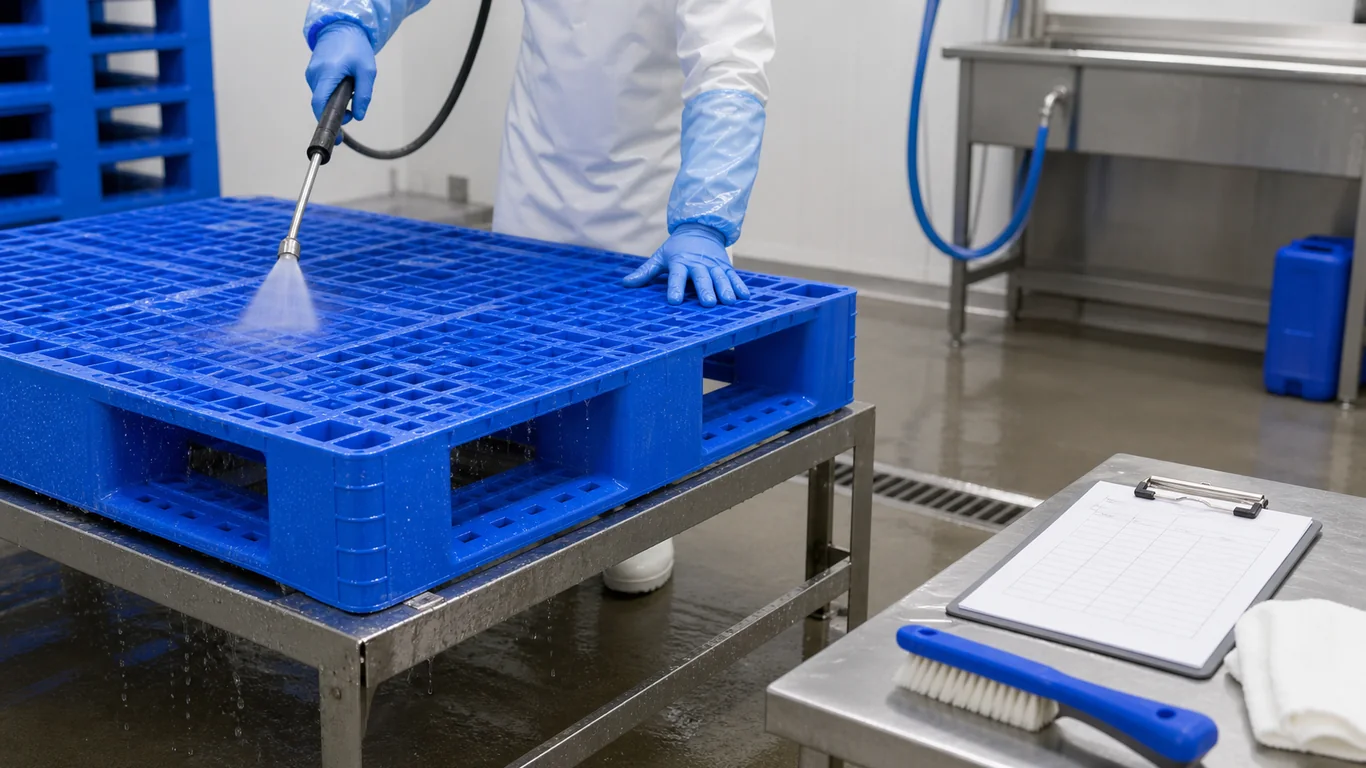
A useful pallet sanitation SOP does not begin with a universal wash temperature or a fixed calendar. It begins by identifying the exact pallet, where it will be used, what it may be exposed to and who has authority to release it.
This guide is for plastic pallets used in warehouse and logistics applications without direct food contact. Baoheng Plastic currently has no food-contact certification or third-party report that would support describing its pallets as food-contact approved or generally “food grade.” Virgin material can be considered for non-direct-food-contact food warehousing; recycled material is not suitable for food, pharmaceutical or other high-hygiene scenarios. The material route still has to be confirmed for the selected model and order.
The operational judgment is simple: use the facility’s risk assessment and approved chemical instructions to define the process, then release each pallet only for a named use when the required record is complete.
First define what the pallet is—and is not
Before writing a cleaning step, record:
- pallet model, specification revision and material route;
- ownership or pool marking and any batch or moulded date code;
- permitted warehouse zone and whether food and packaging are sealed, wrapped or exposed;
- handling and storage interfaces, including pallet jacks, forklifts, conveyors and racks;
- expected soils, allergens, spills, pests, outdoor exposure and temperature range;
- the person or function that owns the cleaning method and release decision.
Do not use a colour alone as proof of material, cleanliness or approval. A label such as “clean pallet” is only meaningful when it points to a current process and record.
The Canadian Food Inspection Agency distinguishes cleaning—the removal of dirt or debris—from sanitizing, which reduces microorganisms after cleaning. Its guidance notes that lower-risk areas and equipment, including loading docks, forklifts and hand pallet jacks, may not always require sanitizing, but still require clean conditions. The facility must decide what outcome is needed for its product, process, jurisdiction and customer controls.
Set model-specific process limits before washing
The SOP should not copy a detergent concentration, water temperature, contact time or pressure from a generic article. For the exact pallet and cleaning system, confirm all of the following:
| Process input | Evidence to approve before use |
|---|---|
| Cleaner or sanitizer | Product label, intended use, concentration range, contact time, rinse requirement and safety controls |
| Pallet compatibility | Supplier or model evidence for resin, components, labels, welds, anti-slip parts and any steel reinforcement |
| Water and temperature | Facility water requirements plus the model’s permitted temperature and thermal-shock limits |
| Mechanical action | Approved brush, pressure, tunnel or manual method that reaches the relevant surfaces without damaging the pallet |
| Drying | Drainage position, time or measured release condition appropriate to the zone and product risk |
| Verification | Defined visual, residue, allergen, microbiological or other check chosen by the facility for the actual hazard |
Under current U.S. 21 CFR 117.35, cleaning compounds and sanitizing agents must be safe and adequate under their conditions of use, and cleaning must protect food, food-contact surfaces and packaging from contamination. The same section requires non-food-contact surfaces of equipment to be cleaned as often as necessary to protect against contamination. It does not provide one pallet recipe.
If compatibility evidence is missing, test a controlled sample and obtain the responsible facility and supplier decisions before applying the process to a fleet. A successful visual result on one pallet does not establish long-term material compatibility.
Use four controlled statuses
Make the status visible and keep physically separate locations where practical:
- Awaiting cleaning: identified pallet with a known trigger and no permission to enter the named clean zone.
- Cleaned, pending release: process completed, but the record or verification is not yet accepted.
- Released for a named use: the approver accepts the pallet for the stated zone and use until the next trigger.
- Hold or withdraw: unknown exposure, failed verification, damage, missing identity or a process deviation requires investigation, rework or removal.
“Washed” is not a release status. “Released” must always state where and for what the pallet may be used.
Copyable cleaning and release record
Use one record per pallet, controlled batch or wash lot only when the facility has defined how that grouping remains traceable.
| Record field | What to enter |
|---|---|
| Identity | model/specification, owner, batch or unique ID, material route if confirmed |
| Use scope | permitted zone, packaged or exposed product condition, lane or customer requirement |
| Trigger | scheduled cycle, zone transfer, spill, allergen change, pest observation, return, repair or unknown exposure |
| Pre-clean check | soil type and location, damage, trapped residue, odor, unknown liquid, label condition |
| Method | SOP version, equipment or manual method, disassembly if allowed |
| Chemical parameters | product, lot if required, actual concentration, contact time, label-required rinse |
| Physical parameters | actual temperature, pressure or cycle setting when the approved SOP requires them |
| Completion | operator, date and time, steps completed and any deviation |
| Drain and dry | orientation, completion criterion and result; see the drainage and drying guide |
| Verification | approved check, location or sample, result and evidence reference |
| Release | released zone/use or hold reason, approver, date and time |
| Corrective action | rewash, isolate, inspect, investigate the process, or withdraw |
The record should contain operational identifiers, not customer contact details or unrelated personal information.
Apply a clear release gate
Release only when every applicable item is satisfied:
- identity and permitted use are known;
- the approved SOP version was followed and required actual parameters were recorded;
- no visible residue, foreign material, pooling water or unexplained odor remains;
- the facility’s drying and verification criteria passed;
- cracks, deep cuts, damaged cavities, exposed reinforcement or deformation do not create an unassessed hygiene or handling risk;
- the status marker is current and the pallet is segregated from dirty or held units;
- deviations are closed by the named responsible person.
Put the pallet on hold when exposure is unknown, a chemical is not approved, the model cannot be identified, the record is incomplete, verification fails, or damage prevents repeatable cleaning. The inspection and retirement guide helps preserve the structural context, but it cannot determine hygiene suitability or remaining capacity for an unknown model.
What procurement should request from a pallet supplier
For a food-warehouse RFQ, give the supplier the real operating conditions and ask for model-specific answers:
- intended non-direct-contact use and zone controls;
- exact resin route and components for the proposed model;
- cleaning agents, concentration range, temperature, contact time and mechanical method to be assessed;
- tunnel, pressure-wash, manual and drying interfaces;
- features that may retain water or residue and how they can be inspected;
- marking and traceability needs;
- evidence required before sample acceptance and fleet release;
- order quantity, destination, load, rack and handling conditions.
Add these items to the plastic pallet RFQ checklist . The buyer remains responsible for validating the cleaning program against the facility’s hazards, chemicals, law and customer requirements.
Baoheng can help screen a plastic pallet model when the application, dimensions, quantity, load, handling equipment, cleaning exposure and destination are supplied. Material, compatibility, price and lead time must be confirmed for the model and order. Use the selection support page to organize these inputs or send the technical summary through the inquiry form ; the cleaning and release record above can be used without contacting us.
Decision boundary
A completed log proves that specified steps were recorded. It does not by itself prove sanitation effectiveness, food-contact compliance, chemical compatibility or product safety. Those conclusions require the facility’s applicable evidence and approval. When a parameter, exposure or result is uncertain, hold the pallet rather than turn uncertainty into a release claim.