Industry Insights
Plastic Pallet Point Loads: How to Specify Support for Drums, Pails, and Rigid Containers
A practical guide for buyers handling drums, pails, jerrycans, and rigid containers on plastic pallets, with checks for contact area, deck support, stability, containment, and sample validation.
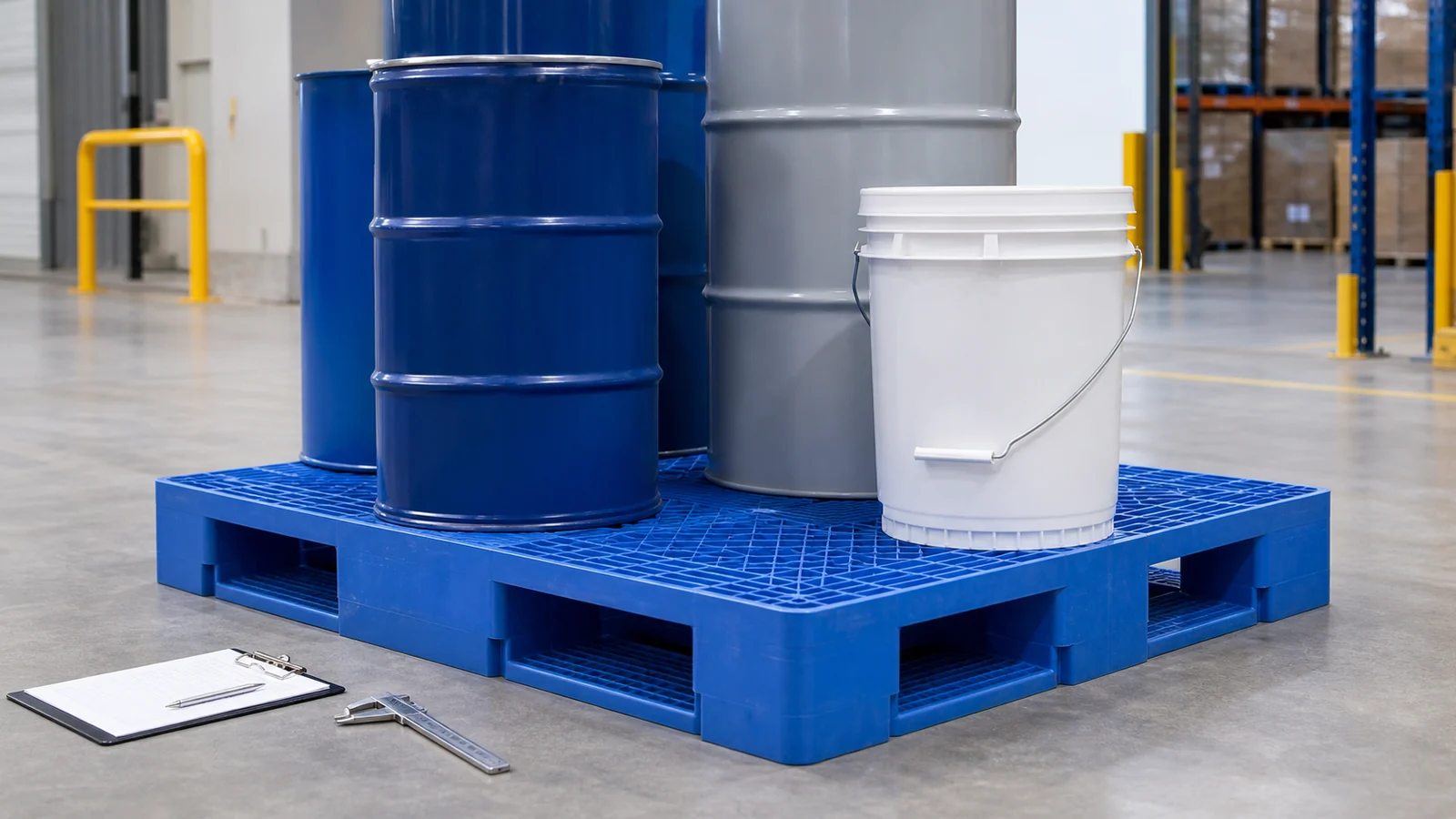
Drums, pails, jerrycans, buckets, and small rigid tanks create a different pallet problem from cartons or bags. A carton spreads weight across a broad base. A soft bag changes shape and needs deck support across openings. A rigid container often transfers load through a narrow rim, molded foot, chime, corner, or ring.
That concentrated contact can make a plastic pallet behave differently from what a static or dynamic load number suggests. The pallet may have enough total strength, but the container can still rock, dent the deck, slide on a smooth surface, press into an unsupported area, or overload a small group of ribs during storage and handling.
The practical question is:
How should buyers specify plastic pallets for drums, pails, and rigid containers so point loads stay supported, stable, and suitable for the full handling route?
Define the point load before comparing pallet ratings
A pallet load rating describes a condition. It does not automatically confirm that every container footprint is safe on that pallet.
For rigid containers, record the actual contact pattern before reviewing pallet models:
- container type: steel drum, plastic drum, fiber drum, pail, jerrycan, bucket, crate, or small tank;
- nominal volume and filled weight;
- base diameter, bottom rim, molded feet, corner pads, or raised rings;
- whether the base is flat, recessed, ribbed, or slightly bowed;
- number of containers per pallet and layer pattern;
- whether containers are stacked directly, separated by slip sheets, or held in trays;
- whether lids, caps, handles, or closures create height and stacking limits;
- whether liquid movement, powder settling, or product sloshing changes stability;
- whether the load will be stored on floor, moved by forklift, handled by pallet jack, conveyed, stacked, or transported.
The supplier cannot judge point-load risk from gross pallet weight alone. Four drums at 250 kg each and fifty pails at 20 kg each may have similar total weight but very different contact pressure, stability, and handling risk.
Map where the container actually touches the deck
The first sample check should be visual and physical. Place the filled container on the pallet and identify exactly where it contacts the deck.
Common point-load patterns include:
| Container base condition | Pallet risk to check |
|---|---|
| narrow drum chime or bottom ring | high local pressure on ribs, lips, or unsupported openings |
| molded pail feet | load concentrated on small pads instead of the full base |
| recessed plastic drum base | outer ring carries most of the load while the center floats |
| slightly bowed or dented metal base | contact shifts to a few uneven points |
| small jerrycan footprint | container may land between ribs or near deck gaps |
| mixed container sizes | load may be uneven across the pallet surface |
After loading, mark the container positions and inspect the deck contact areas. Look for deck whitening, rib deformation, excessive deflection, container rocking, bottom dents, scuffing, or any contact point that sits partly over an opening.
If the container base does not match the pallet deck geometry, increasing the pallet’s nominal load rating may not solve the problem. The better correction may be a different deck design, more continuous support, a different pallet size, a divider tray, or a revised layer pattern.
Match deck support to the container footprint
Rigid containers usually need predictable support under the base ring, foot, or corner. Open-deck pallets can work when the ribs line up well with the container footprint and the load path is stable. Problems appear when a narrow base ring crosses openings or rests on a small number of ribs.
Check these deck details before approval:
- Rib spacing: container rings and feet should not bridge wide openings under normal load.
- Rib width and radius: contact points should not create sharp pressure lines on plastic or metal containers.
- Deck flatness: warped deck surfaces can make one drum carry more load than the others.
- Deck texture: enough grip is useful, but aggressive texture can scuff pail bases or retain residue.
- Edge lips: lips may help alignment, but they must not lift one side of a container or interfere with the base ring.
- Usable deck area: containers should sit inside supported zones, not only inside the outer pallet dimensions.
A smoother or more closed surface may be useful when pails are small, bases are recessed, or containers need fast cleaning inspection. The guide to closed-deck plastic pallet selection explains when a continuous deck surface is worth specifying. The final decision still depends on filled weight, contact pattern, handling route, cleaning method, and storage duration.
Keep rigid containers stable, not only supported
Point-load support is only one part of rigid-container handling. The load must also remain stable when the pallet starts, stops, turns, and crosses floor joints or dock plates.
Review the movement pattern:
- Do drums or pails rock when the forklift stops?
- Does the container bottom slide on a wet or smooth deck?
- Does the first row shift outward during stretch wrapping?
- Do handles, lids, or closures interfere with stacking?
- Does the load need corner boards, strapping, trays, anti-slip sheets, or containment frames?
- Does the route include ramps, dock transitions, container loading, or long-distance truck transport?
Warehouse storage rules should also be part of the discussion. OSHA’s general material-handling rule for 1910.176 expects tiered containers and stored materials to remain stable and secure against sliding or collapse. A plastic pallet specification should support that operating requirement rather than leaving stability entirely to stretch film or operator skill.
If the main issue is movement during truck or container transport, connect the pallet review with a broader plastic pallet load shift prevention plan . A stable floor-storage pattern may still fail after vibration, braking, or repeated handling.
Separate support from spill containment
Many rigid containers hold liquids, powders, chemicals, food ingredients, lubricants, coatings, or cleaning products. Buyers sometimes combine three different questions into one:
- Can the pallet support the filled containers?
- Can the pallet keep the unit load stable?
- Does the operation need spill containment or segregation?
These questions are related, but they are not the same.
A standard plastic pallet may support sealed pails safely in a dry warehouse. A spill-control zone may need a containment pallet, sump, grating, or separate bunded area. A chemical area may also require compatibility review for the pallet material, cleaning agents, residue, and possible leak scenarios.
For chemical or liquid handling, review the point-load question together with the plastic pallet chemical compatibility guide . For work areas where containment is the primary concern, a model such as the 130130 spill containment pallet can be reviewed as a reference category, but containment volume, chemical compatibility, local regulations, handling route, and operating procedure must be confirmed for the actual site.
Do not use a containment product as a shortcut for load approval. The grating, sump structure, pallet base, and forklift access still need to be validated with the real container weight and contact pattern.
Check the bottom structure and handling equipment
The top deck may support the containers, but the bottom of the pallet controls how the load moves through the facility.
Confirm:
- forklift fork length, spacing, and entry direction;
- pallet jack wheel path and clearance under load;
- whether the pallet will be pushed, pulled, rotated, or side-shifted frequently;
- rack beam span and whether loaded pallets will be stored in racks;
- conveyor roller spacing if the load moves through automated equipment;
- stacking or nesting requirements for empty pallets;
- floor condition, ramps, dock plates, and outdoor staging areas;
- whether liquid movement increases dynamic forces during turns and stops.
Drums and pails often look stable when stationary because the containers are rigid. The weakness may appear only during handling: a pallet jack wheel flexes the base, a forklift turn makes the outer drums rock, or a deck opening catches a small pail foot.
If manual pallet trucks are part of the route, use the checks in the plastic pallet pallet-jack compatibility guide before approving the pallet structure.
Validate with the heaviest and least stable normal load
Point-load suitability should be tested with the real container and the worst normal operating condition, not an empty sample or average SKU.
A practical trial should include:
- Load the pallet with the actual container type, filled to normal weight.
- Use the maximum approved number of containers and the normal layer pattern.
- Include slip sheets, trays, straps, stretch film, or corner protection exactly as used in operation.
- Store the loaded pallet for the normal dwell time.
- Move it through the actual forklift, pallet jack, dock, staging, and transport route.
- If liquid movement matters, include starts, stops, turns, and floor transitions.
- Inspect the pallet deck for whitening, cracking, rib deformation, permanent deflection, and contact damage.
- Inspect containers for dents, scuffs, base deformation, closure movement, leakage, and instability.
Repeat the trial after several handling cycles if the pallet is part of a returnable program. A point-load problem may appear after repeated loading, washing, impact, or long dwell time.
This sample approval can be integrated into a broader plastic pallet load testing plan before bulk orders , especially when the same pallet will serve several container types.
Write point-load requirements into the RFQ
“Suitable for drums” or “suitable for pails” is too vague for a reliable quotation. A useful RFQ should describe the container, contact pattern, route, and pass/fail criteria.
Include:
- container type, dimensions, filled weight, base design, and material;
- number of containers per pallet and layer pattern;
- whether containers are stacked, strapped, wrapped, or separated by trays;
- required pallet size and whether overhang is allowed;
- preferred deck style and any restrictions on openings, ribs, lips, or sharp contact points;
- static storage duration and maximum stack height;
- dynamic handling route, including forklifts, pallet jacks, conveyors, racks, docks, and transport;
- cleaning, chemical exposure, spill, residue, or segregation requirements;
- sample quantity and validation route;
- rejection rules for container rocking, sliding, base damage, leakage, pallet deformation, and unsafe handling.
A practical clause may read:
Pallets must support filled drums, pails, or other rigid containers without unacceptable rocking, sliding, base deformation, deck whitening, rib damage, leakage, or instability under the buyer’s normal storage, handling, cleaning, and transport conditions. Supplier samples must be validated with the actual container base, filled weight, layer pattern, and handling route before bulk approval.
This wording gives the supplier the information needed to recommend a pallet structure instead of guessing from total load weight.
Practical decision rule
Approve a plastic pallet for drums, pails, or rigid containers only when four conditions are clear:
- The contact pattern is known. The base ring, feet, pads, corners, and actual deck contact points have been checked with filled containers.
- The deck supports the point load. Ribs, openings, lips, texture, and usable deck area do not concentrate stress in unsafe locations.
- The unit load remains stable. Wrapping, trays, strapping, grip, route conditions, and storage height control rocking, sliding, and collapse risk.
- Containment is handled separately. Spill control, chemical compatibility, and segregation are specified where needed, without replacing load validation.
For rigid containers, the best plastic pallet is not simply the strongest model in a catalog. It is the pallet whose deck, base, and handling behavior match the real container footprint through storage, movement, cleaning, and transport.