Industry Insights
Plastic Pallet Load Shift Prevention: How to Specify Pallets for Truck and Container Transport
A practical guide for export, warehouse, and logistics teams on reducing load shift by matching plastic pallet design, unit load controls, and transport validation.
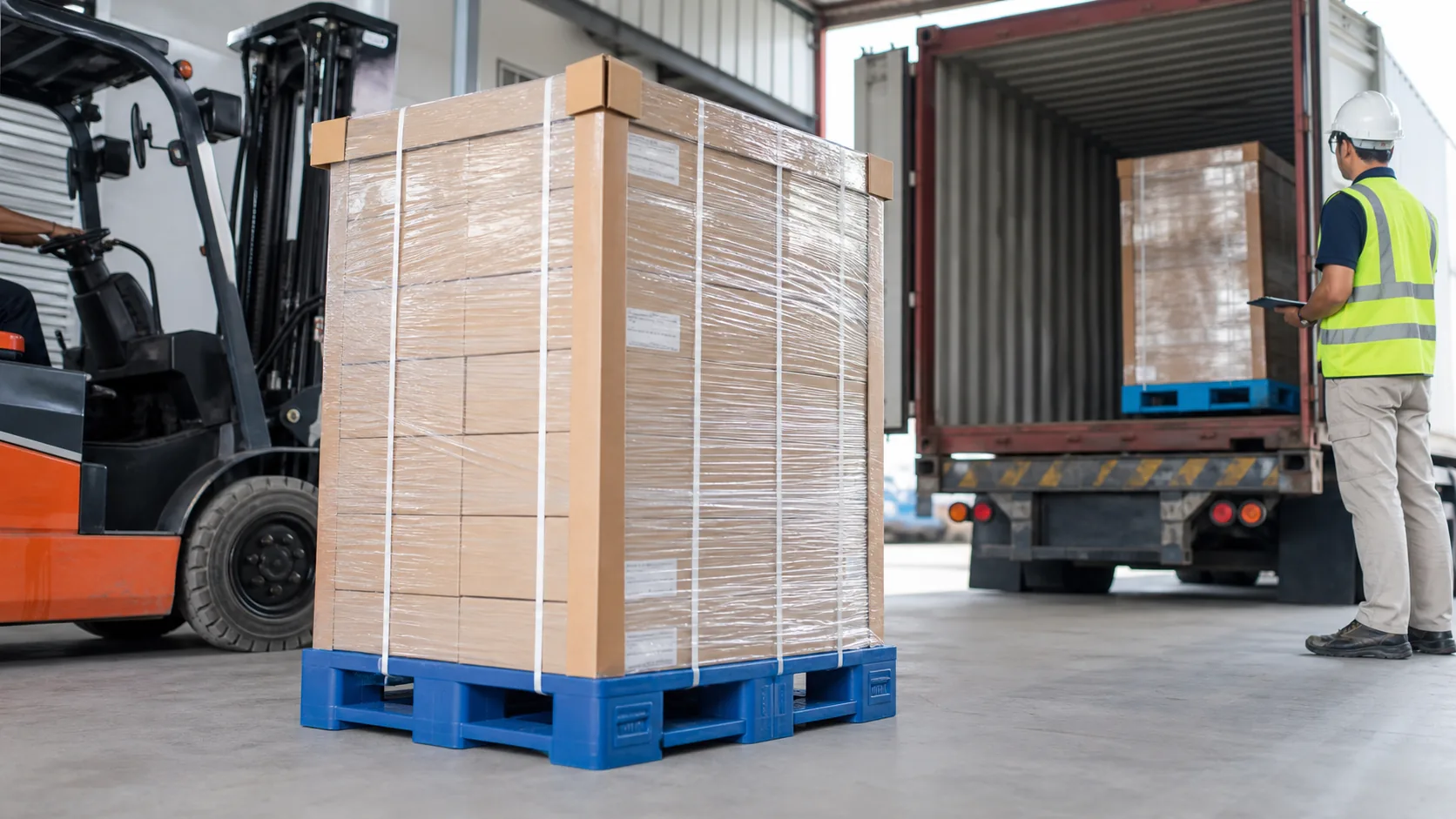
A plastic pallet can perform well inside a warehouse and still create problems during truck or container transport. The forces are different. Forklift handling is intermittent and visible. Transport movement is repetitive, directional, and often discovered only after cartons have shifted, film has loosened, or pallets arrive out of square.
For export shippers and distribution teams, load shift is not solved by choosing a stronger pallet alone. It is controlled by the complete unit load: pallet footprint, deck surface, packaging pattern, stretch wrap, restraint method, trailer or container floor condition, and the way pallets are loaded against each other.
The practical question is:
How should buyers specify plastic pallets so loaded pallets stay stable during truck and container transport without adding unnecessary cost or handling complexity?
Treat the pallet as the base of the transport system
During transport, the pallet is not only a storage platform. It is the base layer of a moving load system. If the base is too small, too slippery, too flexible, or poorly matched to the carton layout, the rest of the securing method has to compensate.
That compensation usually appears as:
- extra stretch film applied by operators;
- more corner boards than expected;
- straps added after a near miss;
- manual rework before loading;
- carton damage near pallet edges;
- rejected loads at receiving because the pallet arrived leaning or twisted.
The pallet specification should therefore connect with the shipping method. A pallet used for short internal transfer may need a different stability review from a pallet used in long-haul truck transport, export containers, mixed-temperature routes, or multi-stop distribution.
The first decision is not whether the pallet is “strong enough.” It is whether the pallet supports the actual load pattern through the transport route.
Identify which type of load shift is happening
“Load shift” can describe several different failures. Each one points to a different correction.
| Shift pattern | Common symptom | What to review first |
|---|---|---|
| Cartons slide on the pallet deck | first layer moves before the whole load moves | deck texture, edge lip, carton base, wrap containment |
| The whole unit load moves on the pallet | wrapped stack stays together but drifts over the deck | pallet footprint, wrap anchoring, bottom film wraps |
| Pallet moves on the truck or container floor | pallet and load remain square but change position in transit | bottom deck contact, floor condition, blocking, void fill |
| Load settles and leans | bags, cartons, or mixed goods compress during transport | stack pattern, product density, corner support, dwell time |
| Pallets push into each other | outer cartons crush or rub during movement | loading plan, pallet spacing, interlocks, restraint method |
| Empty pallet stacks slide | nested or stacked return pallets shift in the vehicle | pallet-to-pallet friction, stack height, banding or strapping |
Do not approve a pallet feature before naming the failure mode. A raised edge lip can help control carton migration, but it will not stop a pallet from sliding across a smooth trailer floor. Rubber deck inserts can improve top-deck friction, but they do not correct a weak stretch-wrap program.
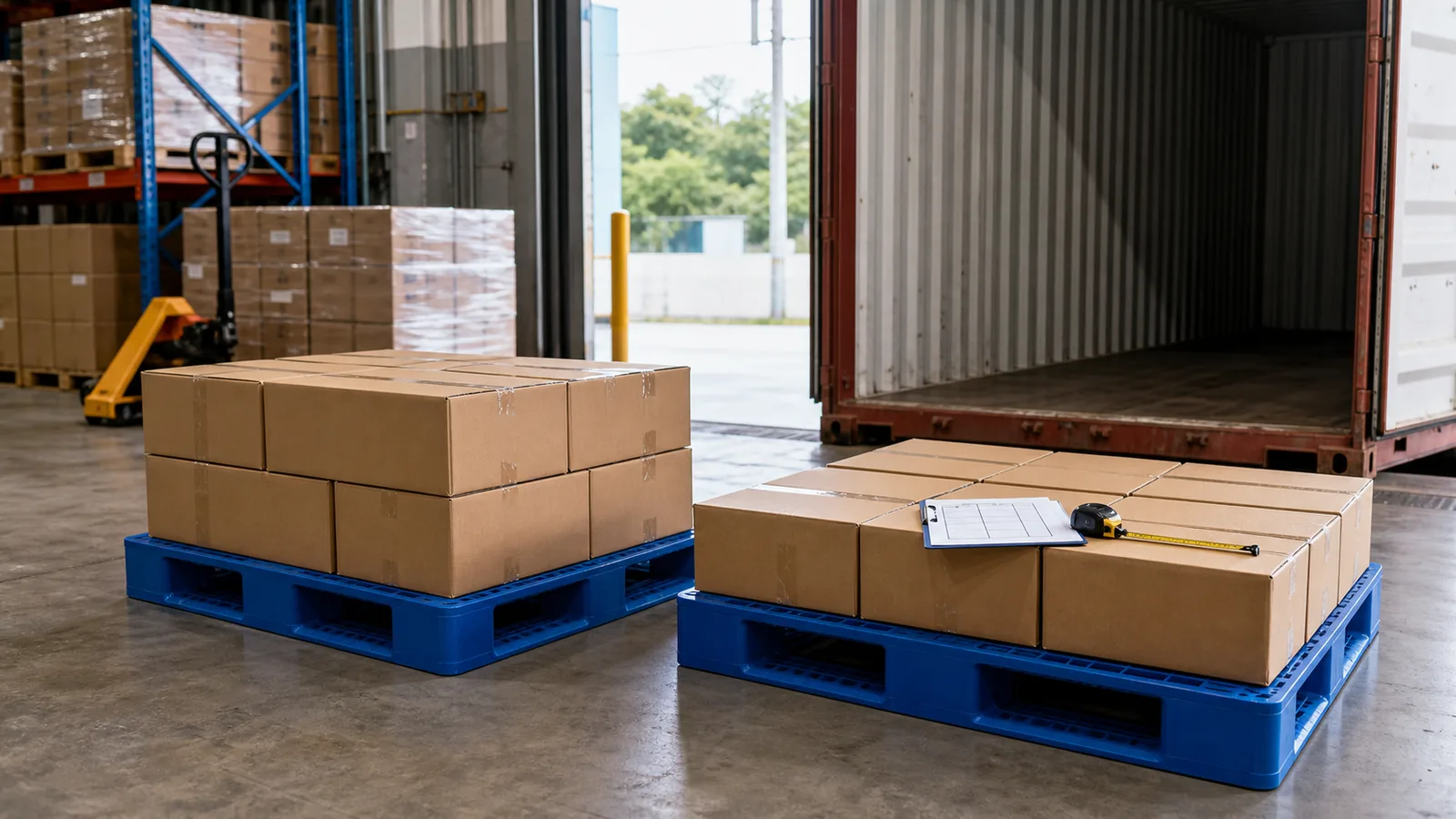
Keep the load inside the usable pallet deck
Transport stability starts with the first layer. If cartons overhang the pallet, vibration and braking forces act on unsupported packaging. The pallet may still carry the weight, but the unit load becomes easier to deform.
For most truck and export container routes, the safer default is:
The loaded product footprint should stay inside the usable deck area of the plastic pallet.
This is especially important when:
- cartons have weak edges or light corrugated board;
- the route includes long road vibration;
- pallets are loaded tightly against container walls;
- the destination uses clamp trucks, pallet jacks, or narrow aisles;
- pallets will be stacked or double-stacked during staging;
- receiving teams reject distorted or leaning loads.
If a project is still deciding between common footprints such as 1200 x 1000 mm and 1200 x 800 mm, review carton fit before confirming the pallet model. The plastic pallet size guide for container loading explains how carton footprint, pallet size, and export space should be checked together.
Match top-deck features to the packaging base
The pallet top deck controls the first contact between product and pallet. The right feature depends on the load surface.
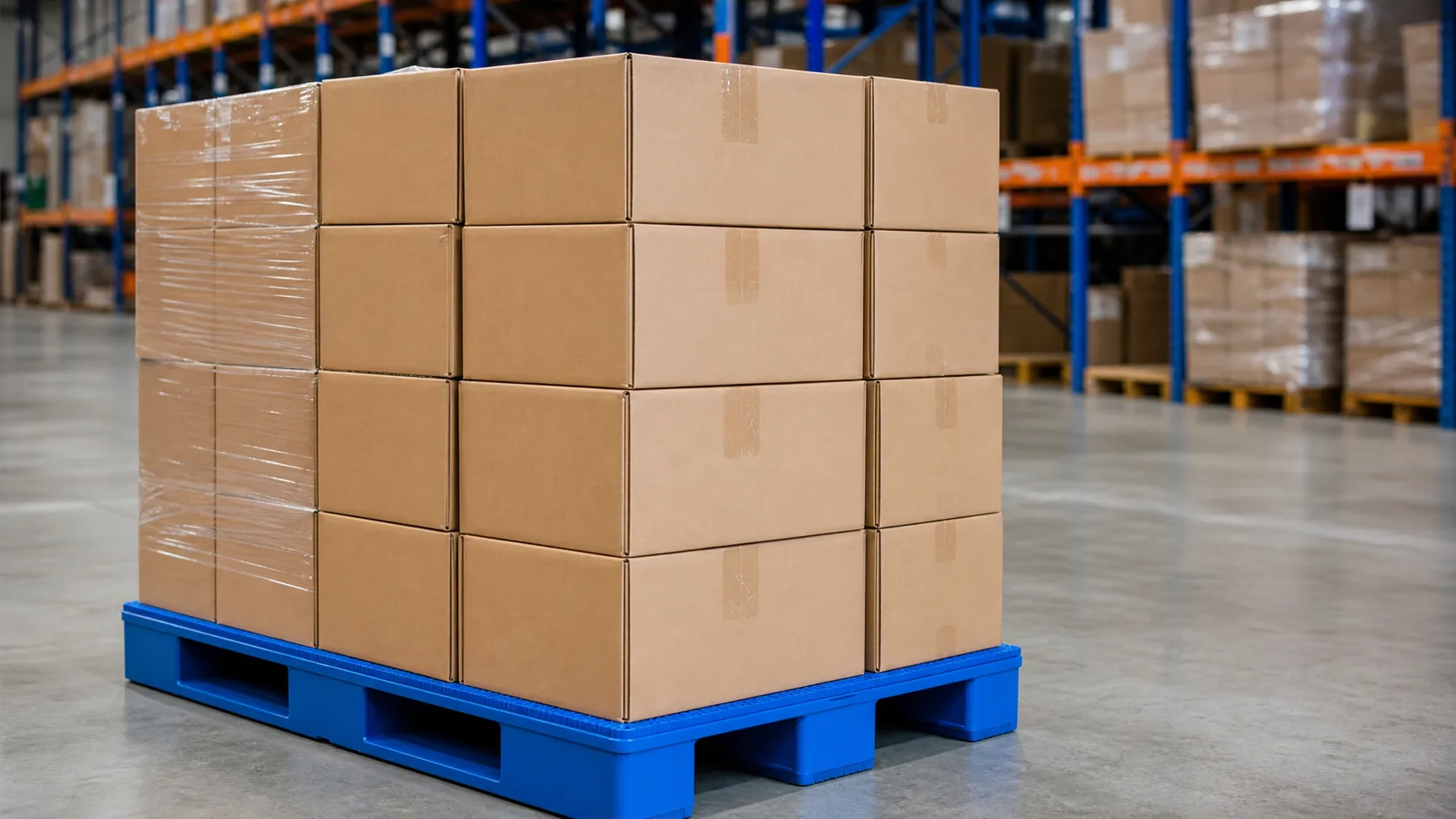
Flat cartons usually need a stable deck, enough support under carton corners, and moderate friction. A low edge lip can help the first layer stay aligned during wrapping and transport, but the lip must not crush carton edges.
Plastic crates and totes may have smooth feet or narrow contact points. Textured zones or anti-slip inserts can help, but the contact points need to land on useful grip areas rather than open deck gaps.
Bags settle and push outward. An aggressive edge lip may create pressure points, so the real filled bag should be tested instead of a rigid substitute.
Drums and pails create concentrated loads. Deck strength and point-load support matter before friction is considered.
Mixed-SKU pallets often shift because the first layer is uneven or because the wrap cannot apply consistent containment force. In this case, pallet grip may help, but the pallet should not be expected to fix a poor stacking pattern.
For teams comparing edge lips, deck texture, and rubber inserts, the plastic pallet anti-slip design guide gives a deeper framework for selecting the smallest feature that controls the real movement risk.
Do not ignore the bottom of the pallet
Transport stability is not only a top-deck issue. The pallet bottom determines how the unit load behaves on a truck floor, container floor, roller deck, or staging area.
Check the bottom structure for:
- continuous contact zones that sit flat on the floor;
- runner or perimeter-base geometry that does not rock under load;
- fork entry areas that do not deform after repeated handling;
- enough contact area to avoid point pressure on weaker floors;
- compatibility with pallet jacks and forklifts at both origin and destination;
- stacking behavior when empty pallets are returned by truck.
A pallet that grips the cartons well but slides on a smooth trailer floor still needs additional transport controls. Depending on the route, that may mean tighter loading, anti-slip sheets, blocking, bracing, dunnage, straps, or a different pallet bottom structure.
For rackable and transport-heavy operations, a model such as the 1210 open deck 3-runner plastic pallet can be reviewed as a practical reference because the runner base gives defined support lines for forklift handling and many warehouse flows. The final choice should still be validated with the actual load, floor, equipment, and transport route.
Connect stretch wrapping to the pallet design
Stretch film is often treated as a packaging decision, while the pallet is treated as a procurement decision. In transport, they cannot be separated.
The wrap program should answer:
- Does the film capture the pallet base enough to connect the load to the pallet?
- Does the wrap tension damage cartons or pull the stack out of square?
- Are bottom wraps applied low enough to reduce unit-load movement?
- Are corner boards needed to spread film pressure?
- Does condensation, dust, or cold temperature reduce film grip?
- Does the pallet deck or edge lip cut, snag, or weaken the film?
If the load shifts as one wrapped block, the film may be holding the product together but not anchoring it to the pallet. If the bottom layer shifts while upper layers remain straight, the pallet surface, edge control, or first-layer layout may need attention.
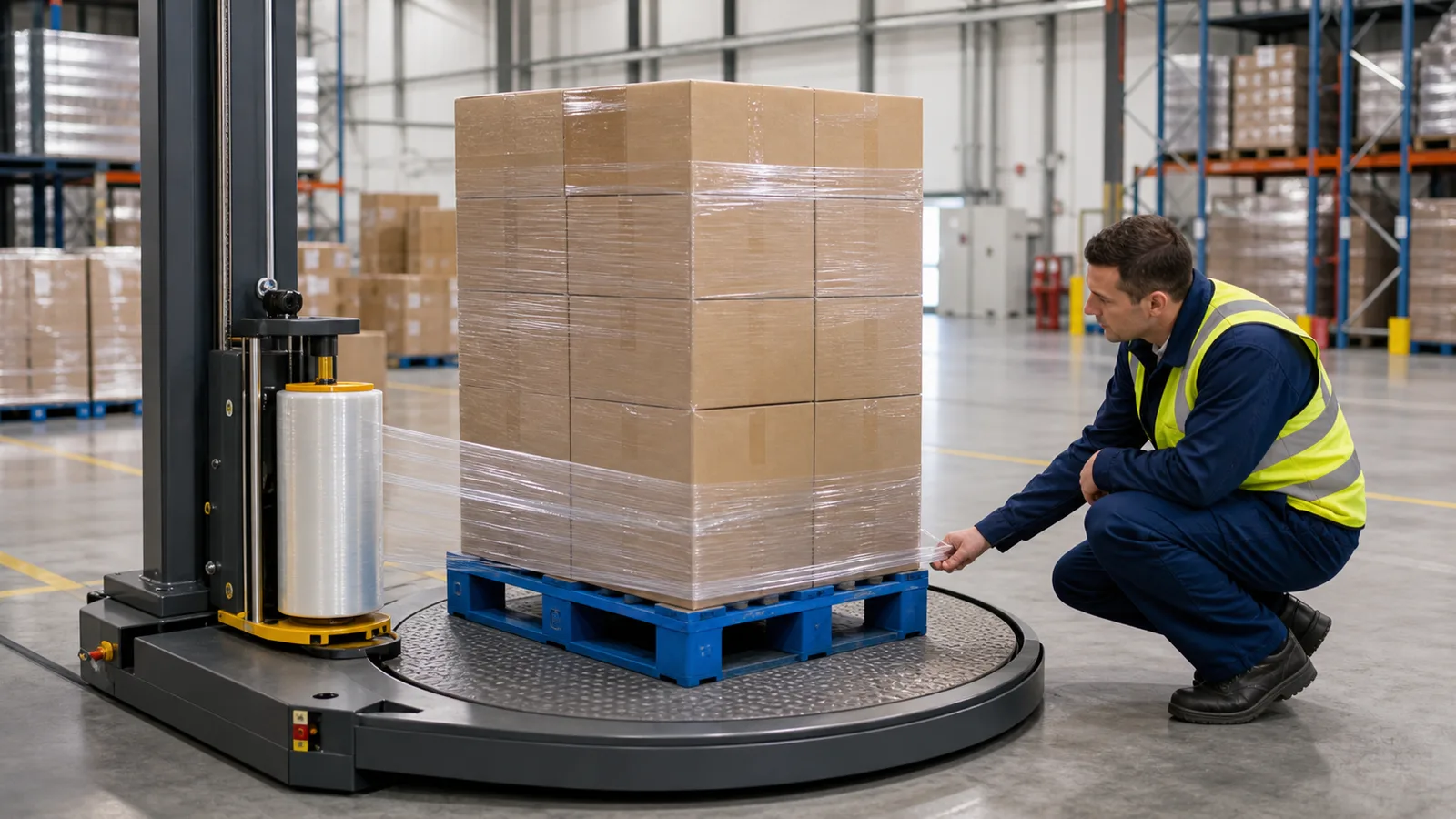
For high-volume lanes, record the wrap settings used during sample testing: film type, pre-stretch, number of bottom wraps, number of top wraps, rotation count, and any corner protection. Without those details, two teams can test the same pallet and get different results.
Build a transport stability test before bulk purchase
A useful validation does not need to be complicated. It does need to reproduce the movement that matters.
Before approving a bulk order, test the selected pallet with the real product or the closest safe substitute:
- Build the normal first-layer pattern on the pallet.
- Apply the normal stretch-wrap or strapping method.
- Move the loaded pallet through the actual forklift route, including turns and dock transitions.
- Load it into the truck or container in the intended orientation.
- Use the normal loading density, including void fill or blocking if used.
- Run a short transport trial when practical, or expose the load to the most realistic site-approved movement test.
- Inspect carton movement, pallet movement, film damage, edge compression, leaning, and bottom-deck contact marks.
- Photograph the load before and after the test from the same angles.
The test should include the worst normal product family, not the easiest SKU. For example, a dense carton that fills the pallet evenly may pass while a lighter, taller, smoother carton shifts during the same route.
This transport review can be added to a broader plastic pallet load testing plan before bulk orders , so strength, deflection, handling, and load stability are approved together.
Write transport stability into the RFQ
Vague wording such as “suitable for export transport” does not give suppliers enough information. The RFQ should describe the route and the failure that must be prevented.
Include:
- pallet size and usable deck area;
- product type, carton or container base material, and gross pallet load;
- first-layer carton pattern and whether overhang is allowed;
- required deck surface, edge lip, or anti-slip inserts;
- bottom-deck structure and equipment compatibility;
- stretch-wrap, strapping, corner board, or slip-sheet method;
- truck, container, or mixed transport conditions;
- whether pallets will be floor loaded, double-stacked, blocked, or braced;
- sample test method and pass/fail criteria;
- acceptable cosmetic marks after transport validation.
A practical clause may read:
Pallet must support 1200 x 1000 mm carton unit loads for truck and export container transport with no carton overhang. The selected deck and bottom structure must reduce first-layer movement and maintain stable floor contact during loading, road transport, and unloading. Supplier samples must be validated with the buyer’s normal stretch-wrap program and transport stability checks before bulk production.
Clear wording helps suppliers recommend a specific pallet structure instead of treating load shift as a generic packaging problem.
Define acceptance criteria before the shipment trial
Testing is more useful when the pass/fail rules are written before the sample arrives.
Useful acceptance criteria include:
- cartons remain inside the pallet footprint after the test;
- first-layer movement stays within the agreed limit;
- no carton edge crushing caused by pallet lips or wrap tension;
- film remains intact at pallet contact points;
- pallet does not rock, twist, or slide under normal handling;
- fork entry remains smooth after loaded movement;
- no visible cracking, whitening, or permanent deformation;
- operators do not need unplanned rewrapping or manual correction;
- receiving condition is acceptable after the transport route.
If one criterion fails, avoid changing everything at once. First identify whether the root cause is pallet size, deck grip, bottom contact, wrap anchoring, carton strength, loading pattern, or vehicle restraint. The smallest correction is usually the most reliable one.
Practical decision rule
Specify the pallet for the movement that must be controlled.
Choose a better pallet footprint when cartons overhang, layers are unsupported, or the load arrives out of square.
Choose deck grip or an edge lip when the first layer moves across the pallet during handling or transport.
Review the bottom deck and transport restraint when the whole pallet moves on the vehicle floor.
Improve wrapping and unitization when the product stack moves independently from the pallet or settles during the route.
Validate with the real route before ordering at scale. A plastic pallet that prevents load shift is not simply stronger or more textured. It is the pallet that works with the packaging, stretch wrap, truck or container plan, and receiving process as one controlled transport system.