Industry Insights
Plastic Pallet Sizes and Dimensions for Container Loading
Compare plastic pallet sizes and dimensions by carton footprint, container loading plan, payload, forklift entry, and destination handling.
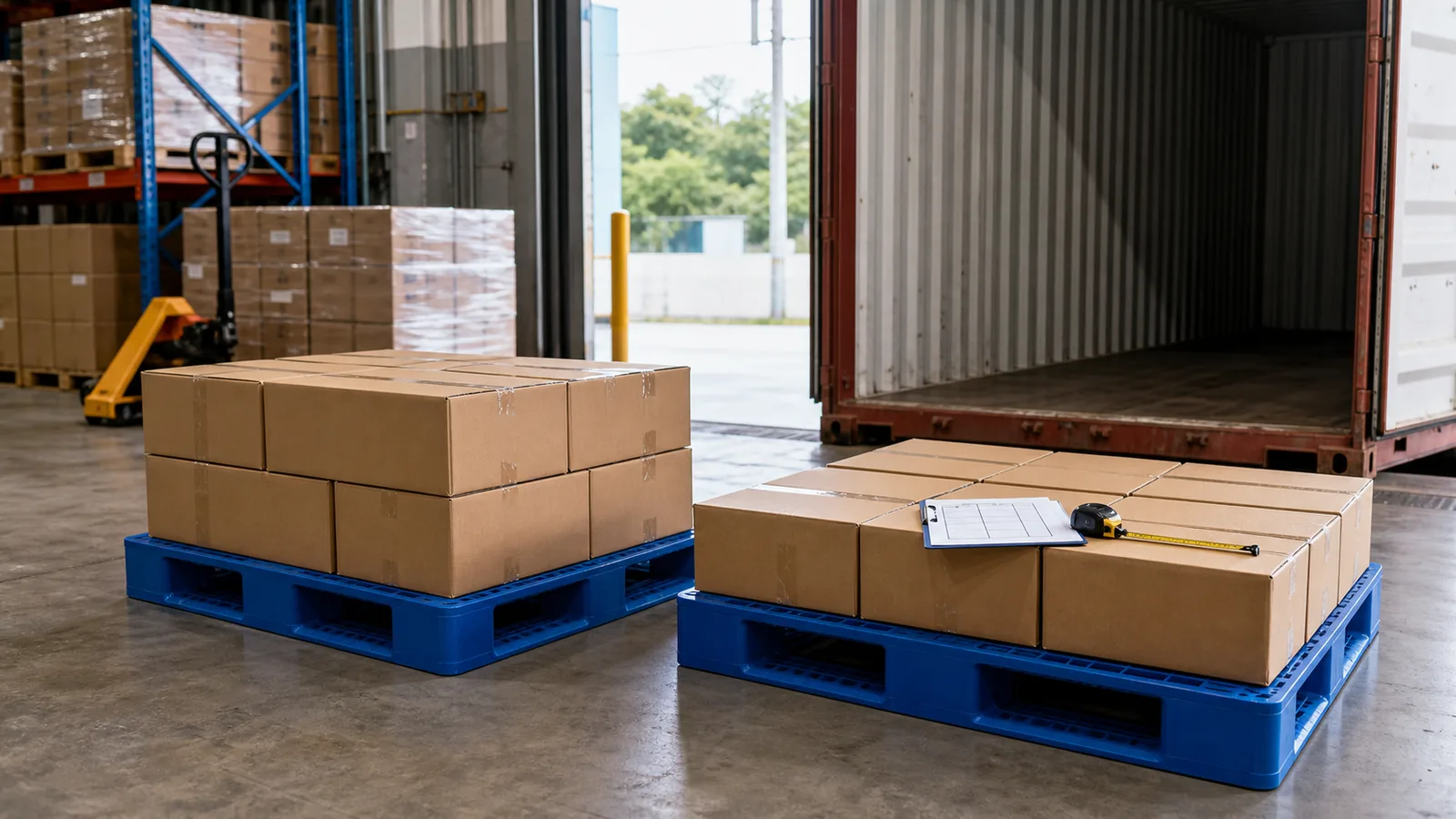
There is no single plastic pallet size that fits every export load. The right dimensions depend on the carton footprint, usable deck area, container loading pattern, payload, fork-entry direction, and the equipment used at the destination.
Start with the completed unit load, not a familiar pallet size. This guide shows how to shortlist dimensions, test carton fit and container utilization, and confirm handling compatibility before approving a pallet model.
How do you choose plastic pallet dimensions that protect the load, use container space efficiently, and still work in the receiving warehouse?
Start with the carton footprint, not the pallet catalog
A pallet only works well when the first layer of cartons sits correctly on the deck. If the carton footprint is poorly matched, every downstream process becomes harder: wrapping, stacking, forklift movement, truck loading, and receiving inspection.
Before comparing pallet models, list the actual packaging data:
- carton length, width, and height;
- gross weight per carton;
- maximum cartons per layer;
- permitted carton orientation;
- whether labels, barcodes, or arrows limit rotation;
- whether cartons can slightly interlock or must remain column-stacked;
- maximum compression load allowed on the bottom carton.
Then test the first-layer layout on likely pallet footprints. The goal is not only to maximize the number of cartons per layer. The layout should keep the load square, avoid unsupported edges, and leave enough deck support under carton corners.
A pallet that carries one more carton per layer may still be a poor choice if the outer cartons sit on weak deck zones or if the layer becomes difficult to wrap tightly.
Avoid carton overhang unless the lane is designed for it
Carton overhang is one of the fastest ways to turn a good plastic pallet into a weak unit load. Overhanging cartons are more likely to crush at the edges, catch during forklift handling, rub against container walls, and lose stability during truck vibration.
For most export lanes, the safer default is:
The loaded carton footprint should stay inside the usable pallet deck.
Small exceptions may be acceptable in some low-risk lanes, but they should be deliberate. If the operation allows overhang, define:
- maximum overhang per side;
- whether overhang is allowed on both length and width;
- whether the pallet will be stretch-wrapped, strapped, or corner-boarded;
- whether pallets will touch each other inside the container;
- whether destination forklifts or pallet jacks can handle the final load width.
If overhang is being used only to make an inefficient carton size fit a standard pallet, review the carton first. A modest carton redesign can often save more freight cost than a long search for an unusual pallet size.
Compare 1200 x 1000 mm and 1200 x 800 mm by lane logic
Two common export pallet footprints are 1200 x 1000 mm and 1200 x 800 mm. Neither is automatically better. The right choice depends on carton modularity, load weight, destination handling, and container plan.
1200 x 1000 mm: useful for larger cartons and heavier unit loads
A 1200 x 1000 mm pallet provides a broader deck and is often easier to use with larger export cartons, bagged goods, drums, and mixed industrial loads. The larger footprint can improve load stability when carton dimensions do not divide cleanly into a narrower pallet.
For operations that need rack compatibility, forklift handling, and repeated warehouse movement, a model such as the 1210 open deck 3-runner plastic pallet can be evaluated as a working reference. The final approval should still depend on the actual load, rack span, and handling route.
1200 x 800 mm: useful when carton modules and truck handling fit
A 1200 x 800 mm pallet can be efficient when cartons are designed around that footprint and when the destination network expects this size. It may support cleaner aisle movement and standardized handling in some European or retail-linked distribution systems.
For buyers comparing this footprint, the 1208 open deck 3-runner plastic pallet is a relevant structure to review when rackable handling is part of the flow.
The important point is not to choose by habit. A 1200 x 800 mm pallet with poor carton fit can waste more container space than a 1200 x 1000 mm pallet with a tighter, safer layer pattern. The reverse can also be true.
Calculate pallet layer efficiency before container efficiency
Container utilization starts with pallet layer utilization. If the first layer wastes too much deck space, the container plan is already carrying hidden air.
Use a simple check:
Pallet layer utilization = total carton footprint area in one layer / usable pallet deck area
This calculation is not a perfect performance measure, but it is a useful warning signal. If the utilization is low, ask why:
- Are cartons too long or too narrow for the selected pallet?
- Is rotation blocked by label orientation or product protection rules?
- Is the pallet lip or deck geometry reducing usable area?
- Is the carton layout leaving unsupported corners?
- Would a different carton count per master case improve the layer pattern?
Do this before building a container plan. A pallet layout that looks acceptable in isolation may become expensive when multiplied across hundreds of pallets per month.
Build the container plan with real loaded dimensions
Many loading estimates use nominal pallet size only. That is risky. A loaded pallet may be wider or taller than the pallet footprint because of carton bulge, wrap thickness, corner boards, labels, strapping, or slight placement variation.
For container planning, measure or estimate:
- loaded pallet length and width after wrapping;
- total loaded pallet height;
- gross weight per loaded pallet;
- whether pallets can be turned inside the container;
- whether pallets can be double-stacked;
- required clearance for loading equipment;
- whether the receiver unloads from container floor, dock, or cross-dock.
Container floor utilization is only one part of the decision. A loading plan that fills the floor but exceeds weight distribution limits, causes carton crush, or cannot be unloaded at the destination is not a good plan.
For export teams, pallet choice should also be reviewed together with packaging compliance. If the project includes a move from wood packaging, this ISPM 15 export pallet compliance framework can help separate compliance risk from size and loading decisions.
Watch the weight limit, not only the floor pattern
A pallet pattern can look efficient on paper and still fail because of weight. Export teams should check both pallet load and container payload.
At pallet level, confirm:
- total gross weight per pallet;
- whether the load is uniformly distributed or concentrated;
- dynamic handling load during forklift movement;
- stack load if pallets are double-stacked;
- rack exposure if the pallet enters warehouse storage before or after shipment.
At container level, confirm:
- maximum legal payload for the route;
- axle and road weight rules after inland transport;
- even weight distribution across the container floor;
- destination unloading equipment capacity.
Heavy goods often reach weight limits before they fill cubic volume. Lightweight cartons may fill cubic volume before they reach payload limit. These two cases require different pallet decisions.
If the pallet will be used in both export loading and warehouse storage, include sample validation before bulk order. A broader testing approach is covered in the plastic pallet load test before bulk order .
Include destination handling in the size decision
Export pallet size is not finished when the container doors close. The destination warehouse must unload, move, inspect, and store the pallet safely.
Confirm these points before standardizing a size:
- Can the receiver’s forklifts or pallet jacks enter the pallet from the required side?
- Does the pallet fit local racking, staging lanes, and dock equipment?
- Is the receiver expecting a regional standard footprint?
- Can the pallet pass through doors, lifts, conveyors, or stretch-wrapper turntables?
- Will the goods be stored on the same pallet or re-palletized after arrival?
- Who owns the pallet after delivery, and will it return?
This is especially important for reusable plastic pallets. A size that improves origin loading but creates destination rework can raise total cost per shipment.
For one-way or semi-closed export flows, pallet structure should be reviewed together with return economics. This comparison of nestable vs rackable plastic pallets is useful when the same size decision also affects empty transport and storage density.
Decide whether one pallet size is enough
Some procurement teams try to force all export SKUs onto one pallet size to simplify purchasing. Standardization is valuable, but only when it does not create large loading penalties or damage risk.
Use one standard pallet size when:
- carton families share similar modular dimensions;
- load weights fall within a narrow range;
- destination handling equipment is consistent;
- container plans remain efficient across major SKUs;
- warehouse teams can use one wrapping and inspection process.
Use two pallet sizes when:
- one size creates repeated carton overhang on a major product family;
- heavy and lightweight SKUs need different footprints;
- different regions expect different handling standards;
- some shipments are container-focused while others are warehouse-rack-focused;
- returnable and one-way flows have different economics.
The cost of carrying two pallet SKUs may be lower than the freight waste, repacking labor, and damage risk created by one poor universal size.
Write the size requirement into the RFQ
Suppliers cannot quote accurately if the RFQ only says “plastic pallet for export.” The size decision should be supported by packaging and loading data.
Include:
- target pallet footprint and height limit;
- carton dimensions, gross weight, and layer pattern;
- maximum loaded pallet dimensions after wrapping;
- typical and peak pallet gross weight;
- container type and target loading pattern;
- whether double-stacking is allowed;
- forklift, pallet jack, rack, or conveyor requirements;
- destination country or regional handling constraints;
- overhang allowance, if any;
- sample test and acceptance criteria.
A useful RFQ statement may read:
Pallet must support export carton loads with no carton overhang under the approved layer pattern. Supplier must confirm pallet deck support, fork entry, loaded height, and container loading fit based on wrapped pallet dimensions. Samples must be validated with actual cartons before bulk production.
For teams preparing a complete supplier request, the plastic pallet RFQ checklist can help align size, load, material, testing, and commercial terms in one document.
Run a short palletization trial before final approval
A trial does not need to be complex. It should simply use real cartons and normal operators.
Check:
- Build the planned first layer on each candidate pallet size.
- Confirm no unsupported carton corners or unwanted overhang.
- Apply the normal wrapping or strapping method.
- Measure final loaded pallet length, width, and height.
- Move the pallet through the normal forklift route.
- Load two or more pallets in the planned container orientation.
- Inspect carton scuffing, shifting, wrap tension, and unloading access.
- Record photos and measurements for the final RFQ file.
This small step often reveals issues that drawings miss: carton bulge, wrap growth, fork entry direction, pallet-to-pallet interference, and operator handling difficulty.
Practical decision rule
Choose plastic pallet size by system fit, not by catalog habit.
Start with the carton footprint. Reject layouts that create avoidable overhang, unsupported carton edges, or unstable first layers. Compare pallet sizes by loaded dimensions, not only nominal dimensions. Check container utilization together with payload, double-stack rules, and destination unloading. Then write the approved size, layer pattern, and validation method into the RFQ.
The best export pallet size is not always the one that fills the container floor most tightly. It is the one that gives the shipment a stable unit load, predictable handling, acceptable freight efficiency, and fewer surprises after the container arrives.