Industry Insights
Plastic Pallet Load Testing Before Bulk Orders: A Practical Validation Plan for B2B Buyers
A practical guide for procurement, warehouse, and logistics teams on validating plastic pallet load capacity, deflection, rack fit, and handling performance before committing to a bulk order.
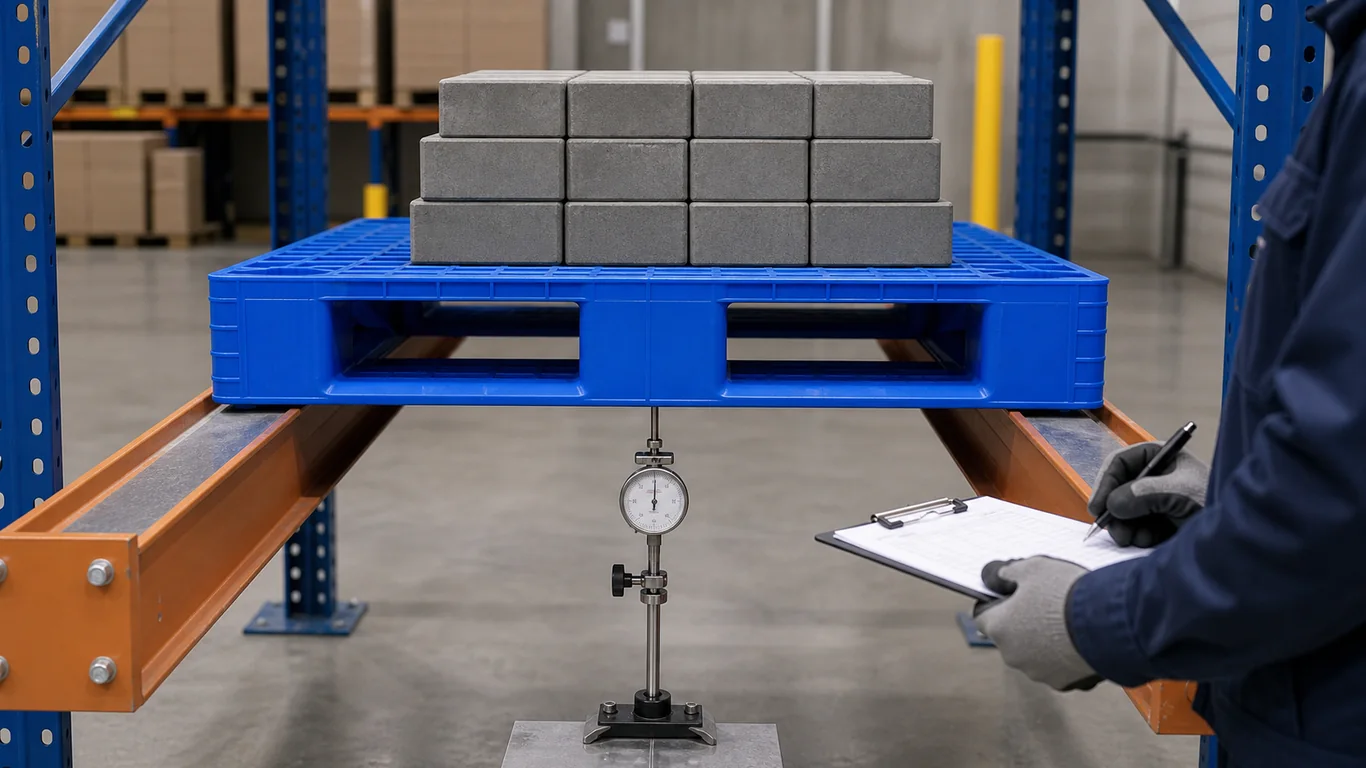
A plastic pallet specification can look correct on paper and still fail in a real warehouse. The problem is rarely one single number. Static load, dynamic load, and racking load are useful starting points, but they do not fully describe how a pallet behaves under uneven cartons, humid floors, fork impacts, rack beam spacing, cold-room cycles, or repeated stacking.
For procurement teams, the safest approach is to validate the pallet before the bulk order is released. A structured plastic pallet load test does not need to be complicated, but it must reproduce the risks that matter in the actual operation. The goal is not to prove that a pallet can survive one impressive overload. The goal is to confirm that the selected model can support daily work without unacceptable deflection, instability, damage, or process delays.
Start with the load case, not the pallet model
Many purchasing mistakes begin with a generic request such as “1-ton dynamic load” or “rackable plastic pallet.” These phrases are common, but they are not detailed enough for validation.
Before testing, define the load case in operational terms:
- maximum gross load per pallet, including goods, packaging, slip sheets, and stretch film;
- load distribution, such as cartons across the full deck, drums on limited contact points, bags that settle, or bins with concentrated feet;
- handling method, including forklift, pallet truck, conveyor, AGV, stacker, or manual repositioning;
- storage mode, such as floor stacking, block stacking, drive-in racking, selective racking, or shuttle storage;
- support condition, including rack beam span, conveyor roller pitch, fork tine width, and pallet orientation;
- environmental conditions, especially freezer rooms, washdown zones, outdoor staging, or chemical exposure.
This information changes the meaning of the load rating. A pallet carrying 1,000 kg of evenly distributed cartons on the floor is not facing the same stress as a pallet carrying 1,000 kg of liquid drums in selective racking. If the load case is unclear, the test result will be unclear as well.
Separate static, dynamic, and racking validation
A useful validation plan treats static, dynamic, and racking performance as different questions.
Static load testing checks whether loaded pallets remain stable during floor storage or stacking. It is relevant when pallets sit in staging areas, production buffers, cold rooms, or block stacks for long periods.
Dynamic load testing checks whether the pallet performs during movement. This includes forklift lifting, pallet truck turns, dock transitions, uneven floors, braking, acceleration, and repeated handling cycles.
Racking load testing checks pallet behavior when the pallet is supported only by rack beams, rails, or specific contact points. This is often the most critical test for high-bay warehouses because the deck and runners can deflect over time, especially under warm conditions or long storage duration.
International standards can help buyers ask better questions. ISO 8611-1 covers test methods for flat pallets used in materials handling, and its scope reinforces an important point: standardized load tests are useful, but field tests on the specific pallet design and application remain important (ISO ). For procurement teams, this means a supplier test report should be reviewed together with an application-specific trial, not treated as a substitute for one.
Build a sample test that matches real warehouse stress
A sample test should use the same pallet size, material, structure, and optional reinforcement that will be supplied in the bulk order. If steel reinforcement, anti-slip plugs, logos, colors, or RFID positions are part of the purchase, they should be included in the tested sample.
A practical pre-order test may include:
-
Dimensional confirmation Measure length, width, height, fork openings, runner geometry, and deck flatness. Confirm that tolerances are compatible with rack beams, conveyors, palletizers, and truck loading plans.
-
Empty handling check Move the empty pallet with the normal equipment. Confirm fork entry, pallet truck clearance, nesting or stacking behavior, and operator visibility.
-
Loaded movement trial Load the pallet with the real product or a close substitute. Move it through the normal path: production exit, staging, stretch wrapping, dock transfer, truck loading, and receiving.
-
Rack or support-span trial Place the loaded pallet on the actual rack beam span or a test frame with the same support distance. Record initial deflection, deflection after a defined holding period, and recovery after unloading.
-
Repeated cycle check Repeat lifting, turning, lowering, and short-distance transport enough times to reveal fork-entry damage, deck cracking, runner stress, and load movement.
-
Cleaning or temperature exposure If the pallet will be washed, frozen, or moved between cold and ambient zones, test the sample under those conditions before approval.
The test does not need to be laboratory-perfect to be useful. It does need to be documented, repeatable, and close enough to the real application that warehouse and quality teams trust the result.
Measure deflection instead of relying on visual judgment
Deflection is one of the most overlooked issues in pallet approval. A pallet may not crack, but excessive bending can still create operational risk. It can interfere with rack clearance, conveyor transfer, automated handling, carton stability, or safe unloading.
For rack and conveyor applications, record:
- load weight and load distribution;
- support span and pallet orientation;
- ambient temperature during the test;
- initial deflection after loading;
- deflection after the expected storage time;
- recovery after unloading;
- visible stress marks, cracking, whitening, or runner deformation.
Use a fixed measuring point, not a casual photo. A simple straightedge, measuring tape, and marked reference location can produce useful data. For higher-risk projects, procurement teams may request third-party testing or supplier laboratory records, but the site trial should still confirm how the pallet behaves with the real unit load.
Test the worst normal condition, not the best condition
Pre-order samples are often tested under clean, controlled, and optimistic conditions. Real warehouses are less polite. If the pallet will experience edge loading, slightly uneven floors, condensation, imperfect stretch wrapping, or frequent forklift contact, the validation should include those normal difficulties.
Do not test abuse that should never be allowed, such as dropping a fully loaded pallet from height or ramming it with a forklift. Instead, test the most demanding condition that can reasonably occur in routine work:
- the heaviest approved SKU;
- the smallest contact area on the pallet deck;
- the longest expected rack storage duration;
- the coldest operating temperature;
- the maximum permitted stack height;
- the tightest forklift aisle or truck-loading path;
- the side of the pallet most likely to receive fork contact.
This approach helps the buyer define a practical safety margin without turning the trial into a destructive demonstration.
Link the test result to the purchase specification
A load test is only valuable if the result becomes part of the commercial and technical agreement. After the sample is approved, the purchase specification should identify the exact approved configuration.
The record should include:
- pallet model and drawing reference;
- dimensions and tolerance range;
- material grade or agreed material standard;
- pallet weight range;
- color and marking requirements;
- static, dynamic, and racking load expectations;
- whether reinforcement is required;
- accepted application limits;
- inspection criteria at delivery;
- photos or videos of the approved sample test;
- agreed procedure for handling nonconforming shipments.
This prevents a common problem: a sample performs well, but the bulk shipment differs in weight, reinforcement, material, or molding quality. For procurement teams preparing a formal request, the plastic pallet RFQ specification checklist can help convert the validation result into clearer supplier requirements.
Choose the structure according to the test result
The best pallet structure depends on the load path. A lightweight nestable pallet may be efficient for one-way distribution or empty return, but it may not be suitable for unsupported rack storage. A perimeter-base or three-runner pallet can provide stronger support for forklift handling and racking, but the final choice should still be confirmed against the actual span and load distribution.
For operations that need four-way entry and stable support in warehouse storage, a model such as the 1210 open deck perimeter-base plastic pallet can be considered as part of the validation shortlist. The point is not to choose by category name alone. The tested structure should match the load, support condition, handling equipment, and required service life.
If the operation involves selective racking or high-bay storage, the validation should also connect with reinforcement decisions. The racking pallet steel reinforcement checklist explains when reinforcement should be reviewed instead of assuming that every rackable pallet needs the same internal structure.
Define acceptance criteria before the trial starts
A test becomes more objective when approval rules are written before the sample arrives. Otherwise, teams may disagree after the trial because procurement focuses on price, warehouse teams focus on handling, and quality teams focus on risk.
Useful acceptance criteria include:
- no cracking, breakage, or permanent runner deformation after the agreed test cycle;
- deflection remains within the site’s rack, conveyor, or automation clearance limit;
- load remains stable during normal forklift movement and turns;
- fork entry is smooth from required directions;
- pallet does not jam, drag, or tilt in the intended equipment;
- labels, markings, or tracking positions remain visible and protected;
- cleaning or temperature exposure does not create unacceptable brittleness, warping, or surface damage;
- operators can handle the pallet without adding manual correction steps.
For safety-sensitive warehouses, also confirm that loaded pallets are stored and handled in a stable manner. OSHA’s warehousing guidance emphasizes safe storage and handling practices to reduce worker injury and property damage risks (OSHA ). Pallet validation should therefore include not only load capacity, but also the stability of the complete unit load.
Keep the pilot small, but make it operationally real
After the bench or sample test, run a small operational pilot before the bulk purchase if the order volume is high or the application is demanding. A pilot of 20 to 100 pallets is often enough to reveal problems that a single sample cannot show, such as stack consistency, dimensional variation, operator acceptance, equipment fit, label durability, and damage patterns across shifts.
Track the pilot by date, route, equipment, load type, and observed issue. If pallets are used in a returnable loop, record return rate and damage at each cycle. If they are used in cold storage, record exposure duration and any change in handling feel after temperature cycling.
A good pilot does not slow the purchase process; it reduces the chance of buying the wrong pallet at scale. The plastic pallet pilot program guide offers a practical framework for turning sample approval into controlled warehouse evidence.
A better approval decision
A plastic pallet load test should answer one business question: can this pallet support the real site load, in the actual handling system, for the expected service conditions?
When the validation plan defines the load case, separates static, dynamic, and racking performance, measures deflection, tests the worst normal condition, and links the result to the purchase specification, the buying decision becomes more reliable. The pallet is no longer approved only because a catalog load rating looks sufficient. It is approved because the warehouse has evidence that the selected structure works in practice.