Industry Insights
Plastic Pallet Traceability: How to Build a Labeling System That Survives Real Warehouse Use
A practical guide for manufacturers, 3PLs, and warehouse teams on designing plastic pallet labels, IDs, scan points, and data rules for returnable pallet control.
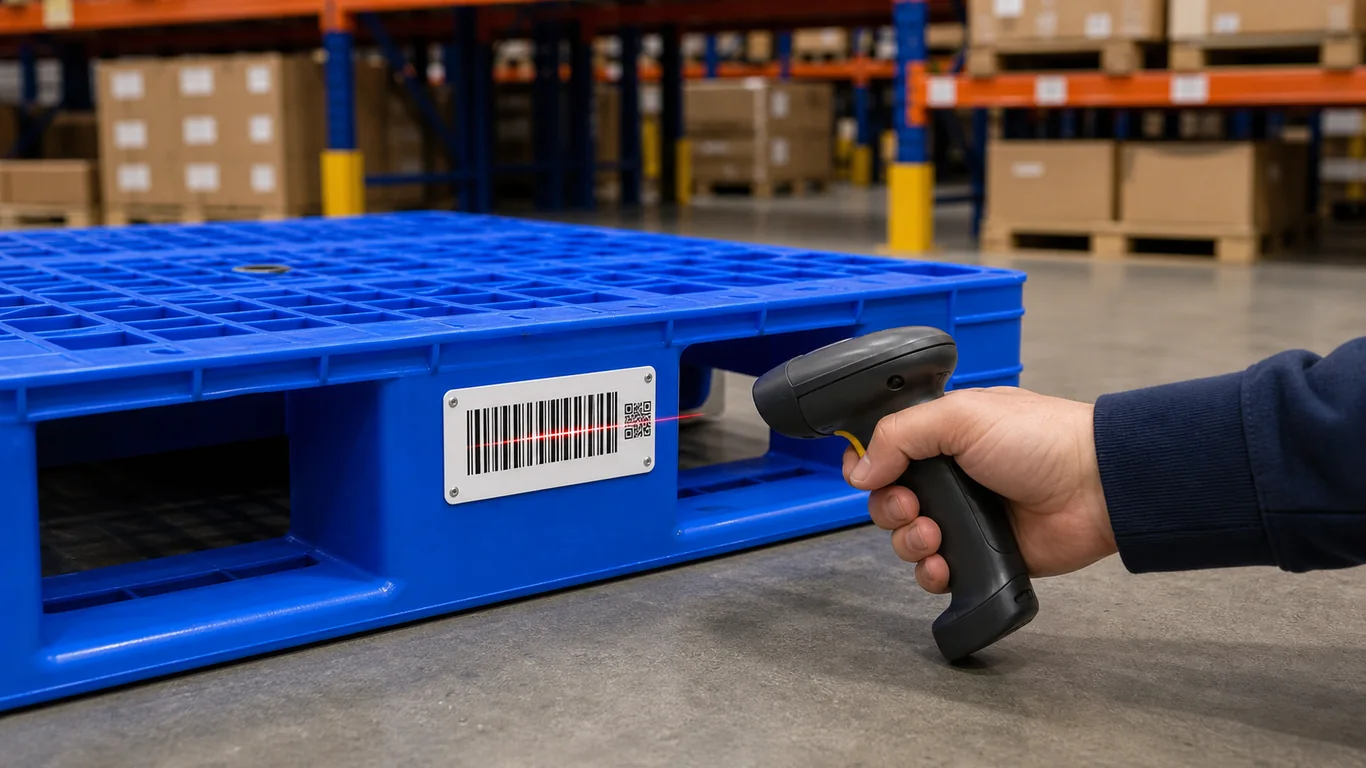
Reusable plastic pallets only become manageable assets when the warehouse can identify them quickly and consistently. A pallet may be durable, rackable, and easy to clean, but if nobody can tell which pool it belongs to, where it was last shipped, or whether it is approved for the current lane, it will still create avoidable cost.
For manufacturers, 3PL operators, food distributors, and closed-loop logistics teams, the practical question is not whether every pallet should carry a label. The better question is:
What level of pallet traceability is necessary for the risk, value, and control limits of the operation?
A good plastic pallet labeling system should help people make faster decisions at receiving, shipping, inspection, and return closure. It should not become a fragile technology project that works only on a clean desk and fails at the dock door.
Start by defining what the ID must prove
Before choosing barcode, QR code, RFID, hot stamping, or molded text, define the decision the ID must support. Different operations need different proof.
A pallet ID may need to prove:
- ownership, so the pallet is not mixed with customer, supplier, or exchange pallets;
- service class, such as racking, food-grade, cold-room, export, or floor-staging use;
- lane authorization, especially when premium pallets are limited to closed-loop routes;
- maintenance status, including passed inspection, downgraded, quarantined, or retired;
- batch history, useful when repeated damage appears in one production lot;
- shipment linkage, when pallet movement must match delivery notes, ASN data, or customer return accounts.
If the only requirement is visual segregation inside one factory, color and molded logo may be enough. If the pallet travels through multiple warehouses and customers, serialized identification becomes more useful. If the pallet supports customer billing, deposit management, or strict return control, the ID must connect to transaction records, not just a label on plastic.
Choose the identification method by handling environment
No identification method is universally best. The right choice depends on dirt, moisture, scan distance, speed, customer requirements, and replacement cost.
| Method | Best fit | Main limitation |
|---|---|---|
| Molded logo or text | Ownership recognition and basic segregation | Not unique for each pallet |
| Color coding | Fast visual sorting by pool, zone, or service class | Color alone cannot confirm history or count accuracy |
| Hot stamping | Durable visible marking for logo, number, or service class | Limited data capacity and may need manual reading |
| Barcode label | Low-cost serialized tracking with common scanners | Requires clean line of sight and label protection |
| QR code label | More data capacity and smartphone readability | Can still fail if scratched, dirty, or badly placed |
| RFID tag | Faster non-line-of-sight reading in higher-volume flows | Requires tag placement, reader setup, and process discipline |
For many mid-sized B2B operations, a hybrid system works best: molded ownership marks for visual control, plus a serialized barcode or QR code for transaction capture. RFID becomes more attractive when pallet volume is high, scan points are predictable, and manual scanning creates bottlenecks.
Use a data structure that warehouse staff can trust
A pallet label should not carry a random number that only one spreadsheet understands. It should follow a clear structure that warehouse, quality, and finance teams can use without translation.
At minimum, each serialized pallet record should include:
- unique pallet ID,
- pallet model or size,
- ownership pool,
- service class,
- production batch or purchase lot,
- current status,
- last known location,
- last transaction date,
- assigned customer, lane, or warehouse if applicable.
For shipments that need standardized logistics identification, the GS1 system uses the Serial Shipping Container Code (SSCC) to identify individual logistics units; GS1 explains that the SSCC can be encoded in GS1-128 and used on a logistics label to support tracking in transport and storage (GS1 US ). In practice, teams should separate two concepts: the pallet asset ID identifies the reusable pallet itself, while the shipment or logistics-unit ID identifies the load moving on that pallet. Mixing these two records can cause confusion when goods are delivered but the empty pallet still needs to be returned.
Place labels where people actually scan
Many pallet traceability failures are caused by poor label placement, not poor software. A label that is technically readable but hidden by forklift forks, stretch wrap, dirt, or rack beams will not be scanned consistently.
When deciding label position, test the normal handling path:
- empty pallet stack picked by forklift or pallet truck,
- pallet loaded in production or picking area,
- stretch wrapping or strapping,
- dock staging,
- truck loading,
- receiving at the destination,
- empty pallet return or inspection.
Labels should be visible from the side where operators naturally approach the pallet. For returnable loops, place identification on at least two opposite sides if pallets are frequently rotated. If the pallet is used in rack storage, avoid locations that are blocked by beams or exposed to repeated rack contact.
For hygiene-controlled operations, label placement must also support cleaning. Labels, recesses, rivets, and tag housings should not create residue traps. If the pallet operates in food or beverage areas, align identification design with the sanitation procedure used for the site. The plastic pallet sanitation SOP for food warehouses provides a practical baseline for cleaning zones, inspection points, and documentation.
Protect the ID from the damage pattern of the site
A label is part of the pallet system. It must be protected against the most common damage sources in that warehouse.
Typical label failure causes include:
- fork tine abrasion during entry,
- impact at pallet corners,
- chemical cleaning agents,
- condensation in cold rooms,
- UV exposure in outdoor staging,
- stretch-wrap adhesive or label residue,
- repeated pressure from nested stacks,
- dirt buildup on textured or recessed areas.
Before rolling out labels across the full pallet pool, run a short pilot with real handling. Place sample labels in different positions, then inspect them after several circulation cycles. The goal is not only to check whether the code still scans. It is to confirm that operators can find it quickly, scan it without changing normal work posture, and trust the result.
If the pallet itself is exposed to frequent damage, traceability will not solve the root cause. It will only make the failure more visible. In those cases, combine labeling with inspection rules and impact reduction. The plastic pallet inspection criteria can help define when a tagged pallet should remain in service, be downgraded, or be removed from the loop.
Define scan points before buying technology
A traceability system is only as good as the events it captures. If scanning happens at random points, the data will be incomplete and disputes will continue.
For a returnable plastic pallet pool, start with five scan events:
1) Pool entry
Scan when a new pallet enters the usable pool. This creates the master record and connects the asset ID to model, batch, purchase lot, and service class.
2) Dispatch
Scan when the pallet leaves the warehouse with goods or empty repositioning stock. Connect the pallet ID to shipment number, destination, carrier, and expected return rule.
3) Receiving confirmation
Scan when the pallet arrives at another company site, internal DC, co-packer, or 3PL location. This confirms custody transfer and reduces arguments about where loss occurred.
4) Empty return
Scan when the empty pallet returns to the pool owner or approved collection point. This closes the loop and updates the available balance.
5) Exception status
Scan when the pallet is quarantined, downgraded, repaired, cleaned, or retired. Without exception scans, the system may show an asset as “missing” when it is actually sitting in a repair area.
These events do not need to be complex. A small operation may use a mobile scanner and a simple database. A larger operation may connect scans to WMS, ERP, EDI, or customer portals. The important requirement is consistency: each scan must change a clearly defined status.
Keep visual rules even when digital tracking is used
Digital tracking should support warehouse behavior, not replace it completely. Operators still need quick visual signals when a pallet is in the wrong place.
Use visible controls such as:
- color by pool or business unit,
- molded or hot-stamped owner name,
- service-class marking such as RACK, FOOD, COLD, or FLOOR ONLY,
- downgrade marks that cannot be confused with approved status,
- designated empty pallet lanes by customer or route.
This is especially important in mixed facilities where supplier pallets, customer pallets, rental pallets, and company-owned pallets all pass through the same dock. A scanner can confirm the record, but visual design helps staff notice problems before the pallet reaches the wrong truck.
Link pallet traceability to return control
Traceability has the strongest financial value when it supports return discipline. A scanned pallet ID should answer three questions:
- Who currently has custody of the pallet?
- What return or exchange rule applies to that lane?
- Is the pallet overdue, damaged, downgraded, or already closed?
For closed-loop programs, pallet IDs should feed into return KPIs such as cycle time, overdue balance, loss rate by customer, and damage rate by lane. These KPIs help procurement and logistics teams decide whether a lane needs a deposit rule, a customer account review, a different pallet type, or a one-way packaging option. The closed-loop pallet loss control guide explains how lane rules, dispatch confirmation, receiving acknowledgment, and empty return closure work together.
Pallet design also affects traceability discipline. A clearly recognizable, stable, reusable pallet is easier to separate and count than a generic mixed pallet. For example, a structured product such as a 1210 open deck 3-runner plastic pallet may be evaluated not only for load support and forklift handling, but also for how marking positions, color choice, and service-class rules fit a controlled warehouse loop.
Avoid common implementation mistakes
Many pallet tracking projects fail because the system is designed around ideal data rather than daily operations. Avoid these mistakes:
- Using one ID for both pallet asset and shipment load. The goods may be delivered while the pallet remains returnable.
- Labeling every pallet without assigning ownership rules. Identification does not recover pallets unless someone is accountable.
- Placing labels where they are covered by stretch wrap or fork contact. Poor placement quickly becomes poor compliance.
- Recording scans without exception codes. Missing, damaged, quarantined, and retired pallets require different actions.
- Expecting operators to scan too many low-value events. Capture the few events that change custody, availability, or risk.
- Ignoring customer and carrier behavior. A system that works internally may fail at a third-party receiving dock if instructions are unclear.
The best system is usually the simplest one that gives reliable answers at the moments where ownership, availability, and risk change.
A practical rollout sequence
A full traceability program should be built in stages.
- Segment the pallet pool. Separate high-value returnable pallets, food-grade pallets, rackable pallets, export pallets, and low-value transfer pallets.
- Define status codes. Use simple terms such as available, dispatched, received, returned, quarantined, downgraded, retired, and lost.
- Select the ID method. Match visual marking, barcode, QR code, or RFID to the operating environment.
- Test label placement. Run real forklift, wrapping, racking, cleaning, and return cycles before full rollout.
- Train by decision point. Teach operators what to scan and what action the scan triggers.
- Review exceptions weekly. Focus on overdue pallets, repeated failed scans, and locations with high mismatch rates.
- Use data in procurement. Feed loss, damage, and dwell-time information into future pallet specifications and supplier reviews.
Plastic pallet traceability is not about collecting more data for its own sake. It is about making reusable packaging visible enough to control. When identification, label placement, scan events, and return rules are designed together, warehouses can reduce pallet loss, prevent service-class misuse, support cleaner audits, and make better purchasing decisions over the life of the pallet pool.