Industry Insights
How to Reduce Plastic Pallet Loss in Closed-Loop Logistics: A Practical Return-Control Program
A practical guide for manufacturers, distributors, and warehouse teams to reduce plastic pallet loss through lane rules, ownership control, return KPIs, and exception management.
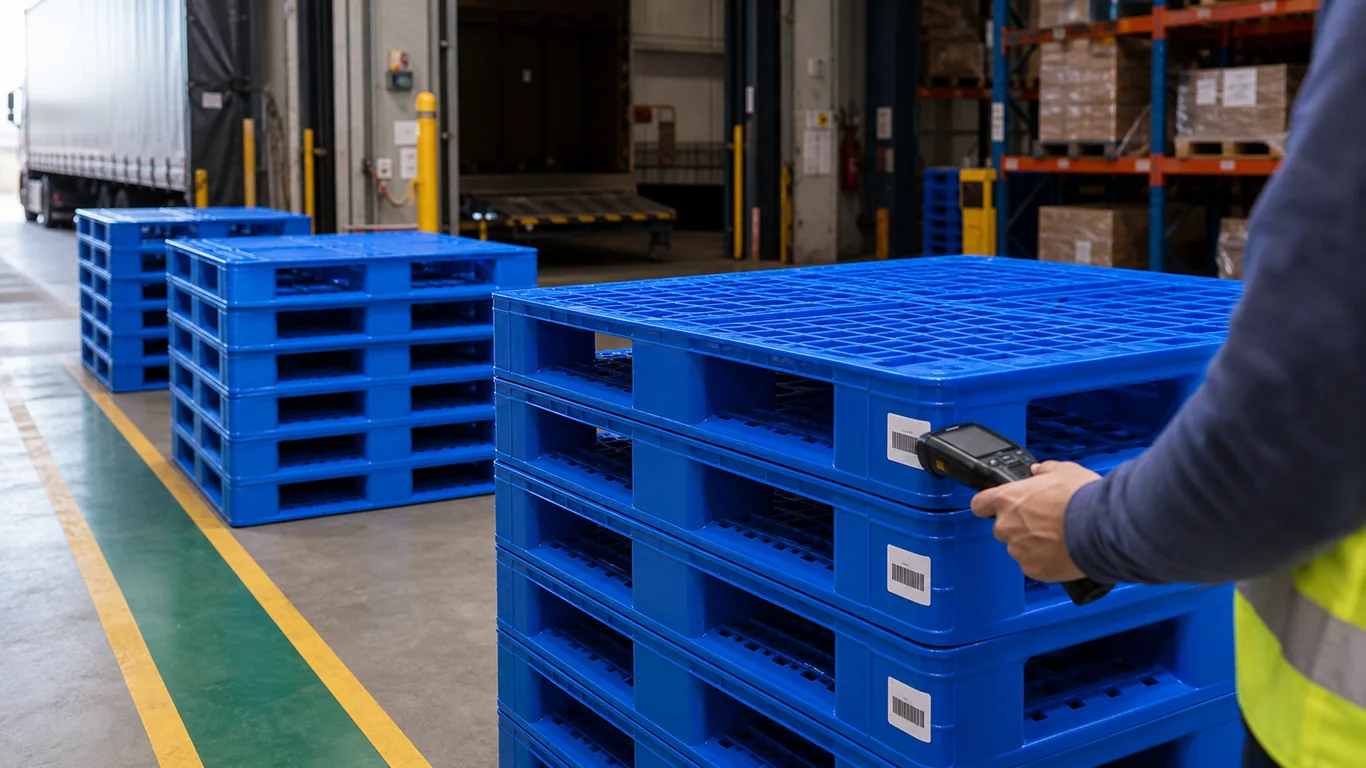
Plastic pallets deliver the best return when they stay inside a controlled circulation system. In many B2B operations, the problem is not that the pallet fails too early. The problem is that good pallets disappear from the loop.
A 2% monthly loss rate may look small on a spreadsheet, but in a pool of 8,000 pallets it means 160 pallets must be replaced every month before any growth or seasonal peak is considered. For operations that ship to distributors, co-packers, retail DCs, farms, or regional depots, pallet loss can quietly become one of the largest hidden costs in the packaging budget.
The practical question is clear:
How can a company reduce plastic pallet loss without slowing down shipments or creating unnecessary administration?
The answer is not a single tracker, label, or contract clause. Loss control works when physical pallet selection, lane rules, receiving discipline, and return KPIs are managed as one program.
1) Separate pallet loss from pallet damage
Before changing procedures, define the problem correctly.
Pallet damage means the asset is still visible but no longer suitable for use. It can be inspected, repaired if possible, recycled, or replaced with a known reason code.
Pallet loss means the asset has left the usable pool without a confirmed return, disposal record, or charge-back decision. It may be sitting at a customer site, mixed with another company’s pallets, used for internal storage, sent to an unauthorized lane, or scrapped without reporting.
This distinction matters because the countermeasures are different:
- Damage is reduced through better handling, load control, forklift behavior, and pallet specification.
- Loss is reduced through ownership clarity, return triggers, site accountability, and exception follow-up.
A warehouse can have excellent pallet durability and still suffer high pallet replacement cost if return control is weak.
2) Start with lane-level ownership rules
Most pallet loss occurs where ownership is ambiguous. If the shipping team, customer service team, carrier, and receiving site do not share the same rule, the pallet becomes “someone else’s problem.”
Create a simple lane matrix before pallets move:
| Lane type | Typical risk | Required rule |
|---|---|---|
| Factory to owned DC | Low to medium | Internal transfer record and return schedule |
| Factory to distributor | Medium to high | Pallet ownership stated in sales or logistics agreement |
| Supplier to plant | Medium | Receiving count matched to supplier return account |
| Co-packer or contract manufacturer | High | Site-level balance, monthly reconciliation, and escalation path |
| Export or one-way shipment | Very high | Use export-approved one-way solution or charge pallet into shipment cost |
The key is to define who is responsible for the pallet at each handover point. A returnable pallet should never move on a lane where the receiving party has no documented obligation to return, exchange, or pay for it.
If a lane cannot support return discipline, it should not be planned as a closed-loop lane. In that case, procurement should compare the cost of one-way packaging, deposit systems, or direct pallet recovery before releasing reusable plastic pallets into the route.
3) Match pallet design to the control level of the loop
Loss control is partly operational, but pallet design still matters. The easier a pallet is to recognize, count, stack, and segregate, the easier it is to keep in the right loop.
For tightly managed internal loops, a durable rackable pallet with a consistent base may be appropriate where the same asset moves between production, storage, and dispatch. For example, a 3-runner plastic pallet can support forklift handling and defined bottom-contact points in many warehouse flows.
For open or semi-open loops, visibility becomes more important. Color, molded logo position, hot-stamp marking, or serial identification can reduce accidental mixing. These features do not prevent every loss, but they make exceptions easier to detect during receiving and yard checks.
Avoid using a premium reusable pallet in a lane where:
- pallets are regularly exchanged with unknown third-party assets,
- receivers break down loads without recording pallet counts,
- carriers consolidate freight at uncontrolled cross-docks,
- pallets remain at customer sites for long dwell periods,
- the commercial agreement does not support return enforcement.
A strong pallet placed into an uncontrolled route is not an asset strategy. It is an unmanaged giveaway.
4) Build the return process around three control points
A practical pallet return program does not need to track every movement with excessive paperwork. It does need reliable control at three moments.
Control point 1: Dispatch confirmation
At shipping, record the pallet quantity by shipment, lane, and customer or destination site. If the operation uses serialized tags, scan the pallet IDs. If not, use batch-level count control with clear ownership coding.
Minimum data fields should include:
- shipment number,
- destination,
- pallet type,
- pallet quantity,
- dispatch date,
- carrier,
- expected return or exchange rule.
Without this baseline, later disputes become opinion-based.
Control point 2: Receiving or customer acknowledgment
The receiving party should confirm the pallet count when goods are accepted. This can be done through proof of delivery, EDI, portal entry, signed delivery note, or monthly account statement.
The important point is timing. If pallet quantity is not confirmed until month-end, discrepancies are already hard to investigate. For high-volume lanes, confirmation should happen at receiving or within a short agreed window.
Control point 3: Empty return closure
A pallet is not closed just because the shipment is delivered. It is closed when one of the following happens:
- the pallet returns to the owner’s pool,
- an equal pallet is exchanged,
- the customer is charged or deposits are deducted,
- the pallet is formally written off with an approved reason.
This closure logic turns “missing pallets” into manageable exceptions instead of an undefined operating cost.
5) Use KPIs that reveal loss early
Annual pallet replacement cost is a lagging indicator. By the time it is visible, the root cause may be months old.
Use operational KPIs that show loss risk early:
Pallet balance by customer or site
Track opening balance, pallets shipped out, pallets returned, adjustments, and closing balance. A rising balance at one site often indicates dwell time, poor segregation, or weak return discipline.
Average dwell days
Dwell days measure how long pallets remain outside the owner’s usable pool. Longer dwell time increases the pool size needed to support the same shipment volume. Teams planning the total pool should connect this metric with a structured plastic pallet pool sizing method .
Return compliance rate
Measure the percentage of pallets returned or exchanged within the agreed time window. This is more useful than simply counting returns because it reflects timing discipline.
Exception aging
Classify missing pallet cases by age: 0–7 days, 8–30 days, 31–60 days, and over 60 days. Older exceptions are harder to recover and should trigger commercial escalation.
Replacement ratio
Compare replacement purchases against average active pool size. If replacement demand rises while shipment volume is stable, the issue is usually loss, damage, or both.
These KPIs should be reviewed with logistics, sales, customer service, and finance together. Pallet loss is rarely solved by the warehouse alone.
6) Decide when to use labels, barcodes, RFID, or deposits
Technology helps only when the operating rule is already clear. A barcode on a pallet does not make a customer return it. RFID does not fix a contract gap. Deposits do not work if deductions are never enforced.
Choose the control method according to risk and transaction volume.
Visual marking
Best for low-risk internal loops or small site networks. Use color, molded branding, printed codes, or hot-stamp marks so operators can quickly identify the owner and pallet type.
Barcode or QR code
Useful when shipments are scanned at dispatch and receiving points. It improves traceability but requires scan compliance and readable label placement.
RFID
Suitable for high-volume lanes, automated gates, or sites where manual scanning is unreliable. RFID can reduce labor in counting, but it requires hardware, tag durability planning, and data governance.
Deposit or charge-back system
Effective when customers or partners have commercial responsibility for return. The rule must be simple: return, exchange, or pay. If exceptions are negotiated informally every month, the deposit loses its effect.
For many mid-sized operations, the best starting point is not the most advanced technology. It is a disciplined pallet account by customer, supported by clear markings and weekly exception review.
7) Create an exception workflow before the first dispute
Pallet loss becomes expensive when no one owns the exception.
Define a standard workflow:
- Detect: system balance or receiving check shows a shortage.
- Classify: wrong count, delayed return, customer hold, carrier issue, damage write-off, or unknown loss.
- Assign owner: logistics, customer service, sales account owner, carrier manager, or warehouse supervisor.
- Set deadline: each case receives a recovery or billing deadline.
- Close: returned, exchanged, charged, written off, or escalated.
The workflow should be short enough for daily use. If the process is too complex, teams will bypass it during peak shipping periods—the exact time when pallet loss risk is highest.
8) Include pallet return terms in B2B agreements
Operational discipline is stronger when commercial terms support it. For reusable pallet programs, agreements should clarify:
- pallet ownership,
- return time window,
- acceptable equivalent exchange rules,
- cleaning or contamination responsibility,
- damage and loss charging method,
- inventory reconciliation frequency,
- dispute resolution process,
- whether pallets may be transferred to third parties.
This is especially important for distributors, co-packers, contract manufacturers, and customers that redistribute goods. If they are allowed to forward pallets without tracking, the original owner loses control immediately.
A simple contract clause will not recover pallets by itself, but it gives operations and finance a clear basis for enforcement.
9) Run a 60-day loss-control pilot before scaling
Before applying a return program to all lanes, test it on one high-value or high-loss route.
A focused 60-day pilot can include:
- baseline pallet balance by site,
- visible pallet marking or scan process,
- dispatch and receiving count discipline,
- weekly exception list,
- return compliance report,
- financial value of recovered or billed pallets.
At the end of the pilot, compare:
- loss rate before and after,
- average dwell days,
- exception closure time,
- administrative workload,
- customer or carrier friction,
- replacement pallet purchases avoided.
If the process reduces loss without slowing shipments, expand it to similar lanes. If it creates too much manual work, simplify the control points before scaling.
Conclusion
Plastic pallet loss is not just a warehouse housekeeping issue. It is an asset-control problem that affects working capital, replacement purchasing, service reliability, and the true cost of a reusable packaging program.
The most effective approach is practical and consistent: define lane ownership, choose pallet designs that are easy to identify and control, record dispatch and receiving quantities, close returns through clear rules, and review exceptions before they become unrecoverable.
A reusable plastic pallet program succeeds when every pallet has a known owner, a known location status, and a defined path back into productive use.