Industry Insights
Plastic Pallet Pilot: Validate Fit Before a Warehouse Rollout
Build a plastic pallet pilot around the real load, equipment, storage method, stop rules, and production-lot checks before ordering at scale.
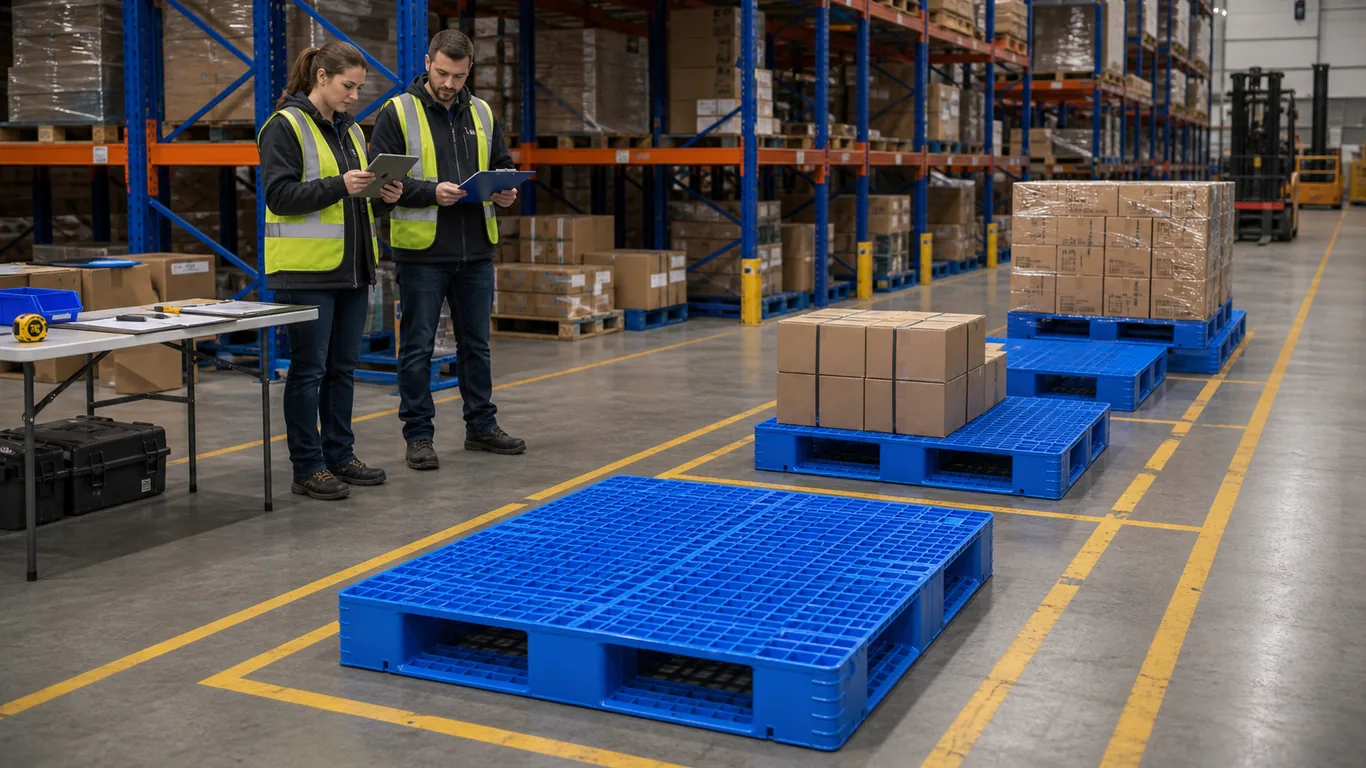
A useful plastic pallet pilot answers one purchasing question: does this exact pallet specification work with our real unit load, equipment, storage method, environment, and control process? It should not begin with a promised pallet count or an arbitrary pass date.
A 90-day window can be a practical project schedule, but it is not proof by itself. A floor-handling lane may need less time. A rack application, cold room, long dwell period, or seasonal route may need more. Set the duration and sample quantity from the conditions the pallet must experience, then agree the evidence and stop rules before the first loaded movement.
Start with a written pilot card
Do not trial an unnamed “plastic pallet.” Freeze the candidate and the use case in one record.
| Record before the trial | Minimum detail |
|---|---|
| Pallet identity | model, drawing revision, dimensions, weight, deck and base, material route, reinforcement, color or marking |
| Unit load | goods and packaging, footprint, typical and maximum mass, load distribution, overhang, restraint method |
| Handling | forklift or pallet jack type, fork geometry, entry directions, turns, ramps, dock plates, conveyors or wrappers |
| Storage | floor, stacking or rack; support pattern, beam span and direction, dwell time and stacking height |
| Environment | operating temperature, wet or dry conditions, cleaning chemicals, outdoor or UV exposure where relevant |
| Decision controls | test owner, trained operators, observation method, stop rule, acceptance rule and approver |
If the intended lane has materially different loads, racks, trucks or temperatures, treat them as separate test cases. One easy lane cannot approve every use across a network.
Gate 1: review evidence before live handling
Ask the supplier for the exact model drawing and data sheet, stated material route, load definitions, test basis and operating limitations. A catalogue load number is incomplete unless its support condition, load distribution, temperature and test method are known.
ISO 8611-1:2025 provides test methods for new flat pallets, including nominal-load, maximum-working-load and comparative-durability testing. ISO also notes that load-capacity testing does not replace the value of field tests on a specific design. ISO 8611-2:2025 addresses performance requirements and selection of tests for different intended uses. Referencing either standard is not the same as claiming that a particular pallet has been tested to it; obtain the model-specific evidence you require.
For a Baoheng shortlist, send the product type, footprint, quantity, use, load requirement, equipment and destination. Material, reinforcement, customization, price and lead time still need confirmation for the selected model and order. Paid samples are available; sample and freight charges are confirmed for the project.
Gate 2: inspect and fit-check the sample
Before a loaded trial, record:
- dimensions, weight, deck flatness, runner contact and visible molding condition;
- fork and pallet-jack entry clearances in every required direction;
- contact with conveyor rollers, chains, guides, sensors, wrappers or other interfaces;
- load footprint, point loads, unsupported edges and permitted overhang;
- the sample identifier and any difference from the proposed production specification.
Isolate a sample if it is cracked, distorted, unstable or otherwise questionable. HSE’s Pallet safety guidance advises users to examine pallets for damage, mark and isolate damaged pallets, and use pallets suitable for the relevant racking. The responsible site team should define its own quarantine and release procedure.
Gate 3: run the real lane with safety stops
Begin in a controlled area with the site’s authorized operators and safety controls. Progress from unloaded fit to a representative load, then to the most demanding approved condition. Do not use a supplier demonstration as the only operating evidence.
Observe the completed unit load through the movements that matter: pickup, travel, turns, ramps, dock transfer, placement, retrieval and any conveyor or wrapper interface. Record visible movement, fork-entry damage, corner or runner contact, load shift, handling interruption and operator feedback. OSHA’s US rules require stable or safely arranged loads and handling within the truck’s rated capacity; local law and the equipment manufacturer’s instructions may impose different or additional requirements.
Stop the trial and quarantine the pallet or test case when a predefined safety condition occurs, such as:
- cracking, permanent distortion, unexpected runner lift or loss of stable support;
- unstable load movement or packaging failure;
- fork, wheel, conveyor or rack contact outside the approved interface;
- deflection or clearance outside the site-approved limit;
- a near miss, equipment alarm or operator loss of control.
A stopped test is useful evidence. Do not relabel a failed high-risk condition as acceptable for lighter duty without a separate assessment and approval.
Gate 4: treat rack storage as a separate approval
Static and dynamic load statements do not prove rack suitability. For rack use, record the rack type, clear beam span, support direction and contact width, load distribution, temperature, dwell time, reinforcement and the site’s permitted deflection or clearance. Confirm the pallet is designed for that support condition before placing a loaded sample on beams.
The pilot should be planned with the rack owner, pallet supplier and a competent person responsible for the site’s storage safety. Continue observations for the required dwell period and after retrieval. Do not infer a universal rack load from a floor test or from another pallet model.
Gate 5: prove repeatability, not only one good sample
A successful prototype is not yet a production control. Before scaling, define how incoming lots will be compared with the approved sample. Useful checks include model and drawing revision, dimensions, weight range, material statement, reinforcement, visible condition, marking and agreed inspection or test records.
Baoheng uses a fixed sampling-based quality-inspection process covering raw material, appearance, dimensions, weight, color, load performance and impact performance. This does not mean internal inspection photos, videos or records are promised for every order. A buyer may arrange a factory visit or commission a third party for pre-shipment inspection; scope, acceptance criteria and responsibility should be agreed before the order.
Use a go, modify or stop decision
| Decision | Meaning | Next action |
|---|---|---|
| Go | Every mandatory safety and fit gate passed, results are traceable, and the production specification can be repeated | approve only the tested use case and define incoming-lot controls |
| Modify | A correctable variable failed, such as load pattern, reinforcement, interface or handling method | revise one controlled variable and repeat the affected gates |
| Stop | A safety-critical condition failed, evidence is missing, or the required use cannot be reproduced safely | quarantine the case and do not scale it |
Compare cost only after the safety and fit gates pass. Use your own purchase, damage, handling, cleaning, downtime, loss and recovery records. Do not insert an assumed lifespan, damage reduction or resale value to force a favorable ROI.
How long and how large should the pilot be?
There is no responsible universal sample count. Choose enough identified pallets and cycles to cover the approved combinations of load, equipment, shift, storage, environment and production lot. Extend the trial when the risk depends on time, temperature, repeated impacts, cleaning cycles, long rack dwell or seasonal conditions.
The pilot can close when the required conditions have been observed, mandatory gates have passed, exceptions are resolved, and the decision owner has enough traceable evidence to approve a defined scope. Calendar completion alone is not a pass.
Turn the result into an RFQ
Attach the pilot card, approved pallet specification, load and equipment details, acceptance table, exception log and incoming-lot checks to the RFQ. That keeps the quotation tied to what was actually tested.
Use the broader wood-to-plastic warehouse upgrade guide to decide where a conversion is justified. When you are ready to shortlist models, send the load, storage, equipment, quantity and destination details . Baoheng can review suitable options and prepare a quotation; final suitability remains subject to the confirmed model, order conditions and buyer approval.