Industry Insights
Racking Safety Deep Dive: How to Evaluate Steel-Reinforced Plastic Pallets Before Purchase
An extension of our wooden-to-plastic pallet upgrade guide, focused on one critical topic: how to evaluate steel reinforcement for racking safety.
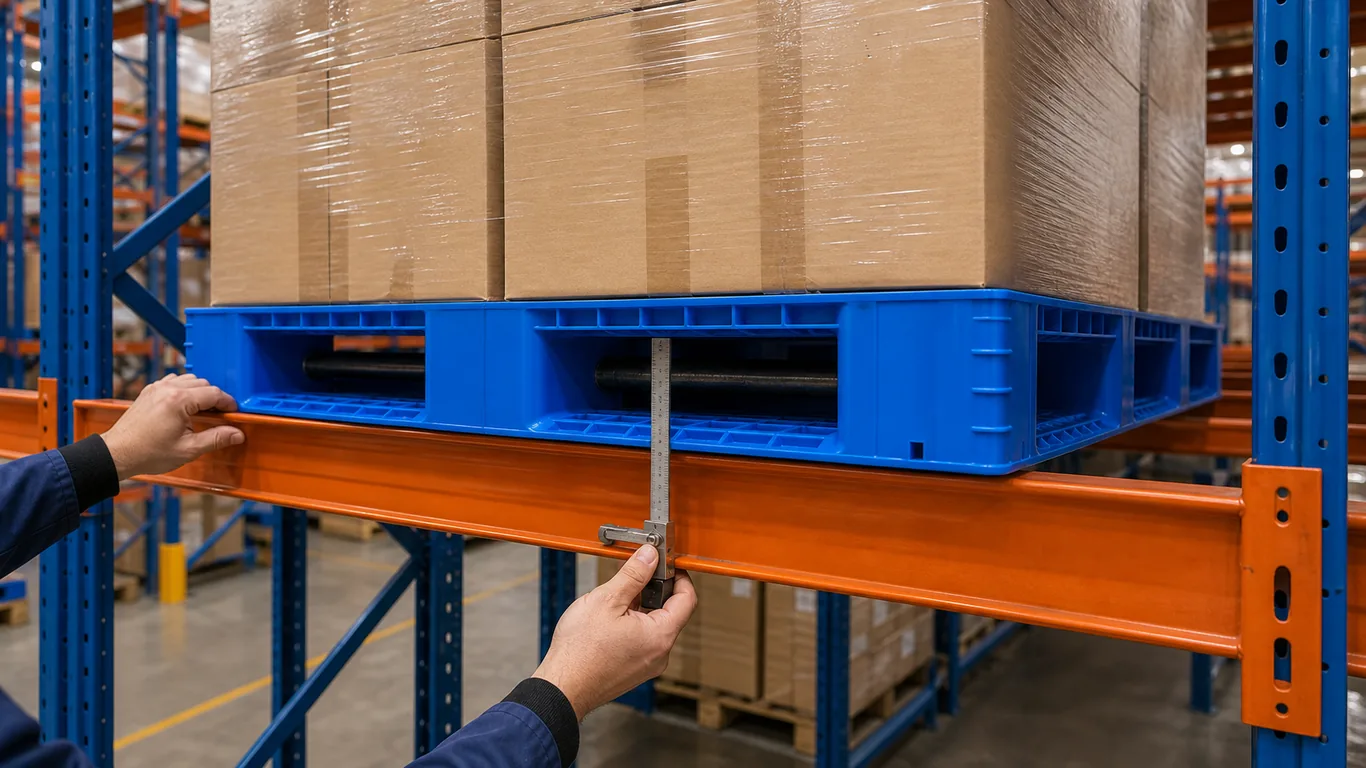
In our previous article, From Wooden to Plastic Pallets: A Practical Guide to Warehouse Storage Upgrades , we mentioned that steel reinforcement is often the “safety fuse” for pallets used on racking.
This follow-up focuses on that single point in more detail:
If your pallet spends time on beams with a suspended center span, steel reinforcement is not a detail — it is a structural decision.
1) Why racking is different from floor storage
On the floor, pallet load is supported continuously from below. On racking, support is limited to beam contact points, so the middle section behaves like a bridge.
That difference creates three practical risks when a pallet is under-specified:
- Excessive deflection in the center;
- Long-term creep deformation;
- Sudden cracking under impact or dynamic handling.
For this reason, many failures that seem like “material quality issues” are actually load path and reinforcement mismatch issues.
2) A simple pre-purchase checklist (what buyers should confirm)
Before placing an order, confirm the following with your supplier.
A. Real working load, not only nameplate load
Provide:
- Typical and peak payload per pallet;
- Whether loads are uniformly distributed or point-loaded;
- Product center-of-gravity behavior during handling.
A pallet that passes a uniform lab load can still fail under concentrated real-world loads.
B. Beam span and rack interface
Provide:
- Clear beam spacing (inside-to-inside support distance);
- Beam type (step beam, box beam, etc.);
- Whether support is two-sided or has additional center support.
The same pallet can perform very differently at 900 mm vs 1100 mm span.
C. Reinforcement layout, not just “with steel tube”
Ask for the exact scheme:
- How many steel tubes;
- Tube position (deck / base / combined);
- Orientation (longitudinal / transverse);
- Tube dimensions and wall thickness.
“Steel-reinforced” is not a specification by itself.
D. Deflection control criteria
Request an acceptable deflection threshold under target racking load.
Even if no immediate break occurs, excessive sag can:
- Reduce forklift handling stability;
- Increase product leaning and load shift risk;
- Shorten service life through cyclic deformation.
E. Test basis and safety margin
Confirm:
- Which test method was used (internal method or standard method);
- Test conditions (temperature, duration, support mode);
- Recommended safety factor for your application.
This is especially important for cold storage, high-temperature zones, or high-turnover operations.
3) When should you definitely consider steel reinforcement?
As a practical rule, prioritize reinforced pallet options when you have one or more of the following:
- High-bay racking with long dwell time;
- Heavy loads close to rated limits;
- Long beam spans;
- High-frequency forklift movement and repeated dynamic shock;
- Strict safety or audit requirements.
If multiple conditions overlap, reinforced pallets are usually the lower-risk and lower-total-cost option over time.
4) Common decision mistakes to avoid
-
Mistake 1: Choosing by unit price only
The cost of one dropped load can exceed the price difference of an entire pallet batch. -
Mistake 2: Copying another site’s configuration directly
Different beam spans, payload patterns and handling intensity require different reinforcement. -
Mistake 3: Ignoring long-term deformation
No breakage in week one does not mean stable performance after 12–24 months. -
Mistake 4: Mixing pallet batches with different stiffness on the same rack lane
Uneven deflection behavior can reduce system-level stability.
5) Practical next step: send a “racking data pack” to your supplier
To get a useful recommendation quickly, prepare and share:
- Pallet footprint and target payload;
- Rack beam spacing and beam profile;
- Stacking/storage duration on racks;
- Forklift type and handling frequency;
- Temperature range and environment conditions.
With these five inputs, most experienced suppliers can propose a reinforcement layout that is far more reliable than generic catalog selection.
Final note
This article is an extension of our main upgrade guide and focuses on one high-impact topic: steel reinforcement for racking safety. If you are currently evaluating a switch from wooden pallets to racking-grade plastic pallets, start with structural fit — then compare price.
In racking applications, good reinforcement design is not “extra configuration”; it is part of the pallet’s core function.