Industry Insights
Plastic Pallet Chemical Compatibility: How to Specify Exposure Before Buying
A practical guide for procurement, warehouse, and EHS teams on defining chemical contact, cleaning agents, leak scenarios, and sample tests before approving plastic pallets.
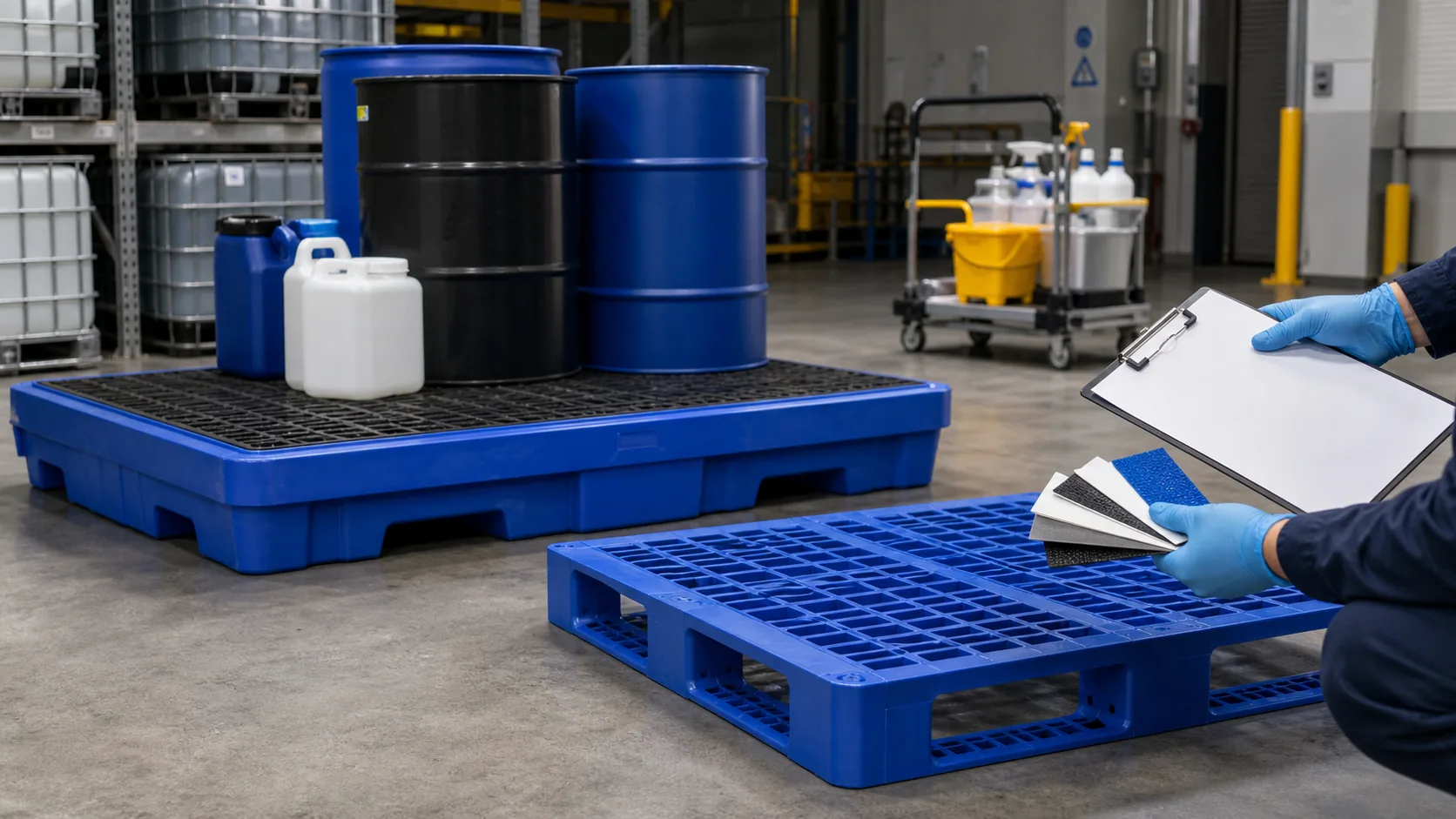
A plastic pallet can be strong enough for warehouse handling and still be the wrong choice for a chemical exposure route. The problem is rarely visible on the first day. It appears after repeated cleaning, leaked product, oily residue, disinfectant contact, forklift abrasion, or outdoor return handling. Surfaces become tacky, labels fail, pallet color changes, cracks form around fork entries, or retained liquid creates an odor and inspection problem.
For industrial buyers, the useful question is not simply whether a plastic pallet is “chemical resistant.” That phrase is too broad to approve a purchase.
How should buyers define chemical exposure so a plastic pallet can be selected, tested, and controlled before bulk ordering?
This review belongs in the specification stage, not after the first spill.
Start with the actual contact scenario
Chemical compatibility depends on the substance, concentration, temperature, contact time, cleaning method, pallet material, and pallet structure. A pallet that handles diluted detergent during weekly washdown may not be suitable for repeated solvent contact. A pallet that survives a brief oil splash may still retain odor or residue in molded cavities.
Begin by separating the exposure route:
| Contact source | What to define before selection |
|---|---|
| Routine cleaning | detergent, sanitizer, concentration, water temperature, rinse method, drying time |
| Product residue | oils, grease, powders, pigments, food ingredients, additives, or process chemicals |
| Accidental leak | liquid type, likely volume, contact duration, response time, disposal method |
| Drum or container storage | point load, container base, sump need, drip risk, forklift movement |
| External return handling | unknown residue, dirty pallets, mixed chemicals, quarantine rule |
This map prevents a common purchasing mistake: approving a pallet based on a general material description while ignoring the real exposure pattern.
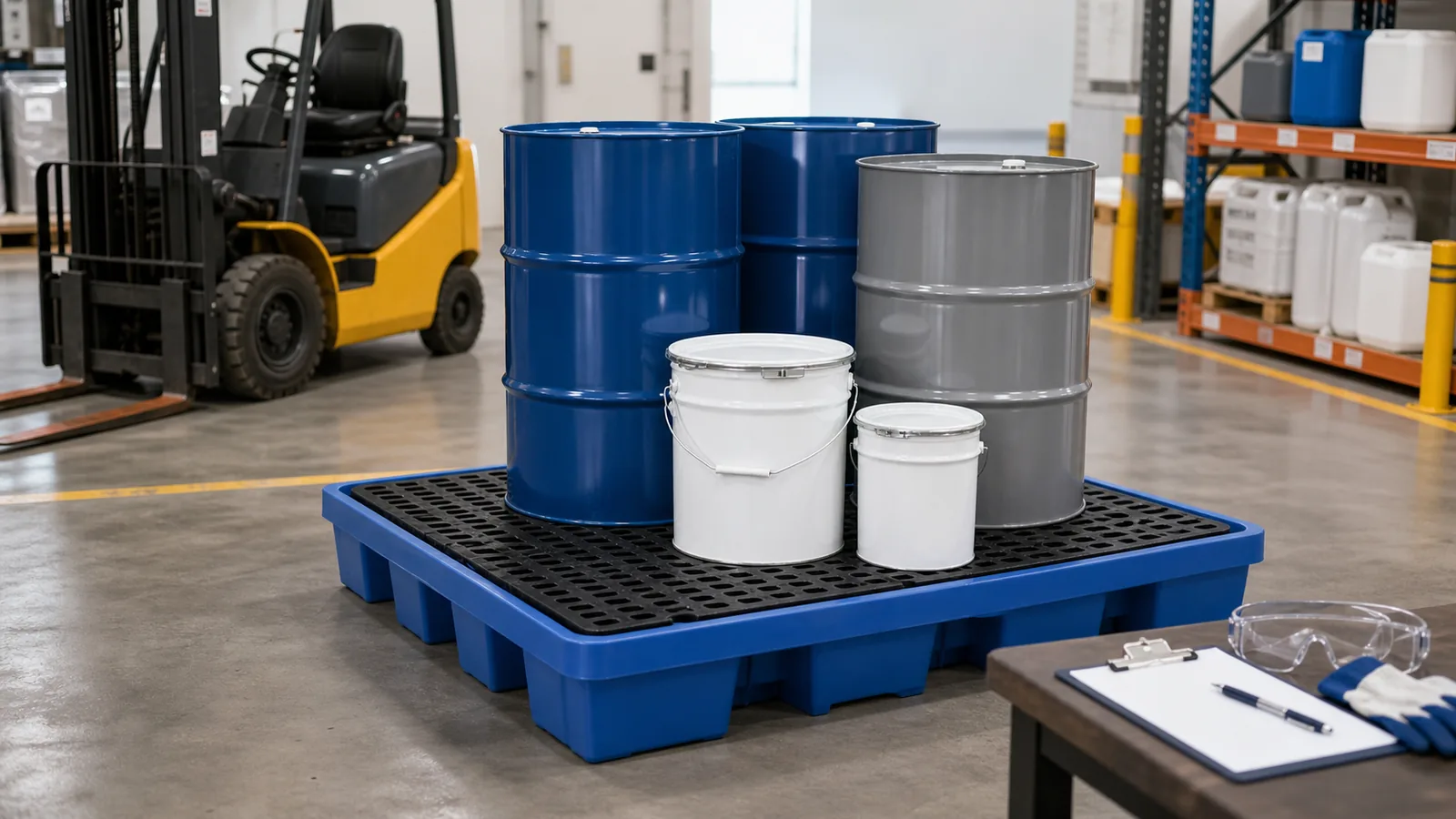
For operations that handle drums, liquids, or risk-zone storage, the chemical and spill-control handling page is a useful starting point. It frames chemical contact, containment, load type, and handling route as separate questions.
Do not treat HDPE or PP as a complete answer
HDPE and PP are common materials for plastic pallets, but the material name alone does not prove compatibility. Performance depends on the exact resin grade, additives, recycled content, colorant, molding quality, and exposure condition. The same chemical can behave differently at different concentrations or temperatures. Short contact and long immersion are also different conditions.
When reviewing a pallet, ask for the current material recommendation for the stated exposure. Avoid vague approvals such as:
Suitable for chemicals.
Use a more practical question:
Based on the listed chemicals, concentrations, temperature range, contact time, cleaning method, and expected handling route, which pallet material and structure does the supplier recommend, and what limitations should be recorded?
This does not transfer the buyer’s safety responsibility to the supplier. The buyer still needs EHS, quality, and process owners to confirm the site risk. It simply gives the supplier enough information to avoid guessing.
Separate chemical resistance from spill containment
Chemical resistance and spill containment are related, but they are not the same requirement.
A standard plastic pallet may carry sealed chemical cartons without needing a sump. A spill containment pallet may capture leaked liquid but still needs review for material compatibility, grate strength, cleaning access, and disposal procedures. A heavy-duty pallet may support drum loads but provide no secondary containment if a container leaks.
Use separate approval questions:
| Requirement | Approval question |
|---|---|
| Chemical compatibility | Will the pallet material and surfaces tolerate the expected contact without unsafe softening, cracking, swelling, odor, or residue retention? |
| Containment | Is leaked liquid expected, and is a sump or spill-control platform required by the site procedure? |
| Load support | Can the pallet support the container footprint under static, dynamic, stacking, or racking conditions? |
| Cleanability | Can the pallet be cleaned, inspected, dried, and returned to service after contact? |
| Safety control | Does EHS require segregation, grounding, labeling, PPE, or disposal rules? |
For drum storage and secondary containment, a product such as the 130130 spill containment pallet can help buyers visualize the difference between a load-carrying pallet and a sump-based containment product. Final suitability still depends on the actual liquid, container arrangement, handling frequency, and site rules.
Review where chemicals can hide on the pallet
Chemical exposure is not limited to the top deck. Liquids and residues often collect in the same areas that are hardest to inspect.
Check these zones on any sample:
- fork-entry lips and impact areas;
- underside ribs, runner channels, and leg pockets;
- anti-slip textures and edge lips;
- label recesses, barcode areas, RFID pockets, or molded logo zones;
- welded, plugged, or reinforced sections;
- contact points between nested or stacked pallets;
- damaged corners where liquid can wick into cracks or rough surfaces.
This matters because the first failure may not be structural. It may be a sanitation delay, odor complaint, unreadable label, slippery deck, or residue transfer onto packaging.
If pallets are washed after exposure, link the chemical review with post-wash release. The plastic pallet sanitation SOP for food warehouses and the drainage and drying guide provide useful controls for cleaning, inspection, and release after washdown.
Define exposure severity before testing
A useful test plan does not need to simulate every chemical in the facility. It should cover the substances and contact conditions that could realistically affect the pallet.
Define:
- chemical name or product group from the site’s approved list;
- concentration or dilution ratio;
- liquid temperature at contact;
- contact duration before cleanup;
- frequency of exposure per week or per cycle;
- whether the pallet is loaded during contact;
- whether exposure occurs on the deck, underside, runners, or label areas;
- cleaning method after exposure;
- acceptance criteria after drying and inspection.
For many operations, grouping exposures is practical. For example, one group may cover alkaline detergent washdown, another may cover oil residue, and another may cover a specific process liquid that creates higher risk. Do not mix chemicals during a pallet trial unless the site safety procedure explicitly allows that test.
The goal is not to prove that the pallet survives every possible liquid. The goal is to approve it for the defined route.
Test finished pallets, not only material samples
Material coupons can help with early screening, but they do not show how the finished pallet behaves. Molded ribs, textured surfaces, labels, reinforcement areas, and fork-entry damage all change the result.
A practical pallet exposure trial can include:
- Photograph and measure the sample pallet before testing.
- Apply the defined chemical exposure to the relevant zones.
- Hold for the agreed contact time under normal temperature conditions.
- Clean or rinse according to the site procedure.
- Let the pallet dry in the normal release position.
- Inspect for softening, tackiness, swelling, cracking, color change, odor, residue, or surface whitening.
- Check pallet dimensions, deck flatness, runner contact, label readability, and handling feel.
- Load and move the pallet through the normal forklift, pallet-jack, conveyor, or storage route if exposure is expected during actual use.
Repeat the trial after several exposure and cleaning cycles when pallets will be reused. A one-time splash test may not reveal cumulative surface damage, label failure, or retained odor.
If the pallet also needs to pass incoming control, extend the plastic pallet incoming inspection plan with chemical-exposure checkpoints such as material declaration, color consistency, label durability, surface condition, and quarantine rules for contaminated returns.
Include packaging and load behavior
The load can change the chemical risk. A sealed carton of chemical additives, a plastic drum, a metal pail, a flexible bag, and an IBC accessory do not contact the pallet in the same way.
Review:
- whether containers create point loads that stress softened surfaces;
- whether leaked liquid can spread under the first layer of cartons;
- whether stretch film traps liquid against the pallet deck;
- whether oily residue reduces friction under the load;
- whether powders or pigments become embedded in deck texture;
- whether a drum rim or pail base damages the deck after chemical contact;
- whether the pallet must be quarantined after any unknown leak.
Chemical compatibility is therefore not only a laboratory question. It is also a unit-load, handling, and cleaning question. If the load may shift because residue or cleaning film reduces friction, connect the review with the load shift prevention guide .
Treat flammable and hazardous areas as EHS-controlled projects
When exposure involves flammable liquids, solvent vapors, combustible dust, corrosive substances, oxidizers, or unknown returned chemicals, pallet selection should not be handled by procurement alone. The site EHS or safety team should define storage, segregation, grounding, ventilation, spill response, and disposal requirements.
In some chemical areas, static control may also matter. A spill-control pallet does not automatically control electrostatic discharge, and an anti-static pallet does not automatically provide containment. If the route includes ESD or ignition-risk questions, review the anti-static plastic pallet selection guide as a separate requirement.
Keep the responsibilities clear:
- the buyer defines the chemical list, use route, safety controls, and acceptance criteria;
- the supplier recommends suitable pallet materials and structures for the stated exposure;
- EHS confirms whether the pallet can be used in the actual risk zone;
- operations confirms whether the pallet can be cleaned, inspected, and controlled daily.
This prevents the pallet from being treated as a shortcut for a wider safety system.
Write chemical exposure into the RFQ
Short RFQ wording such as “chemical-resistant pallet required” is not enough. It invites broad claims and weak evidence.
Include:
- chemical names or product groups, with concentration where available;
- expected contact type: cleaning, residue, leak, storage, or return handling;
- maximum contact time before cleanup;
- temperature range during exposure and storage;
- whether the pallet carries sealed cartons, drums, pails, bags, or loose containers;
- whether spill containment is required separately from load support;
- cleaning method, detergent, sanitizer, rinse, and drying procedure;
- label, barcode, RFID, color-coding, or marking durability requirements;
- sample trial method and acceptance criteria;
- quarantine and disposal rule for unknown or severe contamination;
- change-control requirement for resin, additive, recycled content, color, or molding process.
A practical clause may read:
Supplier shall review the listed chemical exposure conditions before recommending pallet material and structure. Approval will be based on finished-pallet sample testing under the agreed concentration, temperature, contact time, cleaning method, and handling route. Supplier shall identify known limitations, and any material or additive change after approval must be declared before shipment.
This wording is more useful than a generic resistance claim because it connects the pallet to the actual route.
Build a simple rejection rule
Operators need a clear rule for what happens after chemical contact. Otherwise damaged or contaminated pallets return to circulation because no one owns the decision.
Reject or quarantine pallets when any of the following appear:
- unknown chemical contact;
- strong odor after cleaning and drying;
- tacky, softened, swollen, brittle, or cracked surfaces;
- visible residue in deck texture, fork openings, or underside cavities;
- unreadable labels or damaged traceability marks;
- slippery surfaces that affect product stability or forklift handling;
- deformation that changes stacking, nesting, conveyor, or rack behavior;
- chemical contact in a food, pharmaceutical, or clean zone without release approval.
The rule should be short enough for shift teams to use and formal enough for quality or EHS review. For reusable pallet pools, record the event against the pallet ID where traceability is available.
Practical decision rule
Approve plastic pallets for chemical exposure only when four conditions are met.
- The exposure is defined. The team knows the substance group, concentration, contact time, temperature, cleanup method, and frequency.
- The pallet structure is reviewed. Deck texture, runner cavities, labels, reinforcement, nesting, and cleaning access are checked for residue and damage risk.
- The finished pallet is tested. Approval is based on sample pallets exposed, cleaned, dried, inspected, and handled under realistic conditions.
- The control rule is written. Incoming inspection, change control, quarantine, rejection, and EHS responsibilities are clear.
Chemical compatibility is not a catalog adjective. It is a controlled fit between pallet material, pallet structure, the liquid or residue involved, and the way the warehouse responds after contact. When that fit is defined before purchase, the pallet program becomes easier to approve, inspect, and defend during daily operation.