Industry Insights
Spill Containment Pallets: Sump and Handling Checks
How to specify spill containment pallets for drums and liquid containers by checking sump capacity, chemical compatibility, load support, handling, and site rules.
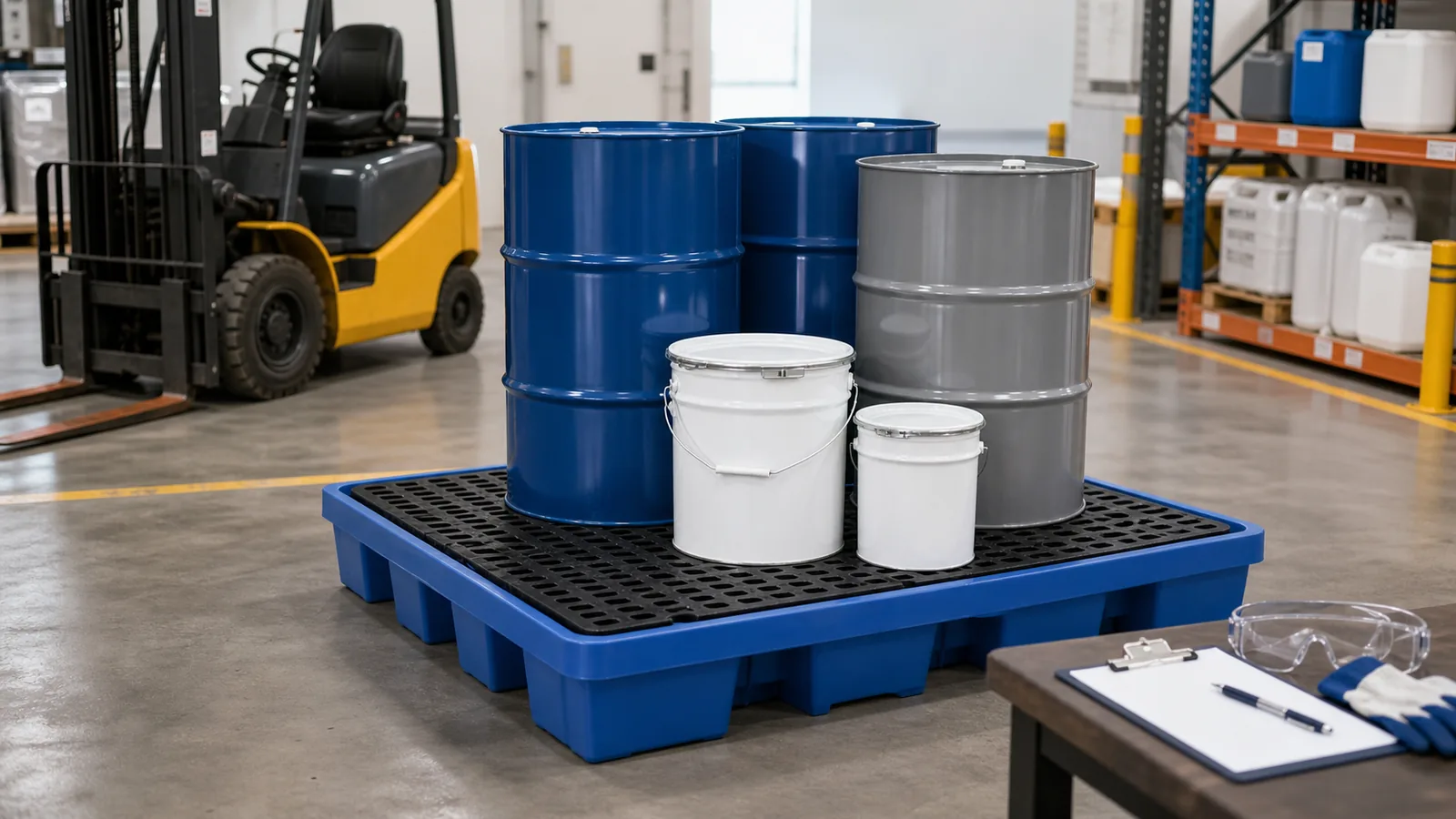
A spill containment pallet is not simply a stronger plastic pallet with a tray underneath. It should be specified only after the site knows what liquid may leak, which containers sit on the grate, how much liquid must be retained, who empties the sump, and whether local rules require a different control. For ordinary sealed goods, a standard pallet plus good housekeeping may be enough. When drums, pails, oils, cleaners, coatings, or process chemicals can leak, buyers should check the sump, grate load, material compatibility, forklift route, inspection access, and EHS procedure before purchase. Treat the catalog sump figure as a starting point, not as regulatory approval.
Start with the spill scenario, not the pallet shape
The first question is not “Do we need a spill pallet?” It is “What spill or drip condition are we trying to control?”
Write down the actual route:
- liquid name or product group, using the SDS or approved chemical list;
- container type, filled weight, base shape, and number per pallet;
- whether the risk is a slow drip, damaged closure, damaged drum, washdown residue, or transfer spill;
- where the pallet will sit: production, warehouse, dock, outdoor staging, or temporary quarantine;
- whether incompatible liquids, flammable liquids, food-area chemicals, or waste streams are involved;
- how quickly the site expects to detect, isolate, pump out, clean, and dispose of liquid in the sump.
Government and safety references usually treat containment as part of a broader control system, not as a standalone product claim. The U.S. EPA’s SPCC information is relevant for regulated oil facilities; the UK HSE’s HSG71 guidance addresses storage of packaged dangerous substances; and OSHA’s Hazard Communication materials remind buyers to work from labels and safety data sheets. Which rule applies depends on location, substance, quantity, use, and site procedure, so confirm with EHS before treating a pallet as compliant.
For a chemical handling route, also review the broader chemical and spill-control handling page . It separates containment, load support, material exposure, and handling into different approval questions.
What to confirm before comparing models
Use this checklist before asking suppliers for prices. It keeps the RFQ practical and prevents a buyer from selecting only by pallet footprint.
| Decision point | What to record before supplier approval |
|---|---|
| Liquid and hazard class | Product name, SDS, concentration, temperature, odor or residue concern, and any incompatibility with other stored liquids |
| Container pattern | Drum, pail, can, jerrycan, or small tank; filled weight; base ring, feet, chime, or corner pads; number of containers per pallet |
| Sump requirement | Site rule for retention volume, whether one container or several containers can leak, displaced volume from grate or supports, and whether rainwater or wash water can enter |
| Pallet material | HDPE, PP, or other material route; supplier limits for the actual liquid, concentration, contact time, and cleanup method |
| Grate and deck support | Grate load, local point-load support, deflection under filled containers, and whether containers rock or sit partly over unsupported openings |
| Handling route | Forklift, pallet jack, floor storage, stacking, transport, dock movement, or temporary quarantine route |
| Cleanout and inspection | How liquid is removed, whether the sump can be inspected, whether drain plugs are controlled, and when a pallet is quarantined or retired |
| EHS confirmation | Local regulation, fire code, waste disposal, segregation, labeling, PPE, and emergency response requirements |
For many ordinary sealed-carton goods, this table will show that a spill pallet is not the main control. For drums and liquid containers, it gives procurement enough detail to ask for the right product instead of buying a shallow tray with unknown limits.
Sump capacity is not the same as approval
Catalogs often list a sump volume. That number is useful, but it does not answer the whole containment question.
Confirm:
- whether the required retention volume is based on the largest container, total stored volume, a site rule, or a local legal requirement;
- whether the grate, containers, or internal supports reduce usable liquid volume;
- whether the pallet can remain level during normal use;
- whether outdoor staging could add rainwater before any leak occurs;
- whether mixed liquids must be kept apart instead of draining into one shared sump;
- how liquid will be removed without exposing workers to unnecessary splash or vapor risk.
Do not copy a capacity rule from another market or another facility. In one site, the spill pallet may be a temporary drip-control measure. In another, it may be part of a documented secondary-containment plan. That difference belongs in the RFQ and in the site’s operating procedure.
Check the grate as carefully as the sump
The sump captures liquid; the grate supports the load. Both matter.
Drums and pails often transfer weight through a narrow chime, molded foot, or bottom ring. A pallet can have enough total strength and still fail locally if the container footprint sits over weak grate sections. Before approving a spill pallet, load the real containers and look for rocking, grate deflection, local whitening, unstable corners, drain-plug interference, or forklift contact with the sump body.
If the load is heavy or has a small footprint, compare this review with the plastic pallet point-load guide . For category reference, a model such as the 130130 spill containment pallet shows the type of sump-and-grate structure buyers should evaluate, but the exact capacity, load, liquid, and site approval still need confirmation.
Match material compatibility to cleanup time
HDPE and PP are common spill pallet materials, but the material name alone does not prove chemical suitability. Concentration, temperature, contact time, additives, recycled content, and repeated cleaning all affect performance.
Ask the supplier to confirm the recommended material route for the actual liquid and cleanup window. A short drip that is cleaned within minutes is not the same as liquid standing in the sump over a weekend. A diluted detergent is not the same as solvent, oil, acid, alkali, or oxidizer exposure. If the route includes sanitizer, waste chemical, process liquid, or unknown returns, connect the review to the plastic pallet chemical compatibility guide .
Not recommended: using the same containment pallet for incompatible liquids because the footprint happens to fit. Segregation is an EHS decision, not a pallet-size decision.
Put the operating rule in the RFQ
A good RFQ clause is short but specific:
Spill containment pallets are intended for [container type and liquid group] in [location and route]. Supplier shall confirm material compatibility, grate support, sump volume, drain or cleanout method, forklift access, and limitations for the stated liquid, concentration, contact time, filled container weight, and handling method. Buyer will confirm local regulatory, fire, waste, and site EHS requirements before approval.
Then add acceptance checks:
- The supplier statement matches the exact pallet model, material, size, color, grate, and drain configuration.
- Filled containers sit flat on the grate without unstable rocking or local damage.
- Forklift movement does not strike, twist, or crack the sump body.
- The sump can be inspected and emptied by the site’s normal method.
- Labels, color coding, quarantine tags, or location controls support the site’s chemical segregation plan.
- After a sample spill or wet-cleaning trial, the pallet can be cleaned, dried, inspected, and returned to service or quarantined by a clear rule.
If the project has several pallet types, keep this clause beside the wider plastic pallet RFQ checklist so procurement, warehouse, and EHS teams work from the same approval record.
Practical decision rule
Use a spill containment pallet when the site has a defined drip or leak risk and can confirm four things: the liquid can be safely retained in that material, the sump volume matches the site’s requirement, the grate supports the filled containers, and the site has a written rule for inspection, cleanout, segregation, and disposal.
If one of those four items is missing, do not treat the pallet as approved. Either downgrade the use to ordinary sealed-goods handling, redesign the storage method, or ask EHS and the supplier for a narrower, documented approval route.