Industry Insights
Plastic Pallet Deck Support for Bagged Goods: How to Prevent Sagging, Punctures, and Unstable Loads
A practical guide for buyers handling flour, resin, fertilizer, chemicals, feed, and other bagged products on plastic pallets, with checks for deck openings, point pressure, wrapping, and sample validation.
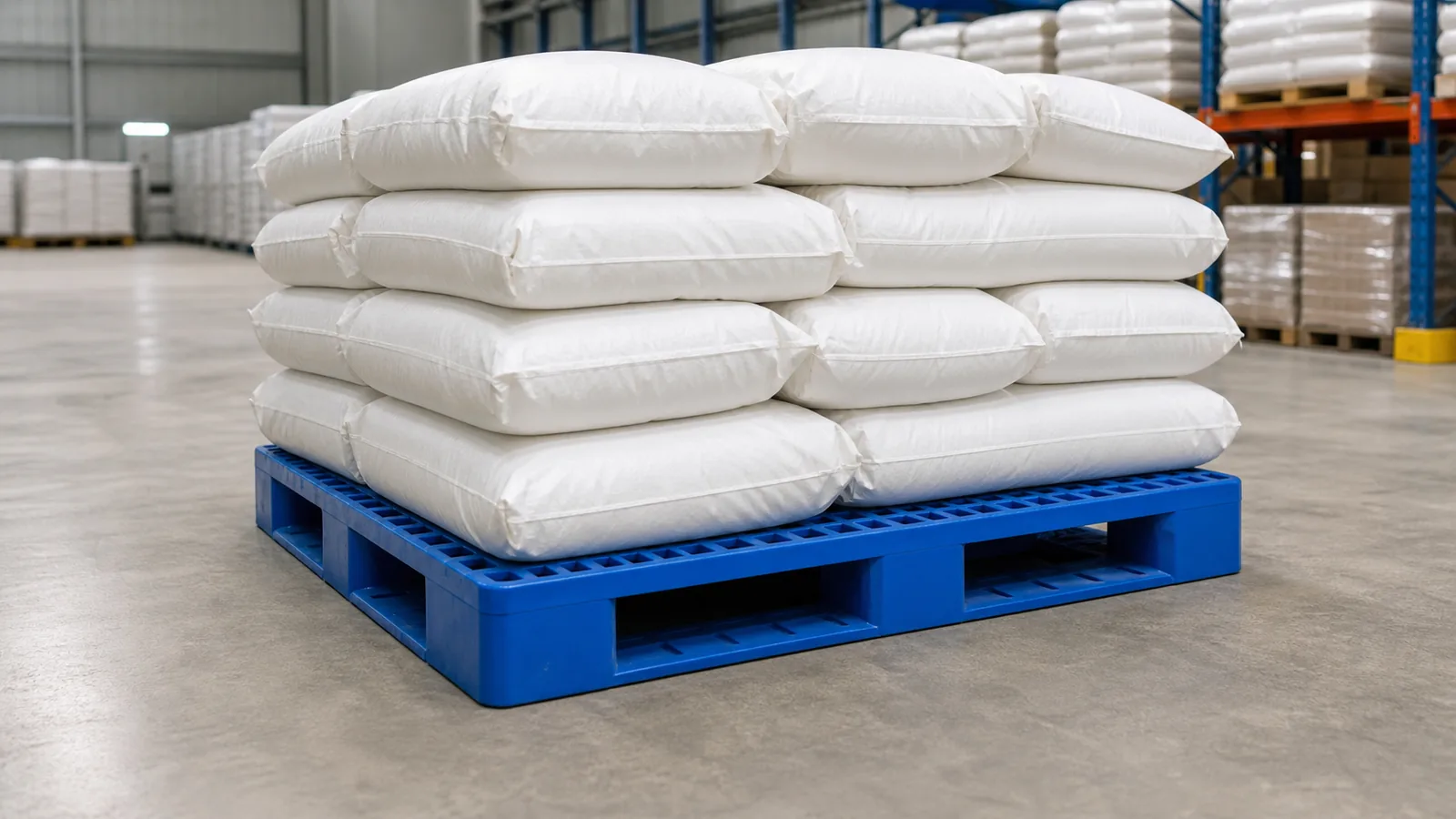
Bagged goods do not behave like cartons. A carton has defined edges and a relatively flat base. A filled bag settles, spreads, bridges across openings, and can press into deck gaps when the lower layers carry the weight of the stack.
This is why a plastic pallet that looks strong enough by static or dynamic load rating may still be a poor fit for sacks of flour, resin pellets, fertilizer, chemicals, animal feed, grain, minerals, or powdered ingredients. The visible problem may be bag sagging, punctures, unstable first layers, broken seams, powder leakage, or a wrapped pallet that slowly leans during storage.
The practical question is:
How should buyers specify plastic pallet deck support so bagged goods stay protected and stable during real handling, storage, and transport?
Start with the bag, not the pallet catalog
The pallet deck should be selected around the actual package. Two products with the same gross pallet weight can need very different deck support if one uses stiff woven sacks and the other uses soft paper bags filled with fine powder.
Before comparing pallet models, document:
- bag length, width, thickness, and filled shape;
- net weight per bag and bags per layer;
- whether the bag is paper, woven PP, PE film, laminated, or valve-packed;
- whether the product is granular, powdered, lumpy, frozen, oily, or moisture-sensitive;
- seam, valve, label, and weak-edge positions;
- stack pattern, layer count, and whether bags are interlocked;
- whether bags are manually loaded, robotically placed, or dropped from a short height;
- cleaning, cold room, outdoor, or washdown exposure;
- whether small leakage or surface marking creates a quality issue.
This information matters more than a generic “one-ton pallet load” statement. The lower layer of bags may see local pressure from deck ribs, edges, and openings. If the bag material is thin or the product flows easily, the pallet surface becomes part of the packaging system.
Check deck openings and rib support under the first layer
Open-deck plastic pallets can work well for many bagged products, especially when the bags are firm, the stack pattern is stable, and the deck ribs give enough support. The risk appears when soft bags bridge across wide openings and then sink into them under stacked weight.
During sample review, look at the underside impression of the first layer after the pallet has been loaded for the normal dwell time. If the bag shows deep rib marks, stretched film, seam pressure, or product settling into openings, the deck may not be providing enough support.
Key checks include:
| Deck support input | What to verify |
|---|---|
| opening size and spacing | bags should not sag deeply between ribs under normal stack weight |
| rib width and edge radius | contact points should not create sharp pressure lines or puncture risk |
| deck flatness | warped surfaces can concentrate pressure on a small number of ribs |
| usable deck area | bags should sit inside supported zones, not across weak perimeter areas |
| drainage or ventilation holes | helpful in some lanes, risky when fine powder or soft bags settle into them |
| deck texture | should support grip without scuffing or cutting the bag surface |
The goal is not always a fully closed deck. The goal is enough continuous support for the actual bag and stack pattern.
Choose deck style by risk, not by label
Terms such as “open deck”, “ventilated deck”, “closed deck”, and “smooth deck” are useful, but they do not decide the application by themselves.
An open-deck pallet may be suitable when:
- bags are firm and do not sag between ribs;
- ventilation or drainage is useful;
- the product is dry and fully sealed;
- the bag footprint aligns well with the deck ribs;
- weight, washing, or return logistics favor a lighter structure.
A closed or smoother deck may be worth reviewing when:
- bags contain fine powder or product that shifts easily;
- bag material is thin, paper-based, or puncture-sensitive;
- the first layer shows rib marks or local stretching;
- hygiene teams need faster visual inspection;
- small leakage creates contamination or allergen-control issues;
- the load includes small cartons, pails, or mixed packaging in addition to bags.
For a deeper comparison of smooth surfaces, see the guide to closed-deck plastic pallet selection . A smooth-deck model such as the 1210 food and medical plastic pallet can be reviewed as a reference for continuous top support, but final suitability still depends on bag weight, stack height, handling equipment, cleaning method, and storage conditions.
Do not let the edge lip become a pressure point
Edge lips can help cartons and crates stay inside the pallet footprint, but bagged goods need more care. A raised lip may keep the first layer aligned during wrapping, or it may press into soft bag edges and create a weak point after storage.
Use an edge lip only after checking:
- whether bags sit against the lip or slightly inside it;
- whether the lip contacts seams, valves, or folded corners;
- whether workers can load bags without dragging them over the lip;
- whether stretch film pulls lower bags into the lip during wrapping;
- whether the lip traps powder, broken bag fibers, or moisture;
- whether automated loading equipment can place bags accurately enough.
If the main problem is sliding or migration, an edge lip may help. If the main problem is bag sagging into deck openings, the lip is not the primary correction. The plastic pallet anti-slip design guide explains how edge lips, deck texture, and inserts should be matched to the actual movement pattern.
Keep the first layer inside supported pallet zones
Bagged loads often fail at the first layer. If the first layer is not supported, every layer above it amplifies the problem.
Review the stack pattern on the actual pallet size:
- Do bags overhang the pallet edge after settling?
- Do bag corners land over deck openings?
- Are seams or valves placed over ribs, gaps, or lips?
- Does the interlock pattern push outer bags beyond the usable deck area?
- Does the wrapped load pull lower bags outward?
- Does the stack height cause the lower bags to flatten more than expected?
Small overhang can look harmless at loading time and become a quality issue after storage, vibration, or truck transport. For export and distribution lanes, keep the bag footprint inside the supported deck unless the route has been validated for a controlled overhang.
If the operation is also trying to reduce movement during shipping, connect this deck review with the broader plastic pallet load shift prevention guide . Bag support and transport stability should be validated together because a soft lower layer can make the entire wrapped load less predictable.
Consider hygiene, leakage, and cleaning together
Bagged products are often dry, but dry does not mean low risk. Flour, starch, milk powder, mineral powder, resin pellets, fertilizer, and chemical granules can leave residue when a bag scuffs or leaks. The pallet deck affects how easy that residue is to see and remove.
For food, feed, pharmaceutical, or chemical operations, review:
- whether powder can collect inside open deck cavities;
- whether bag fibers catch on sharp ribs or damaged edges;
- whether cleaning water drains fully after washdown;
- whether a smoother deck becomes slippery when wet;
- whether color coding is needed for allergen, food-contact, chemical, or return zones;
- whether damaged-bag inspection is part of receiving or release.
A closed deck may make residue easier to inspect, but it still needs drainage and drying controls. An open deck may dry faster, but it may also hide powder in rib cavities. The right answer depends on the product, cleaning method, and inspection standard.
Check handling equipment before approving the top deck
Deck support is only one part of pallet suitability. The bottom structure still has to work with forklifts, pallet jacks, conveyors, racks, and stacking methods.
For bagged goods, pay special attention to:
- fork entry that does not shake or drag the lower bags;
- pallet jack wheels that do not make the pallet flex sharply under load;
- conveyor rollers that do not push unsupported bags into deck openings;
- rack beam support if loaded pallets will be stored in racks;
- empty pallet stacking or nesting if return logistics are important;
- cold-room or outdoor exposure that changes material impact behavior.
Do not approve a smoother top deck if the base structure creates a new handling problem. For racked storage, confirm the racking load under the actual beam span, load distribution, temperature, and storage duration rather than relying only on a catalog number.
Validate with the worst normal bag
A reliable sample test uses the product that is hardest for the pallet to support, not the average SKU.
Before bulk ordering, run a practical validation:
- Load the pallet with the real bag type, filled to normal weight.
- Use the normal first-layer pattern and maximum approved layer count.
- Apply the normal stretch-wrap or strapping method.
- Store the pallet for the normal dwell time.
- Move it through the actual forklift, pallet jack, dock, and staging route.
- If transport is part of the lane, include the normal truck or container handling condition.
- Inspect the bottom-layer bags for rib marks, punctures, seam pressure, leakage, and outward movement.
- Inspect the pallet for deck deflection, sharp contact points, cracks, whitening, and retained residue.
Take photos before loading, after wrapping, after storage, and after handling. The purpose is to separate pallet support issues from wrapping, stacking, or operator issues. This validation can be added to a broader plastic pallet load testing plan before bulk orders so strength, handling, and product protection are approved in one process.
Write bag-support requirements into the RFQ
Vague wording such as “suitable for bagged goods” gives suppliers too little information. A useful RFQ should describe the bag, stack, route, and acceptance criteria.
Include:
- bag dimensions, material, and net weight;
- product type and whether it flows, settles, freezes, or absorbs moisture;
- bags per layer, layer count, pallet gross load, and stack pattern;
- required pallet footprint and whether overhang is allowed;
- preferred deck style, support area, and restrictions on sharp ribs or openings;
- whether an edge lip is required, optional, or prohibited;
- cleaning, leakage, powder, allergen, chemical, or color-segregation requirements;
- forklift, pallet jack, conveyor, rack, and transport conditions;
- sample quantity and test route;
- pass/fail rules for bag sagging, punctures, leakage, load movement, and pallet damage.
A practical clause may read:
Pallets must support filled bagged goods without unacceptable sagging into deck openings, bag puncture, seam pressure, leakage, or load instability under the buyer’s normal stacking, wrapping, storage, handling, and transport conditions. Supplier samples must be validated with the actual bag size, fill weight, layer pattern, and handling route before bulk approval.
This wording gives the supplier enough context to recommend a deck structure rather than guessing from load weight alone.
Practical decision rule
Approve a plastic pallet for bagged goods only when four conditions are clear:
- The bag behavior is known. Filled shape, material, seam position, settling, and puncture sensitivity have been reviewed.
- The deck gives enough support. Openings, ribs, texture, lip design, and usable deck area do not damage or distort the lower layer.
- The load stays inside the supported footprint. Stack pattern, wrapping, and handling do not push bags beyond reliable support zones.
- The trial reflects real operation. Testing includes the worst normal bag, full stack height, normal dwell time, and actual handling route.
For bagged goods, the best plastic pallet is not simply the pallet with the highest load rating. It is the pallet whose deck supports soft packaging consistently, protects the lower layer, and keeps the wrapped unit load stable through the complete warehouse and transport cycle.