Industry Insights
Plastic Pallet Cold Room Transitions: How to Control Condensation, Ice, and Handling Risk
A practical guide for cold-chain warehouses on managing plastic pallets that move between freezer, chilled, and ambient zones without creating moisture, ice, hygiene, or handling problems.
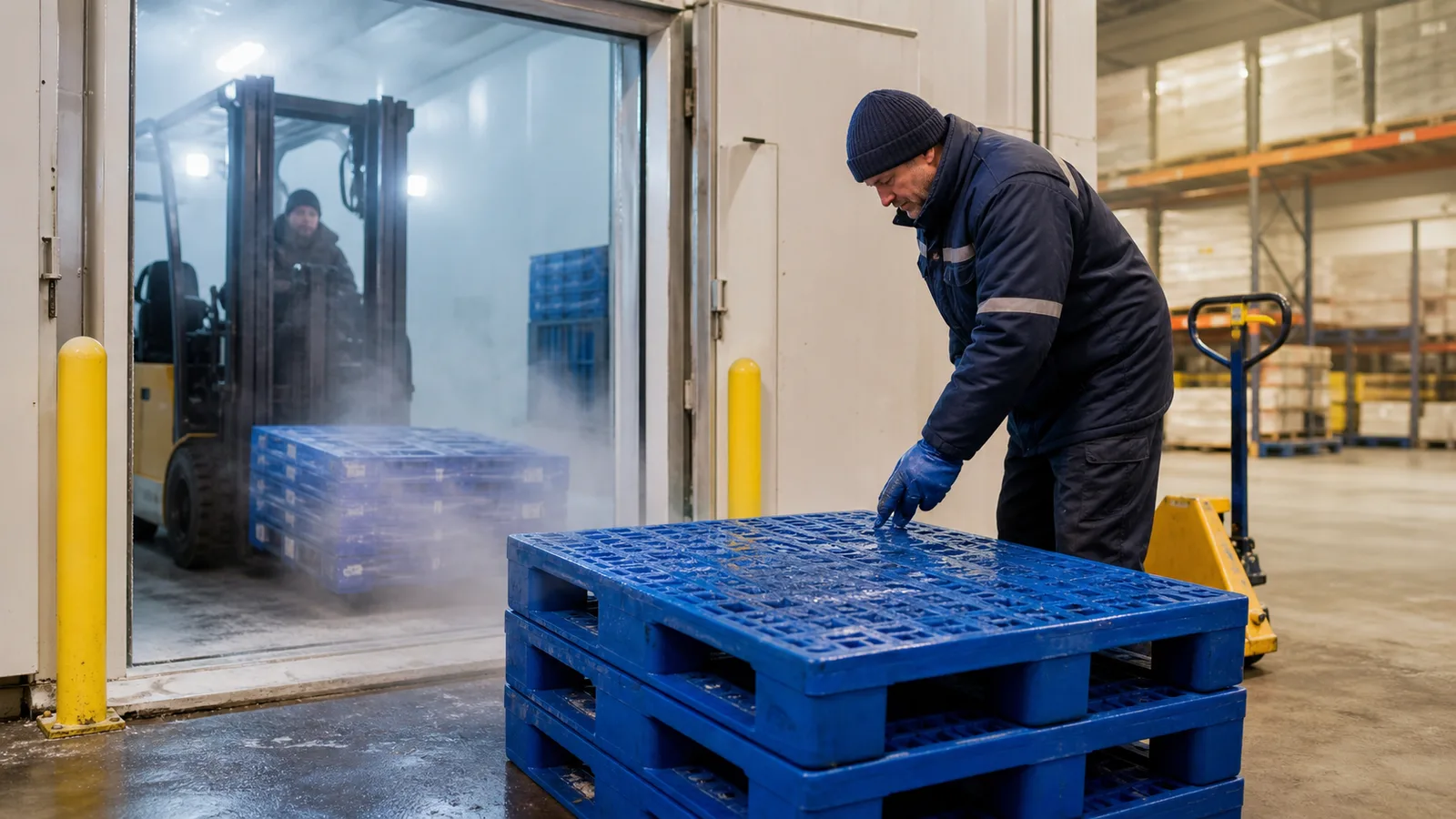
A plastic pallet may perform well inside a freezer and still cause problems at the doorway. Many cold-chain failures happen during transition, not during steady storage. A pallet moves from a freezer to a warmer staging lane, waits near a dock, enters a chilled room, or returns to ambient cleaning. Moisture appears on the deck, water collects in underside ribs, labels soften, surfaces become slippery, and ice can form when the pallet returns to low temperature.
For procurement and warehouse teams, the practical question is:
How should plastic pallets be specified and controlled when they repeatedly move between frozen, chilled, and ambient zones?
This is not only a material question. It is a route, timing, drainage, hygiene, and inspection question.
Map the temperature route before approving the pallet
Cold-chain pallet selection often starts with the lowest temperature. That matters, but it does not describe the whole route. A pallet may experience several zones in one cycle:
- frozen storage;
- cold-room picking;
- door-zone staging;
- ambient dock loading;
- trailer dwell time;
- washdown or sanitation;
- empty return storage;
- re-entry into the freezer.
The transition between zones creates the moisture risk. Warm, humid air can condense on cold pallet surfaces. If the pallet then returns to a freezer, that moisture can become ice. The result may be slip risk, blocked drainage points, label failure, frozen debris, or a pallet that no longer sits flat on the floor.
Before bulk purchase, document the actual route. Include the lowest temperature, highest ambient temperature, humidity exposure, door dwell time, number of daily transitions, whether pallets are loaded or empty during transition, and how long they wait before returning to cold storage.
For pallet material and low-temperature strength decisions, use a dedicated freezer specification process. The freezer-grade plastic pallet selection framework is useful for defining resin, reinforcement, rack span, and cold impact requirements. The transition review should then add moisture and ice controls.
Separate condensation risk from freezer strength
Freezer strength and condensation control are related, but they are not the same approval.
A pallet can be strong enough for low-temperature handling while still retaining water in molded cavities. Another pallet may drain well but lack the stiffness or impact resistance needed for freezer racking. Treat both questions separately:
| Question | What to check | Typical evidence |
|---|---|---|
| Low-temperature performance | material toughness, impact behavior, deflection, rack support | supplier data, sample trial, cold-room pilot |
| Condensation control | deck drainage, underside pockets, surface texture, drying time | transition trial, moisture inspection, cleaning check |
| Handling safety | slip risk, fork entry, pallet jack movement, ice at contact points | operator trial on the real route |
| Hygiene control | retained water, dirt, odor, clean-zone release | sanitation SOP and inspection record |
This distinction helps prevent a common mistake: approving a “freezer pallet” based only on temperature claims while ignoring what happens at the freezer door.
Identify where moisture actually collects
Moisture rarely appears evenly across a pallet. It gathers where the structure traps it or where airflow is poor. Inspect both the top and bottom of the pallet after a real transition.
Check:
- deck recesses, anti-slip textures, and label areas;
- edges and lips where stretch wrap or cartons may hold moisture;
- fork-entry corners and underside ribs;
- runner channels, leg pockets, and molded cavities;
- contact points between nested pallets;
- rubber inserts or anti-slip plugs, if used;
- barcode, RFID, or printed identification surfaces.
Closed-deck pallets may be easier to clean in some hygiene programs, but the actual drainage and drying time still need verification. Open-deck pallets may shed water faster in some positions, but may also expose product to airflow, debris, or sanitation requirements that do not fit every application.
If pallets are washed before returning to the cold room, link the transition review with the plastic pallet drainage and drying guide . A pallet that is clean but still wet can create operational trouble when it returns to freezing conditions.
Control door-zone dwell time
The area near a freezer door is usually the worst place for uncontrolled pallet staging. Door openings, warm air, traffic congestion, and wet floors all combine there.
Define a dwell rule for pallets waiting near cold-room doors:
- maximum time for empty pallets before they must move to the next zone;
- maximum time for loaded pallets before wrapping, loading, or re-entry;
- where pallets may stand without blocking airflow, door seals, or emergency routes;
- whether pallets may be stacked near the transition zone;
- when a pallet must be dried, cleaned, or quarantined before entering the freezer again.
The rule does not need to be complicated. It needs to be visible enough that operators can follow it during busy loading windows.
Avoid treating door-zone waiting as neutral time. A 10-minute pause during normal operation may be harmless. Repeated 60-minute delays in humid dock conditions can create a very different result.
Check slip behavior with water and frost present
Anti-slip deck design is often discussed only in relation to carton stability. In cold-chain transitions, the more useful question is how the pallet behaves when moisture or light frost is present.
Review slip risk in three places:
- between product and pallet deck;
- between pallet base and floor;
- between fork or pallet-jack contact points and the pallet structure.
Moisture can reduce friction on smooth decks. Ice can make textured surfaces unpredictable. Rubber inserts can help in some dry handling conditions, but they should be checked after repeated exposure to cold, water, cleaning chemicals, and abrasion.
Test the actual load. Cartons, plastic crates, frozen blocks, pails, and bagged product do not behave the same way. A wrapped unit load may remain stable while an unwrapped picking load slides during a turn.
For loads that already need edge lips, anti-slip surfaces, or special deck features, connect the cold-chain review with the anti-slip and edge-lip selection guide . The goal is not maximum grip in a catalog photo; it is predictable handling through the real transition route.
Prevent ice from hiding damage
Ice can cover early damage and make inspection less reliable. A small crack near a fork-entry corner, a chipped runner edge, or a distorted rib may be hard to see if moisture freezes around it.
After repeated cold-room transitions, inspect:
- fork-entry lips and impact zones;
- underside runners and corners;
- deck flatness after thawing;
- whitening, cracks, and brittle edges;
- frozen dirt, packaging fragments, or product residue;
- blocked drain points;
- barcode, RFID, and label readability.
Do not judge the pallet only while it is frozen. Some deformation, retained water, or label damage becomes clearer after the pallet returns to ambient temperature. If the pallet pool moves through both cold and ambient zones, the inspection standard should include both states.
The plastic pallet inspection and retirement criteria can be extended with cold-transition defects, including ice retention, repeated wet return, unreadable identification, and cracks that appear after thawing.
Keep hygiene release separate from visual dryness
A pallet can look dry enough for handling but still be unsuitable for a hygiene-controlled area. Moisture held inside ribs or between nested surfaces can carry residue, odor, dust, or microorganisms into a clean workflow.
For food, beverage, pharmaceutical, or clean manufacturing routes, define a release step that is more specific than “looks dry.” Depending on the site, this may include:
- separation of clean pallets and dirty returns;
- defined drying position and minimum drain time;
- inspection under the deck and inside runner areas;
- rejection of pallets with odor, residue, standing water, or damaged surfaces;
- documented cleaning method before re-entry to production;
- quarantine for pallets returning from uncontrolled docks or trailers.
Do not mix wet clean pallets with outdoor or dock returns. Once clean pallets are staged in an uncontrolled area, the site may need to treat them as returned equipment rather than ready-to-use equipment.
For food and beverage routes, the plastic pallet sanitation SOP for food warehouses provides a practical structure for cleaning, release, and documentation.
Review labels, RFID, and color coding under moisture cycles
Cold-chain transitions are hard on identification systems. Moisture can soften adhesive labels, frost can obscure barcodes, condensation can reduce scan reliability, and repeated cleaning can damage printed areas.
If the pallet program uses barcode labels, RFID, molded logos, serial numbers, or color coding, include these in the transition trial.
Check:
- scan performance when the pallet is cold and when condensation is present;
- label adhesion after freezing, thawing, and cleaning;
- whether identification remains readable after abrasion at fork-entry points;
- whether color coding remains clear when pallets are wet or frosted;
- whether RFID position is protected from impact and moisture retention.
Traceability controls are only useful when they survive the route. If identification is important for food safety, pool control, customer returns, or asset loss reduction, the marking method should be tested as part of the pallet approval, not added later.
Match pallet structure to the transition route
Different pallet structures handle moisture and cold transitions differently.
Open-deck nestable pallets may drain quickly and save space for empty return, but nested surfaces can hide moisture. They are better suited when loads are moderate, racking is not required, and empty pallets can be separated or dried before cold re-entry.
Three-runner rackable pallets may suit freezer racking and forklift flows, but underside runner channels and reinforcement areas should be checked for water retention and ice buildup.
Closed-deck hygienic pallets may support cleanability and product separation, but deck drainage, drying time, and surface slip should be tested with the actual load and cleaning method.
Steel-reinforced pallets need extra review if water can enter or remain around reinforcement zones. The supplier should confirm the structure, sealing approach, and suitability for repeated cold and moisture cycles.
For cold-chain applications that include racking, review moisture control together with rack support, span, load distribution, dwell time, and temperature. A pallet that drains acceptably on the floor still needs separate approval for rack use.
Build a cold-transition sample trial
A useful trial does not require a large pilot at first. It requires the real route.
Use this sequence:
- Load the pallet with the heaviest normal product or the most moisture-sensitive product.
- Place it in the freezer or cold room long enough to reach normal operating condition.
- Move it through the actual door, staging lane, dock, or picking route.
- Record dwell time in the warmer zone.
- Inspect condensation on the deck, underside, labels, and runner areas.
- Return the pallet to cold storage if that reflects normal operation.
- Check for ice buildup, blocked drainage, slip behavior, and handling problems.
- Let the pallet return to ambient temperature and inspect again for cracks, deformation, retained water, odor, and label damage.
Run the trial with the equipment used in daily operation: forklift, pallet jack, conveyor, wrapper, or loading dock. Operator feedback matters because small handling delays at the transition point can become daily congestion.
Write transition conditions into the RFQ
RFQ wording should make the route clear enough for the supplier to recommend a suitable pallet and for the buyer to approve it responsibly.
Include:
- freezer, chilled, and ambient temperature ranges;
- expected humidity or wet-floor conditions;
- number of zone transitions per day or per cycle;
- loaded or empty transition condition;
- maximum door-zone dwell time;
- cleaning, washing, or sanitation method;
- required drainage or drying expectation;
- load type, footprint, and wrapping condition;
- handling equipment used at each zone;
- racking, stacking, nesting, or floor-storage requirement;
- barcode, RFID, label, or color-coding durability requirement;
- sample trial and pass/fail criteria.
A practical clause may read:
Pallets will move repeatedly between freezer storage, chilled staging, and ambient dock areas. Supplier shall confirm suitability for the stated temperature transitions and identify any limitations related to condensation, ice formation, drainage, cleaning, labeling, and handling. Final approval will be based on sample performance after loaded cold storage, ambient dwell, cold re-entry, and inspection after thawing.
This wording avoids relying on a broad “cold-chain suitable” claim. It asks for the specific conditions that create most transition problems.
Practical decision rule
Approve cold-chain pallets by route, not only by temperature.
If pallets remain inside one stable freezer zone, focus on low-temperature toughness, rack support, and impact control.
If pallets move repeatedly through doors, docks, chilled rooms, wash areas, and ambient return loops, add condensation, drainage, ice, label durability, hygiene release, and door-zone dwell rules.
Do not let a pallet pass because it looks acceptable when frozen and dry. Check it after moisture exposure, after re-freezing, after thawing, and after real handling.
The right plastic pallet for cold-room transitions is not just the pallet that survives low temperature. It is the pallet that stays cleanable, identifiable, drainable, inspectable, and safe to handle through the complete cold-chain route.