Industry Insights
How to Specify Plastic Pallets for Freezer Warehouses: A Practical Framework for -25°C to -18°C Operations
A procurement and operations guide to selecting plastic pallets for freezer environments, with material checks, impact-risk controls, and implementation standards for cold-chain warehouses.
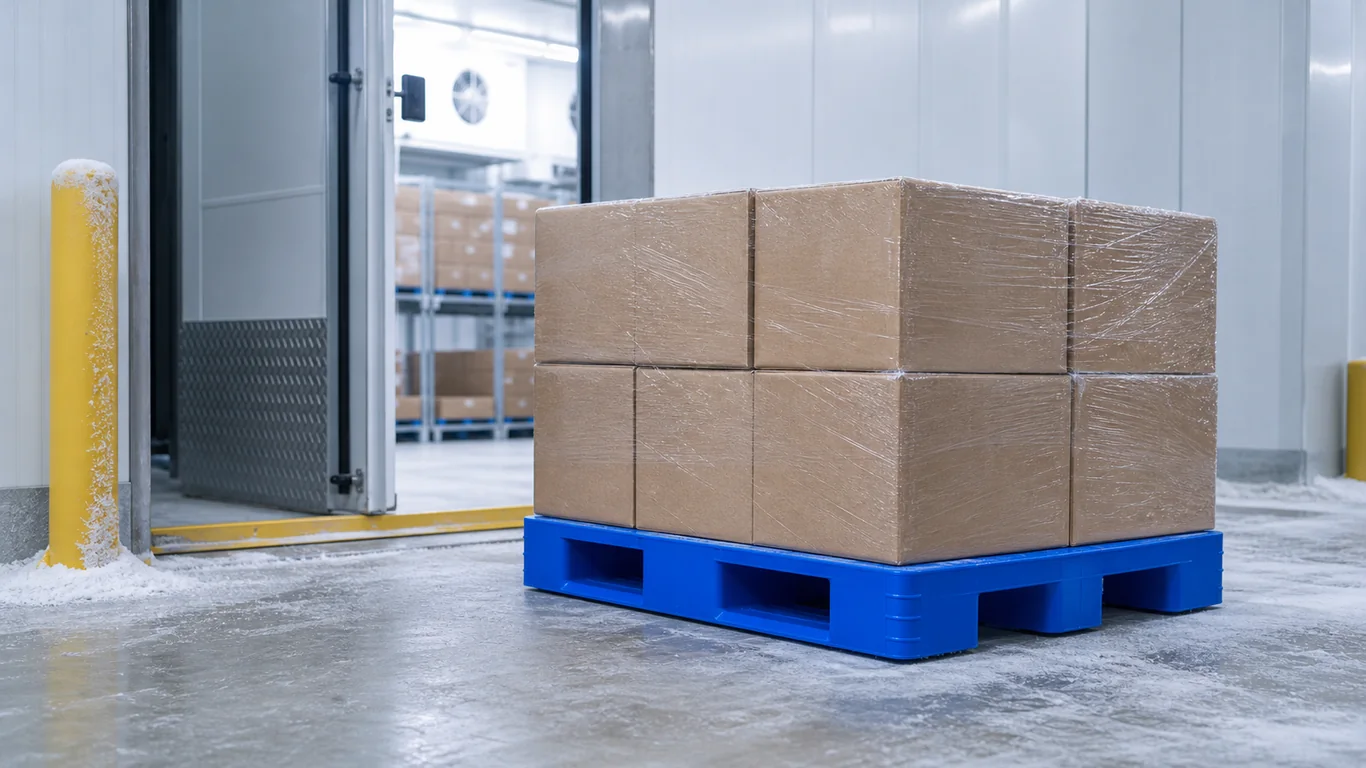
Freezer warehouses create a very different failure pattern from ambient facilities. Teams that run reliably at room temperature often see sudden pallet cracking, deck brittleness, or forklift-impact damage once operations move to -25°C to -18°C.
For procurement and warehouse leaders, the key question is not “plastic or wood.” It is this:
Which pallet specification keeps structural performance stable in low-temperature handling, racking, and multi-shift throughput?
This guide provides a decision framework you can use before RFQ, pilot, and full rollout.
1) Why freezer conditions change pallet behavior
In cold-chain environments, three forces combine:
- Lower material ductility under sub-zero temperatures;
- Higher impact sensitivity during fast forklift handling;
- Longer dwell time in racking, where deflection accumulates over repeated cycles.
A pallet that passes basic ambient tests may still underperform in freezer lanes if the material formulation, reinforcement layout, and handling rules were not designed for low-temperature use.
That is why many cold-chain projects should define pallet specs by temperature zone, not by a single “site-wide standard.”
2) Material selection: what buyers should lock first
HDPE is often the baseline for freezer applications
In many freezer projects, HDPE-based pallets are preferred because they generally maintain better toughness at low temperature than brittle blends. But “HDPE” alone is not a complete requirement.
Ask suppliers to declare:
- Virgin/recycled ratio and consistency policy;
- Any impact-modifier strategy used for low-temperature performance;
- Batch traceability and lot coding;
- Documented low-temperature test conditions.
For hygiene-controlled sectors, align material controls with your food safety system requirements (for example, HACCP-based facility controls and management standards such as ISO 22000 ).
Avoid broad claims without test context
Statements like “freezer safe” are not enough. Require temperature-specific test context and pass/fail criteria, not catalog wording.
3) Structural design rules for freezer lanes
A. Match structure to storage behavior
- Frequent racking exposure: start with rack-capable structures (for example, 3-runner pallets ) and evaluate steel reinforcement by beam span.
- Floor-heavy staging with export movement: lighter nine-leg options may fit some lanes if load profile and impact risk are controlled.
B. Specify reinforcement by geometry, not by keyword
Use measurable RFQ language:
- Number of steel tubes;
- Tube position (deck/base/both);
- Tube orientation;
- Tube dimensions;
- Expected deflection limit under your rack span.
If your team needs a structured format, adapt this plastic pallet RFQ checklist and add a dedicated freezer-test section.
C. Treat beam span as a hard input
Freezer pallets are still subject to normal mechanics. A span increase from 900 mm to 1100 mm can materially change deflection and fatigue behavior under the same payload.
4) The freezer risk matrix procurement teams can use
Before approval, review each lane against four risk categories:
1) Temperature risk
- Continuous setpoint (e.g., -25°C, -20°C, -18°C)
- Door-zone fluctuation and condensation cycles
- Time outside freezer during loading/unloading
2) Load risk
- Typical vs peak payload
- Uniform cartons vs point loads (meat blocks, dense cartons, partial footprints)
- Stretch-wrap tension and top-load pressure
3) Handling risk
- Forklift speed and turn behavior on cold floors
- Collision frequency at rack entrance points
- Shift intensity and touch count per pallet per day
4) Hygiene and compliance risk
- Washdown chemicals and sanitation frequency
- Odor or contamination control requirements
- Audit traceability for lot/batch identification
A lane with high scores in two or more categories should be treated as an engineering-spec project, not a standard commodity purchase.
5) What to test in a 60–90 day freezer pilot
A freezer pilot should capture cold-specific indicators, not only generic damage rate.
Track weekly:
- Pallet crack initiation points (deck, runner, entry lip);
- Impact events during forklift entry;
- Rack deflection drift over time;
- Handling interruptions caused by deformation;
- Product damage linked to pallet instability;
- Washdown and hygiene non-conformance events.
For execution structure, use a staged method similar to this 90-day pilot framework while adding temperature-zone control and cold-shift observation windows.
6) Common freezer mistakes that increase total cost
Mistake 1: Buying on room-temperature performance data
Ambient data cannot replace low-temperature validation.
Mistake 2: Mixing different stiffness classes in the same rack lane
Uneven deflection behavior creates avoidable instability and operator uncertainty.
Mistake 3: Using one pallet architecture for all cold-chain lanes
Blast-freezer staging, long-rack storage, and outbound cross-dock do not share the same mechanical profile.
Mistake 4: Ignoring forklift operating discipline
Even strong pallets fail early when high-speed impacts become routine in low-visibility cold environments.
7) Implementation checklist for cross-functional teams
Before mass purchase, align these owners and deliverables:
- Procurement: lock temperature-specific RFQ clauses and acceptance criteria;
- Warehouse operations: define lane-level use rules (rack vs floor vs transit);
- Quality/EHS: define hygiene checks and incident thresholds;
- Supplier engineering: provide test evidence under declared freezer conditions;
- Finance: evaluate total cost including damage, delays, and replacement cycles.
If your network also includes export lanes, combine this freezer framework with your border-compliance workflow using the ISPM 15 export decision guide .
Final takeaway
Freezer pallet selection is a low-temperature reliability decision.
Teams that define material controls, reinforcement geometry, rack span, and handling discipline before purchasing usually achieve lower disruption and more stable lifecycle cost.
In cold-chain warehousing, the right pallet is not the cheapest unit on paper. It is the one that keeps performance predictable at temperature, at speed, and under real load.