Industry Insights
Automation-Ready Plastic Pallets: A Specification Checklist for Conveyors, AS/RS, and High-Throughput Warehouses
A practical buyer guide to specifying plastic pallets for automated conveyor and AS/RS environments, including dimensional control, bottom-deck design, deflection limits, and pilot validation steps.
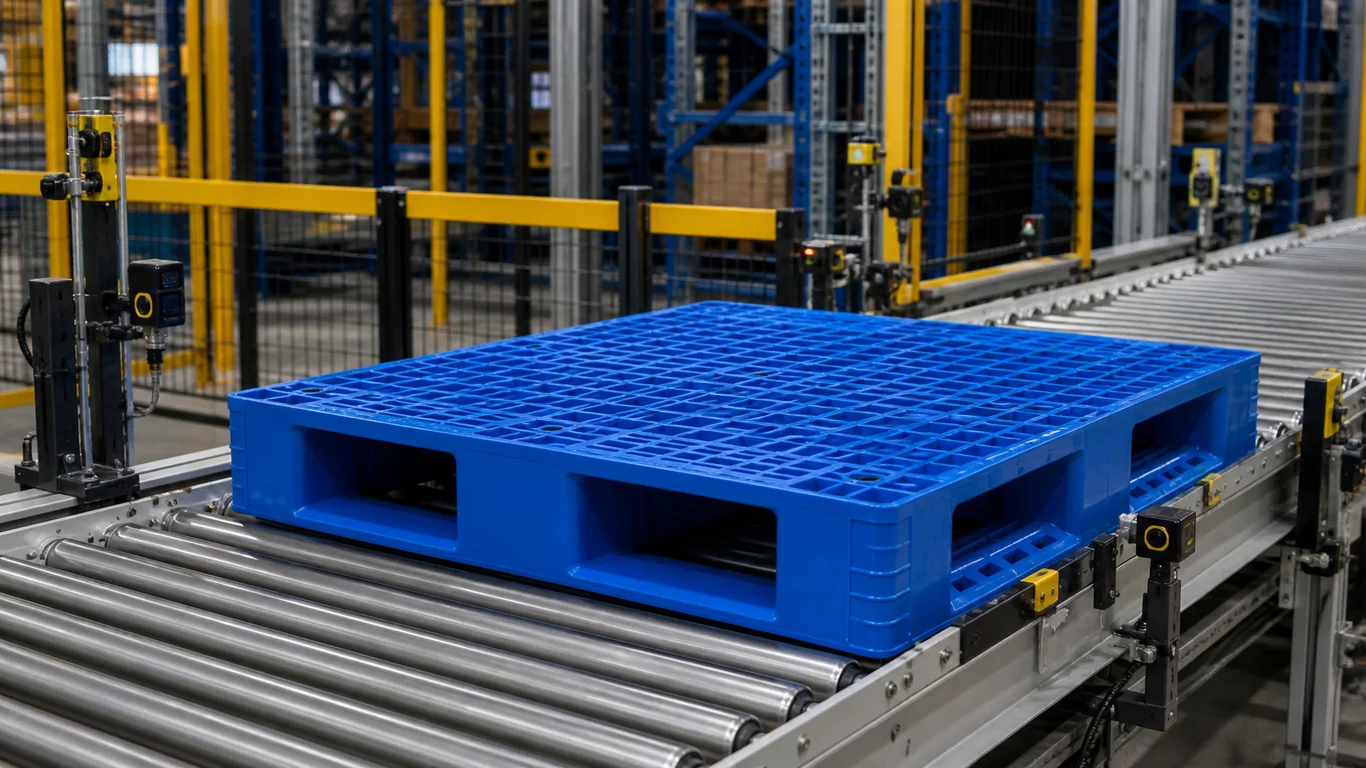
Warehouse automation projects often fail for a simple reason: teams qualify robotics and software in detail, but treat pallets as a standard commodity.
In conveyor lines, AS/RS lanes, shuttles, and palletizers, a small pallet variation can trigger repeated micro-stops, sensor errors, transfer jams, and unplanned manual intervention. The result is usually higher labor demand and lower OEE—even when automation hardware is correctly selected.
For procurement and operations leaders, the key question is practical:
What should be written into a plastic pallet specification so it runs reliably in automated material-handling systems?
This guide focuses on that single question.
1) Why automated systems expose pallet weaknesses faster
Manual warehouses can absorb pallet inconsistency through operator judgment. Automated systems cannot.
In automated flow, every pallet must pass repeatable checkpoints:
- infeed centering,
- conveyor transfer gaps,
- lift-table contact points,
- scanner or vision checkpoints,
- rack entry alignment in AS/RS.
If the pallet bottom is unstable, dimensions drift, or deck deflection is higher than expected, the system may still run—but only with frequent slowdowns and recovery events.
That is why “works with forklift” is not a valid proxy for “works with automation.”
2) The five pallet parameters that matter most in automation
A. Dimensional consistency (length, width, height)
For automation, nominal size is not enough. You need tolerance control by batch.
Define in RFQ:
- target dimensions (for example, 1200 x 1000 mm),
- dimensional tolerance limits,
- measurement method and sample size per lot.
When tolerances are loose, pallets may track off-center at merges and transfers. Over time, this appears as random stoppages rather than one obvious failure.
B. Bottom-deck geometry and contact continuity
Conveyors and transfer modules interact with the bottom of the pallet, not only the top deck.
Specify:
- bottom runner or base layout,
- entry profile at leading/trailing edges,
- flatness expectations at conveyor contact zones,
- minimum support continuity for roller or chain transfers.
For many automated lanes, stable runner designs such as 3-runner pallets are easier to control than highly discontinuous bases.
C. Deflection behavior under real dynamic loads
Automation-related instability is often a deflection issue before it becomes a breakage issue.
Request suppliers to provide:
- dynamic load test context,
- rack deflection data where AS/RS storage is involved,
- pass/fail thresholds linked to your support conditions.
Teams that already use structured procurement templates can extend this RFQ specification checklist with dedicated automation clauses.
D. Surface condition for sensors and handling tools
Rough flash, excessive warpage, or inconsistent openings can interfere with sensor triggering and gripper contact.
Add QC criteria for:
- warpage limits,
- unacceptable molding defects,
- gate/flash control in key sensor zones,
- repeatability of fork-entry and transfer points.
E. Material stability across temperature and shift patterns
Even in ambient automation, pallet behavior changes with night/day temperatures, dock exposure, and washdown cycles.
For chilled or mixed-temperature operations, include environmental validation steps inspired by freezer-focused evaluation methods such as this low-temperature framework .
3) A practical “automation compatibility” checklist before purchase
Before release to mass order, ask integrators, warehouse engineering, and suppliers to sign off these points together:
- System map: exact equipment where pallets will travel (conveyor type, transfer modules, AS/RS entry, palletizer).
- Critical interfaces: positions where pallet geometry affects centering, lifting, or detection.
- Tolerance agreement: dimensional and warpage limits tied to incoming inspection.
- Load envelope: typical and peak payload, including off-center and partial-load scenarios.
- Throughput target: required speed and acceptable stoppage rate.
- Failure definition: what counts as non-conformance (jam, sensor miss, skew, deflection drift).
- Corrective path: who owns root-cause analysis and replacement timing.
Without this joint checklist, automation teams often discover pallet issues only after go-live, when any change becomes expensive.
4) Common specification mistakes in automated projects
Mistake 1: Buying only by static/dynamic load numbers
Load ratings alone do not guarantee transfer reliability, centering stability, or sensor consistency.
Mistake 2: Ignoring bottom-deck design in RFQ
Many RFQs describe top-deck features in detail but leave bottom contact surfaces vague. In automated lines, this is a high-risk omission.
Mistake 3: Validating with too few pallets
Testing 5–10 pallets may hide lot variation. For automation, pilot quantity should be large enough to represent production spread.
Mistake 4: Running pilot only at reduced speed
A pallet that passes low-speed tests may fail at production cycle time, especially at transfer points.
Mistake 5: No lane-level segmentation
Inbound staging, AS/RS storage, and outbound palletizing may require different pallet stiffness or base behavior. One universal model is not always optimal.
5) How to run a 6-week automation pallet pilot
A focused pilot can prevent long-term downtime costs.
Week 1–2: Baseline and interface checks
- Confirm dimensional distribution and warpage profile of the pilot lot.
- Validate travel through every critical equipment interface.
- Record initial stoppage causes by location.
Week 3–4: Throughput stress testing
- Run at target line speed and normal shift pattern.
- Include peak load and off-center load scenarios.
- Measure micro-stop frequency, manual recovery time, and rejected cycles.
Week 5–6: Stability and decision review
- Compare defect growth, edge wear, and bottom-deck deformation.
- Separate pallet-related events from equipment-control events.
- Finalize accepted specification and incoming QC thresholds.
If your team already uses a longer rollout process, align this with your existing pilot program method and add automation-specific KPIs.
6) Standards and references worth using in technical alignment
When creating acceptance criteria, buyers often reference recognized standards to avoid ambiguous supplier claims:
- ISO 8611 for test methods related to pallet handling performance and loading conditions (ISO standard page ).
- ISO 6780 for principal dimensions and tolerances of flat pallets in intercontinental material flow (ISO standard page ).
Standards do not replace on-site pilot validation, but they improve quote comparability and technical discussions.
Final takeaway
In automated warehousing, pallet selection is a system-integration decision—not just a packaging purchase.
When dimensional control, bottom-deck geometry, deflection limits, and pilot criteria are defined before sourcing, teams usually achieve smoother startup, fewer manual interventions, and more stable throughput.
The best automation pallet is the one that keeps your line predictable at real speed, under real load, across real production variation.