Industry Insights
Reefer Pallet Airflow Check: Why an Open Deck Is Not Enough
Before approving plastic pallets for refrigerated transport, check the completed load's side openings and wrap height so the trailer airflow plan is not assumed from the pallet alone.
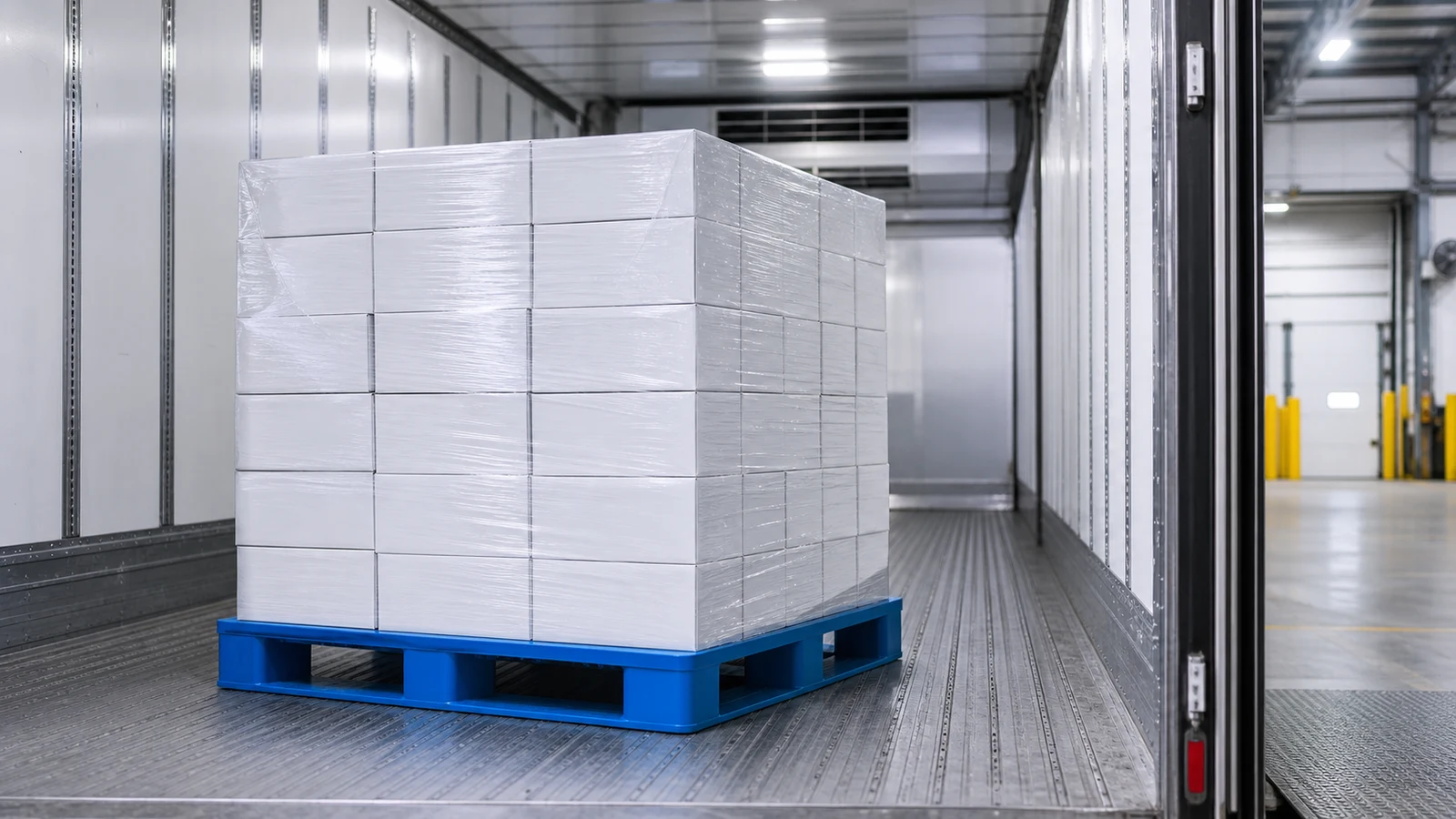
An open-deck plastic pallet is not, by itself, an approval for refrigerated transport. A pallet can have open sides on a drawing, while the completed unit load leaves no usable path beneath or through it. The practical mistake is to approve the pallet model, then treat the trailer’s airflow plan as settled.
For refrigerated food transport, the GCCA Cold Chain – Transportation Best Practices guide says that airflow restrictions should be minimised; when pallets are used, their open ends and sides should allow airflow under and through the slats from front to rear. It also says that plastic wrap should not be installed below the top surface of the pallet. This is industry best-practice guidance, not a certificate for a pallet model or a universal temperature-control rule.
The useful action is narrow: release the completed palletised load for the stated reefer route, not the pallet alone. Record the pallet’s openings, the carton pattern, the lowest wrap position, the trailer floor and airflow arrangement, and the responsible cold-chain owner’s acceptance. A pallet supplier can describe the pallet. The shipper, carrier, receiver, and site quality team must decide whether the actual cargo and vehicle plan are suitable.
Start with the air path the load needs
Do not ask only whether the pallet has vents or an open deck. Ask where air is intended to travel in this specific vehicle, and what the finished load leaves open. In the GCCA guide, the stated direction is under and through the pallet slats from the front to the rear of the box. That does not mean every open pallet creates the same result in every trailer, temperature range, product, loading pattern, or carrier programme.
A closed bottom wrap, a low skirt of film, loose debris, a solid sheet, or a carton pattern that closes the intended openings can change the load condition even when the pallet number is unchanged. Conversely, opening a pallet deck is not a reason to ignore the cargo’s own protection, hygiene, stability, or temperature instructions.
Treat this as a route question. A design that is suitable for a frozen-food trailer may not be appropriate for a chilled product, an ambient shipment, a washdown area, or a different vehicle floor. The applicable product specification and carrier instruction control those choices.
Make a short reefer-load release record
Before a new pallet or wrapping method is released for a refrigerated route, record the facts that determine the actual condition:
| Record | What to capture | Why it matters |
|---|---|---|
| Pallet | Exact model, deck and side openings, height, orientation, and condition | A generic “vented” claim does not show the path left by the selected model |
| Completed load | Carton footprint, overhang, layer pattern, slip sheets, corner boards, and gross height | The product arrangement can close openings or change the intended air path |
| Wrap boundary | Lowest normal film position, film tails, bands, and whether any material lies below the pallet top surface | The GCCA guide specifically distinguishes wrap height from the pallet deck |
| Vehicle plan | Trailer or container type, floor/channel layout, loading direction, placement, and carrier instructions | Pallet geometry has meaning only in the actual transport arrangement |
| Product controls | Required temperature range, handling time, packaging limits, and monitoring method | The pallet does not establish a food-safety or product-temperature condition |
| Release owner | Shipper/quality owner, carrier or logistics owner, and receiver where required | The responsible route parties, not the pallet supplier, own the final decision |
Use photographs of a normal loaded pallet from the sides and bottom edge, not only an empty sample. If the route uses more than one pallet, carton height, wrapping station, or trailer type, identify each approved combination. “Open pallet” is too broad for a release record.
Keep three decisions separate
Pallet selection asks whether the pallet has the stated dimensions, support, fork entry, cleanability, and openings for the intended application. For a broader cold-store choice, see the freezer-grade plastic pallet selection framework .
Unit-load and wrap approval asks whether cartons remain supported and stable, and whether the wrapping method suits the completed load. A wrap that secures a unit load on the dock is not automatically suitable for a refrigerated airflow plan. The stretch-wrapper compatibility guide helps separate film-machine contact from this transport decision.
Reefer-route release asks whether the specified product, vehicle, airflow arrangement, loading pattern, sanitation controls, and monitoring plan have been accepted by the responsible parties. The GCCA guide supports checking airflow restrictions in its refrigerated-transport scope. It does not replace a carrier’s instructions, a food-safety plan, or product-specific temperature validation.
Keeping these decisions separate prevents an appealing pallet feature from becoming an unsupported claim about the whole cold chain.
Changes that should reopen the check
Recheck the route when any normal condition changes, including:
- a different pallet model, orientation, deck design, or damaged return pallet is used;
- a new carton footprint, taller stack, slip sheet, base pad, or layer pattern changes the side or bottom openings;
- the wrapper starts placing film, tails, straps, or protective material lower on the pallet;
- the product, required temperature range, loading direction, trailer, floor configuration, carrier, or receiving programme changes;
- debris, ice, damaged packaging, or another condition obstructs the planned passage or conflicts with the site’s hygiene controls.
This is reasoned operating guidance, not a rule that every visual change requires a new trial. The shipper and quality owner should set the change threshold for their product and route. When the completed load no longer matches the recorded condition, pause the prior release rather than assuming that the pallet’s open deck is still enough.
What to ask a pallet supplier—and what not to ask
Ask the supplier for the exact pallet drawing or revision, deck and side-opening geometry, overall height, weight, fork-entry directions, declared load conditions, material, and cleaning limits. Those facts help the route team understand what the pallet can contribute.
Do not ask a pallet supplier to certify refrigerated airflow, cargo temperature, food safety, or carrier acceptance from a pallet drawing. Those outcomes depend on the completed load and route conditions outside the supplier’s control. If a supplier sample has open sides, use that as input to the route review—not as a substitute for it.
Practical release rule
Do not release a new palletised reefer load when the lowest wrap position, the intended openings, the vehicle arrangement, or the responsible party’s product and carrier requirements are unknown. First document the normal completed load and obtain the route owner’s confirmation. Then keep the approval limited to that pallet model, product pattern, wrap boundary, vehicle arrangement, and route.
The contrast is simple: an open pallet can support an airflow plan, but it does not prove one. Releasing the whole palletised load makes the boundary visible before a cold-chain shipment turns a pallet feature into an assumption.