Industry Insights
Plastic Pallet Stretch Wrapper Compatibility: How to Prevent Film Tears, Load Lift, and Base Damage
A practical guide for warehouse, logistics, and procurement teams on specifying plastic pallets that work reliably with semi-automatic and automatic stretch wrapping lines.
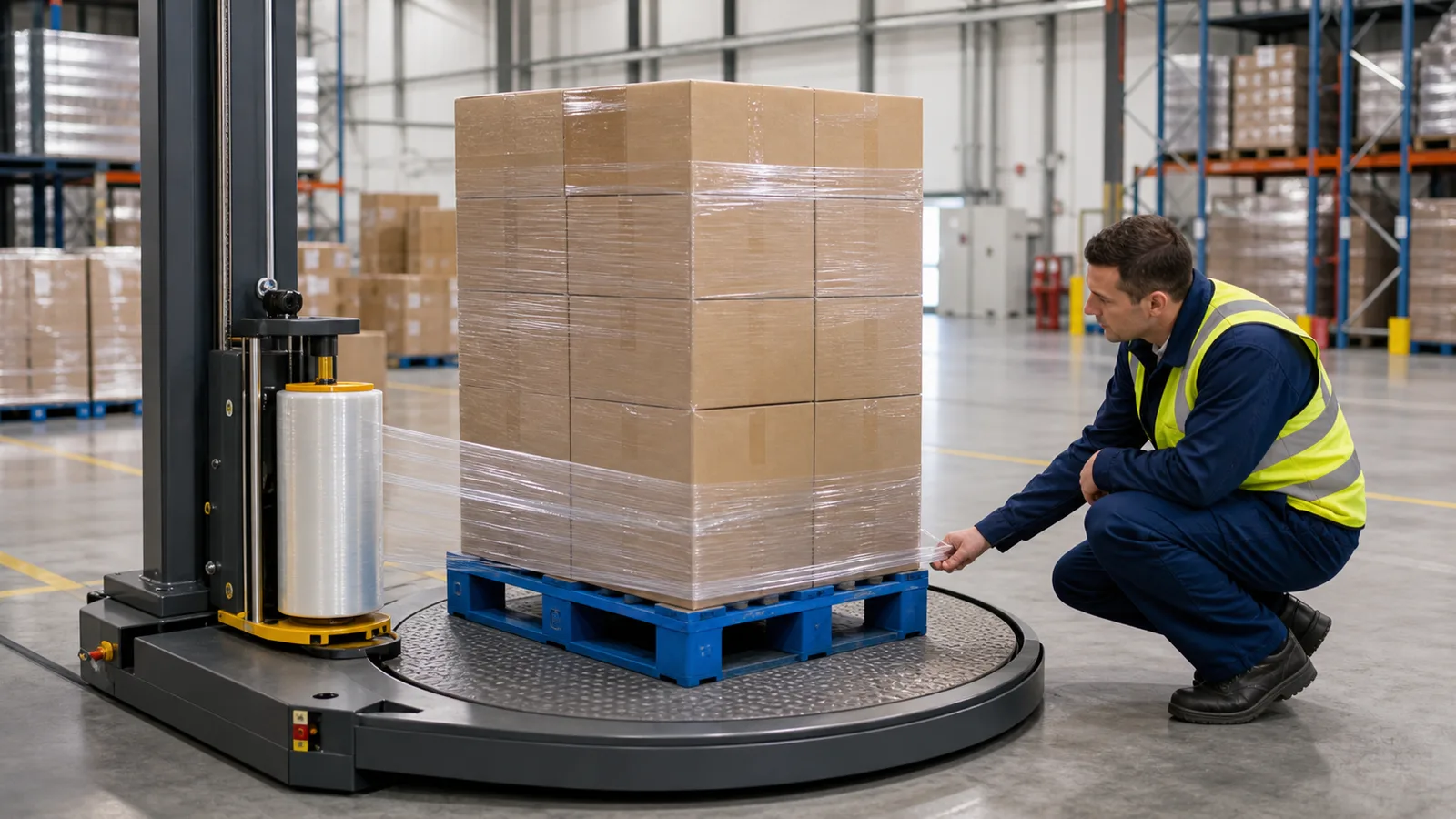
A plastic pallet can pass a load test and still create problems at the stretch wrapper. Film may tear at a sharp pallet corner, the bottom wraps may slide above the pallet instead of locking the load, a low deck may interfere with the clamp or turntable, or high film force may pull a light unit load out of shape before it reaches the truck.
These failures are often blamed on the film or the wrapper settings. Sometimes that is correct. But the pallet is part of the wrapping system. Its height, corners, deck lips, base openings, surface texture, runner layout, and dimensional consistency all affect how the film grips the load and how safely the pallet leaves the wrapping station.
The practical question is:
How should buyers specify plastic pallets when the load must be wrapped on semi-automatic or automatic stretch wrapping equipment?
Map the wrapper before approving the pallet
Start with the wrapping equipment, not the pallet catalog. A manual wrap station, turntable wrapper, rotary arm wrapper, orbital wrapper, and fully automatic line place different forces on the pallet and load.
Record the actual wrapper conditions:
- equipment type and whether the pallet rotates or stays stationary;
- turntable diameter, height, ramp, and edge clearance;
- film carriage starting height and lowest film position;
- film gauge, pre-stretch setting, wrap force, and number of bottom wraps;
- clamp, cut, wipe, and heat-seal positions on automatic machines;
- top platen or load stabilizer use;
- pallet orientation at infeed and discharge;
- conveyor, forklift, or pallet jack movement after wrapping;
- whether the load is wrapped to the pallet, wrapped only around cartons, or wrapped with sheets, corner boards, straps, or top covers.
A pallet that works on a manual station may fail on a high-speed automatic wrapper because the film tail, clamp, or wiper interacts with the pallet base. A pallet that works on a turntable may need a different review on a rotary arm line, where the load stays still but film force and corner contact remain critical.
Do not treat stretch film as the main pallet-retention system
Stretch film should stabilize the unit load. It should not be asked to correct every pallet, stacking, or handling problem.
Before changing film settings, check the load pattern:
- cartons, crates, pails, or bags should sit fully inside the usable pallet deck;
- the first layer should not bridge unsupported deck openings in a way that sinks during wrapping;
- overhang should be avoided unless it is intentionally validated;
- underhang should not leave the film squeezing the load while missing the pallet edge;
- the stack should be square enough for film force to distribute evenly;
- fragile cartons should not be crushed by a wrap force chosen only to control pallet movement.
If transport movement is the main concern, review the pallet and film plan together with a broader plastic pallet load shift prevention guide . Wrapping can reduce movement, but it cannot replace a stable footprint, suitable deck support, and a handling route that matches the unit load.
Check pallet corners, deck lips, and film contact points
Most wrapping issues happen where film first catches the pallet or load. On plastic pallets, these locations are usually the corners, deck edge, edge lip, runner ends, fork-entry openings, and underside transitions.
Inspect these details:
| Pallet feature | Wrapping risk to check |
|---|---|
| sharp or damaged corner | film tearing, tail breakage, or loose bottom wraps |
| high edge lip | film may snag, ride upward, or pull one carton row inward |
| very smooth deck edge | bottom wraps may slide during handling |
| rough flash or damaged rib | repeated film cuts and operator rework |
| deep fork-entry opening | film tail may catch or fail to anchor consistently |
| warped deck or base | load can wobble on the turntable and wrap unevenly |
An edge lip can help hold cartons or crates, but it should not become a cutting edge. A smooth deck can support cleaning, but it may need validation with actual film force, product surface, and moisture conditions. The anti-slip and edge-lip selection guide explains how these features should be matched to the movement pattern rather than specified as generic improvements.
Match pallet height and base structure to the wrapper
Wrapper compatibility is not only about the top deck. The pallet base controls how the load sits on the turntable, conveyor, or wrapping lane.
Confirm:
- pallet height compared with the film carriage’s lowest stable wrap position;
- whether bottom wraps can include the pallet without dragging on the turntable;
- clearance for the clamp, cutter, and wipe arm on automatic wrappers;
- whether the pallet base sits flat on the turntable or conveyor;
- whether runners, legs, or perimeter bases create unstable rotation;
- whether pallet jack or forklift pickup after wrapping damages the bottom wraps;
- whether the wrapped pallet can leave the station without film catching on ramps, guards, or conveyor transfers.
For automated lines, also check whether the wrapped pallet still triggers sensors correctly. Film glare, loose tails, dark pallet colors, or low deck height can affect detection. The plastic pallet sensor detection guide is useful when wrapping is part of a conveyor, AS/RS, or palletizer route.
Control overhang and underhang before changing film force
Overhang and underhang create different wrapping problems.
Overhang occurs when the load extends beyond the pallet. Film may pull the product downward around the pallet edge, crush the bottom cartons, or tear where the load creates a sharp corner. Overhang can also hide pallet edges from forklift drivers and increase impact damage.
Underhang occurs when the load is smaller than the pallet deck. The film may tighten around the product but fail to lock the load to the pallet. The result can look neat at the wrapper but shift during forklift turns, dock movement, or truck transport.
Measure the actual loaded footprint, not only the pallet size. If several SKUs share the same pallet, test the narrowest, widest, tallest, and least stable normal load. A pallet size that is efficient for one carton pattern may create poor film anchoring for another.
When mixed carton sizes make a perfect footprint impossible, consider changes such as layer pattern adjustment, slip sheets, corner boards, trays, banding, anti-slip sheets, or a different pallet size. Raising film force alone may hide the problem until damage appears in transit.
Watch for load lift, squeeze, and bottom-layer damage
High wrap force can improve containment, but it can also expose weak unit-load design. The first warning signs are often visible at the bottom layer.
Look for:
- bottom cartons bowing inward after wrapping;
- pails, crates, or bags moving out of their original positions;
- film pulling upward instead of anchoring around the pallet base;
- light loads rotating or walking on the turntable;
- crushed carton corners near pallet deck lips;
- film cutting into plastic crate handles or rib edges;
- stretch film trapped under runners and torn during pickup.
If the pallet is very light, has a smooth deck, or carries tall but low-weight goods, the load may need lower wrap force, a revised bottom-wrap height, a top platen, interlayer sheets, or a pallet with better deck friction. If the pallet carries heavy goods, the risk may shift toward film tearing at corners or damage to the bottom layer during forklift pickup.
The goal is not maximum film tightness. The goal is enough containment to keep the unit load stable through the actual route without damaging the product, pallet, or film.
Include cleaning, moisture, and cold conditions when relevant
Plastic pallets are often selected for reusable, washable, food, beverage, cold-chain, or clean manufacturing workflows. Those same conditions can change wrapping behavior.
Review whether the pallet is:
- wet after washing or sanitation;
- cold enough to create condensation;
- dusty from cartons, powder, or outdoor returns;
- carrying cold goods that make film behave differently;
- fitted with labels, RFID tags, or color marks that may sit under film;
- returned with worn corners, whitening, or impact damage.
A clean new pallet may wrap well, while a wet or cold returned pallet causes film slip, label failure, or unstable bottom wraps. If the pallet is washed before reuse, the wrapping check should connect with drainage and release rules, not only with packaging settings.
Validate with the real wrapping sequence
A useful sample trial should reproduce the wrapper settings and the handling route after wrapping.
Test at least:
- the actual pallet model and color;
- the normal loaded footprint and the least stable approved SKU;
- the normal film, pre-stretch, wrap force, and bottom-wrap count;
- automatic clamp, cut, wipe, and discharge actions if used;
- forklift or pallet jack pickup after wrapping;
- movement across ramps, dock plates, conveyors, or staging lanes;
- transport vibration or route simulation where shipment stability is critical;
- inspection after unwrapping to check pallet edges, bottom cartons, labels, and deck damage.
Record film breaks, loose tails, load shift, carton crush, pallet rocking, pallet edge damage, and operator intervention. Do not approve the pallet only because one clean sample made it through the wrapper once. A wrapping issue is often repetitive only after several loads, a different SKU, a worn pallet corner, or a wet return.
If the same pallet will be part of a broader bulk order, combine this check with a plastic pallet load testing plan before bulk purchase . The wrapping station should be one step in sample approval, not an afterthought after pallets arrive.
Write wrapper conditions into the RFQ
“Suitable for stretch wrapping” is too broad. A useful RFQ should describe the machine, film, load, and acceptance criteria.
Include:
- wrapper type, brand or functional layout, and whether the pallet rotates;
- turntable, conveyor, clamp, cutter, and discharge constraints;
- film gauge, pre-stretch, wrap force, bottom-wrap count, and top-wrap requirement;
- loaded footprint, overhang or underhang limits, stack height, and product fragility;
- pallet deck edge, lip, corner, and surface requirements;
- handling method immediately after wrapping;
- wet, cold, dusty, or washable pallet conditions;
- label, barcode, RFID, or color-coding zones that must remain readable;
- sample quantity, SKU range, and pass/fail rules.
A practical clause may read:
Pallets must run through the buyer’s stretch wrapping process without repeated film tearing, loose bottom wraps, unsafe load movement, carton crush, pallet edge damage, sensor failure, or manual rework under the stated load, film, wrapper, and handling conditions. Supplier samples must be validated on the actual wrapping line before bulk approval.
This gives the supplier enough context to discuss pallet geometry and surface details instead of answering with only a load rating.
Practical decision rule
Approve a plastic pallet for stretch wrapper use only when four conditions are clear:
- The wrapper interface is known. Film carriage height, bottom wraps, clamp path, turntable or conveyor support, and discharge handling have been checked.
- The load footprint is controlled. Overhang, underhang, bottom-layer support, and product fragility are understood before film force is increased.
- The pallet edges do not damage the film. Corners, lips, runners, openings, and worn areas do not create repeated tearing or loose wraps.
- The wrapped pallet survives the route. The unit load remains stable after pickup, staging, dock movement, transport, and unwrapping inspection.
The best pallet for a stretch-wrapped load is not simply the strongest pallet or the pallet with the smoothest surface. It is the pallet whose deck, edge, base, and dimensional consistency let the film do its job without hiding a handling problem.