Industry Insights
Plastic Pallet Stack Height: How to Plan Safe Floor Storage Before Buying
A practical guide for warehouse and procurement teams to calculate pallet stack height, floor load, and handling limits before approving plastic pallets for block storage.
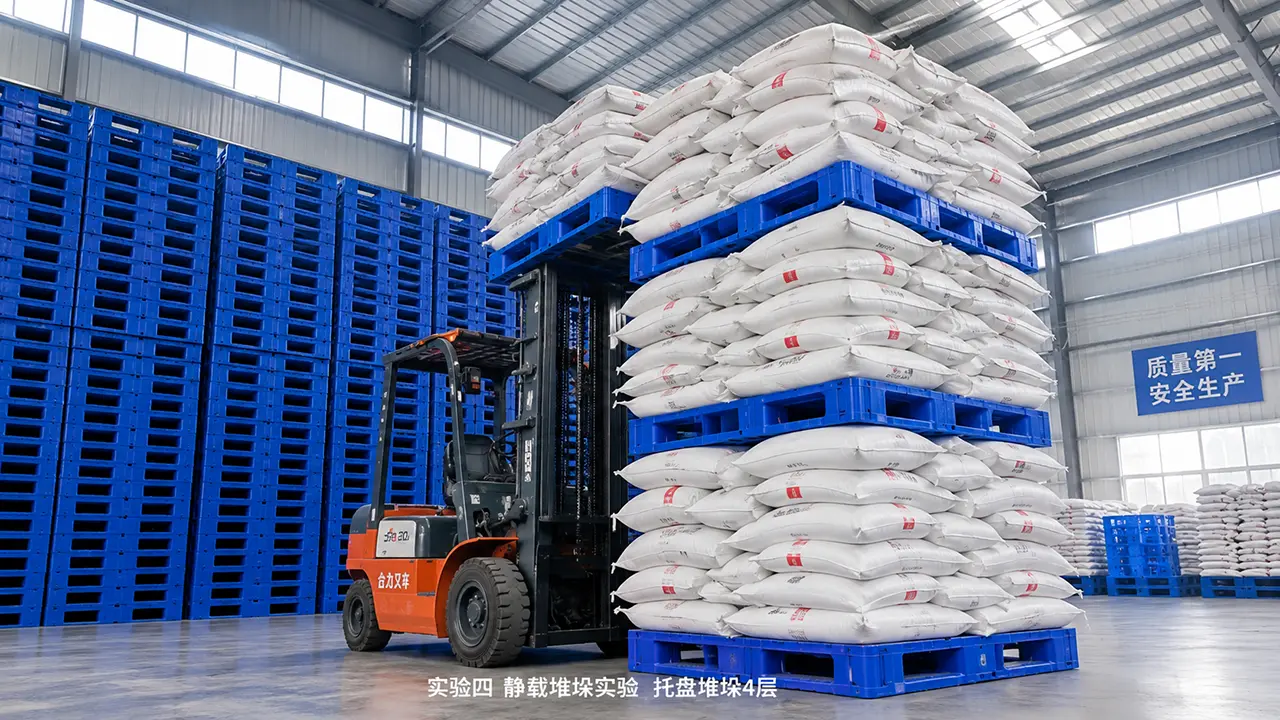
Floor storage looks simple: place loaded pallets on the warehouse floor and stack additional pallets above them when the product allows it. In practice, stack height is one of the most common places where pallet specifications, packaging strength, forklift behavior, and warehouse floor limits are mixed together too casually.
A plastic pallet with a strong static-load rating is not automatically safe for every block-storage plan. The real decision depends on the load distribution, the strength of the cartons or containers, the stability of the stack, the dwell time, and the way operators build and break down the block.
Before approving a pallet order for floor stacking, buyers should define the working stack height as an operating limit, not just a catalog number. This helps prevent crushed packaging, leaning stacks, forklift incidents, and premature pallet deformation.
Start with the difference between static load and stack height
Static load describes how much weight a pallet can support when it is stationary and properly supported. Stack height describes how many loaded pallet positions can be placed vertically in a real warehouse.
Those two numbers are related, but they are not the same.
A pallet may have a high static-load rating when the load is evenly distributed across the deck. The same pallet may perform poorly if the load is concentrated in four drum feet, a few carton corners, a metal frame, or an uneven bagged load. In the same way, the bottom pallet may be strong enough, while the product packaging above it is not.
For procurement documents, avoid writing only “static load 5 tons” and treating that as a stacking approval. A more useful requirement is:
Pallet must support the target floor-storage stack under the actual product footprint, packaging format, dwell time, and forklift handling method used in the warehouse.
That wording forces the discussion to include the whole storage system, not only the pallet.
Calculate the weight on the bottom pallet
The bottom pallet carries the highest load in a floor stack. The simplest calculation is:
Bottom pallet load = weight per loaded pallet × number of loaded pallets above and including the bottom position
If each loaded pallet weighs 900 kg and the warehouse wants to stack three high, the bottom pallet position is exposed to approximately:
900 kg × 3 = 2,700 kg
This number should then be compared with the pallet’s static-load capability under similar support and load-distribution conditions.
However, the calculation should not stop there. Add a practical safety margin for daily variation:
- overweight pallets caused by mixed SKUs or wet product;
- uneven load placement on the deck;
- forklift impact during stacking;
- small floor slopes or damaged floor areas;
- longer-than-planned storage dwell time;
- temperature changes that affect plastic stiffness.
For heavy industrial products, buyers often focus on whether the pallet breaks. A better question is whether it remains dimensionally stable enough for safe handling after repeated stacking cycles. Visible sag, deck distortion, or base deformation can reduce forklift entry clearance and create handling problems even before a complete failure occurs.
Check whether the product can carry the stack
In many block-storage failures, the pallet is blamed first, but the product packaging is the weak point.
Before setting a stack height, confirm how the load transfers downward:
- Are cartons strong enough to carry upper layers without bulging?
- Do sacks settle and shift after several hours?
- Are pails, drums, or trays placing point loads on the pallet deck?
- Does stretch film keep the unit load square, or does it pull corners inward?
- Is there a slip sheet, divider, or top board that changes compression behavior?
A pallet can only support the load it receives. If cartons collapse, the upper pallet may tilt even though the plastic pallet itself is not overloaded. If bags settle unevenly, a stack that looked stable after loading can lean by the next shift.
For mixed SKU warehouses, the safest method is to approve stack height by product family, not by pallet type alone. Strong cartons, flexible bags, liquid containers, and metal parts may each need a different stacking rule.
Match pallet design to the floor-storage pattern
Different pallet structures behave differently in block storage. The right choice depends on how loads are stacked, moved, and stored.
Double-faced pallets for heavy and repeat stacking
A double-faced pallet provides a broad bottom contact area and can be useful when heavy goods are stacked repeatedly in floor storage. A product such as the 1210 open deck double-faced plastic pallet illustrates why buyers often evaluate double-sided structures for heavy loads: the base and deck are both designed for stable contact and frequent forklift handling.
The final approval still depends on the product, floor condition, and handling method. A double-faced pallet may not be suitable for every conveyor or pallet-jack flow, so equipment compatibility must be checked before standardization.
Three-runner pallets for forklift flow and selective storage
Three-runner pallets can be efficient where forklift entry, directional handling, and some rack compatibility are needed. They may be easier to integrate with certain warehouse flows, but the runner layout also controls how weight reaches the floor or lower pallet.
When three-runner pallets are used in floor stacking, check whether the load path aligns with the product below. Narrow contact lines can create higher pressure on cartons or on the deck of the lower pallet.
Nine-leg and nestable pallets for lighter or empty handling
Nestable pallets can save space when empty, but they are usually selected for lighter distribution or return logistics rather than heavy multi-high block storage. If the warehouse needs loaded floor stacking, nesting efficiency should not be allowed to override stack stability.
The same principle applies across all pallet types: the best design is the one that matches the actual load path.
Include warehouse floor load and layout limits
Stack height is not only a pallet question. It is also a building and layout question.
For every proposed block-storage area, warehouse teams should confirm:
- floor load rating or engineering guidance for the slab;
- maximum permitted stack height under site safety rules;
- sprinkler clearance and fire-protection requirements;
- aisle width for forklifts placing upper pallets;
- lighting, visibility, and pedestrian separation;
- floor flatness, drainage slopes, and damaged zones;
- emergency access and inspection routes.
A three-high pallet stack may be acceptable in one part of a warehouse and inappropriate in another. Heavy loads near columns, dock edges, drains, ramps, or cracked concrete should be reviewed carefully.
If the same pallet will also be used on racks, floor-storage approval is not enough. Racking introduces beam span, deflection, and suspended-load issues that require a separate review. For that case, a dedicated racking pallet reinforcement checklist is a better starting point.
Define a working stack-height rule
A practical stack-height rule should be easy for operators to understand and strict enough for supervisors to enforce.
Instead of writing “stackable,” define the rule in operational terms:
| Item to define | Example of a useful rule |
|---|---|
| Approved SKU group | Finished cartons only; no bagged raw materials |
| Maximum loaded pallet weight | 850 kg per pallet position |
| Maximum stack height | 2-high in normal storage, 3-high only in marked zones |
| Dwell time | Maximum 14 days at full stack height |
| Floor area | Zone A and Zone B only, excluding dock staging lanes |
| Handling equipment | Counterbalance forklift only; no pallet jack stacking |
| Inspection trigger | Remove from stack if pallet deck sags, base bends, or load leans |
This type of rule is more useful than a general purchasing claim because it turns the pallet specification into a daily warehouse control.
For multi-site operations, do not copy the same stack-height rule automatically. A plant with heavy forklifts, flat floors, and stable cartons may safely use a different limit than a smaller warehouse with mixed loads and frequent temporary staging.
Run a small stacking trial before bulk approval
A short trial can reveal problems that drawings and catalog ratings cannot show. The trial should use the most demanding realistic load, not the easiest average pallet.
A useful test includes:
- Build the proposed stack height using normal operators and equipment.
- Leave the stack in place for the expected dwell time, or at least long enough to observe settling.
- Check pallet deflection, product compression, film tension, and stack lean.
- Break down and rebuild the stack several times to include forklift impact and real handling variation.
- Inspect the bottom pallet for deck distortion, base deformation, cracks, and fork-entry clearance.
- Record the approved SKU, weight, stack height, zone, and handling restrictions.
For larger procurement projects, this trial can be combined with a broader plastic pallet load testing plan before bulk orders . The goal is not to create a laboratory report for every lane. The goal is to prevent a catalog load rating from being used as a substitute for warehouse validation.
Common purchasing mistakes to avoid
Treating static load as a universal safety number
Static load is useful, but it must be interpreted under the right conditions. Load distribution, dwell time, temperature, and pallet design all matter.
Approving one stack height for all products
Different packaging formats behave differently under compression. A rule that works for boxed metal parts may fail with sacks, pails, or lightweight export cartons.
Ignoring the bottom pallet after repeated use
The bottom pallet experiences the highest compression and frequent fork contact. Inspection should focus on the pallets that repeatedly sit at the bottom of stacks, not only on pallets visible at the top.
Allowing temporary staging to become permanent storage
Dock staging areas often have tighter space, more traffic, and less supervision than formal storage zones. If operators build high stacks there “just for today,” the risk can be higher than in the main warehouse.
Practical conclusion
Safe plastic pallet stack height is not decided by pallet strength alone. It is decided by the interaction of pallet design, product packaging, floor condition, forklift handling, dwell time, and warehouse discipline.
Before buying a large batch, define the maximum loaded pallet weight, approved product groups, permitted storage zones, and stack-height rules. Then validate those rules with a realistic trial.
When the stack height is written as an operating standard instead of a vague product claim, procurement teams can compare suppliers more fairly, warehouse teams can enforce safer storage, and pallets are more likely to perform for their intended service life.