Industry Insights
When an ISO 8611 Test Report Does Not Cover a Pallet Box
Use the scope of ISO 8611-1:2025 to avoid applying a flat-pallet test report to a rigid pallet box or attached container without confirmation.
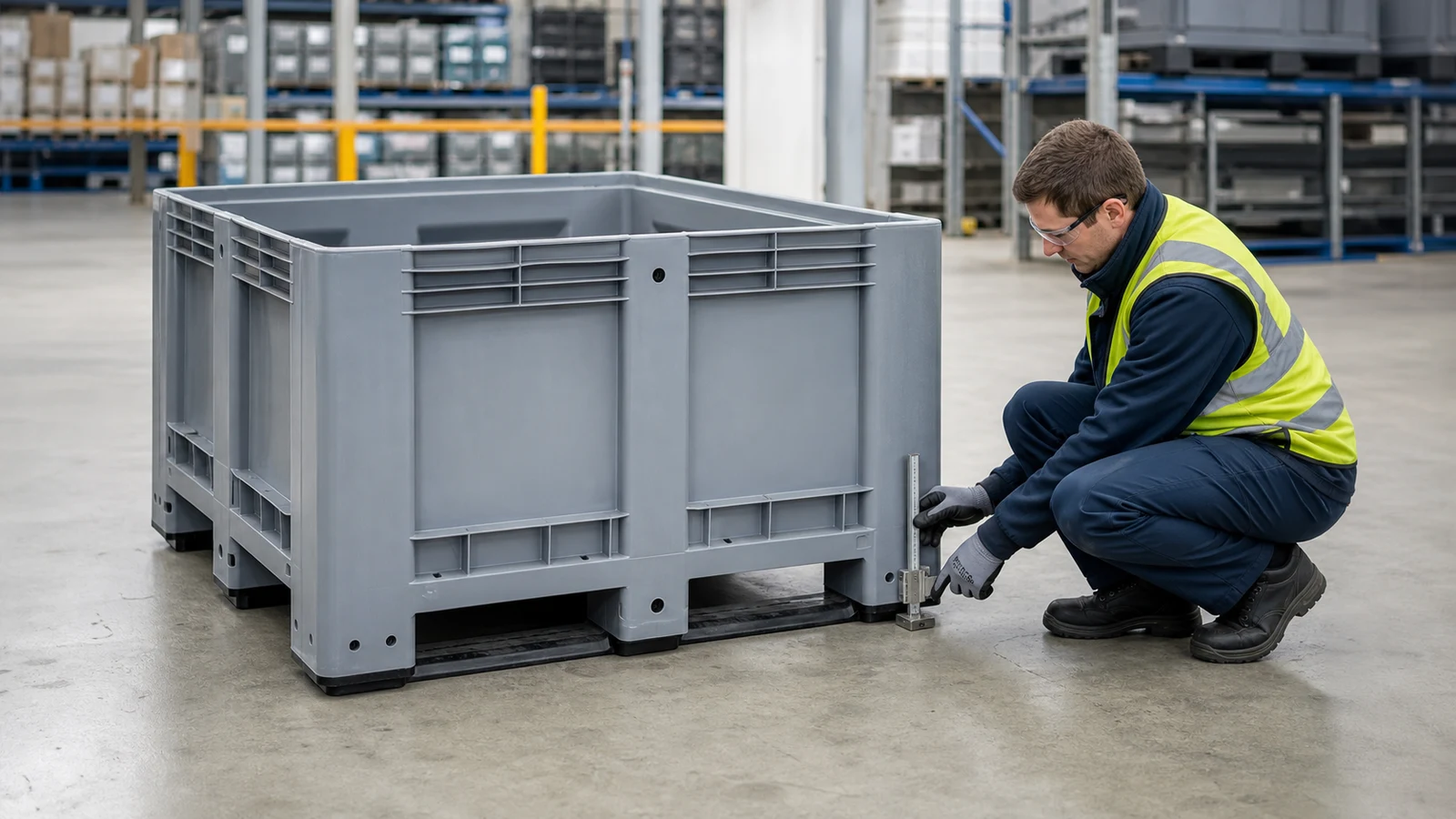
A supplier sends an ISO 8611 report for a flat plastic pallet. Your project uses that pallet with a fixed rigid box above it. Do not treat the report as automatic proof for the assembled carrier.
ISO 8611-1:2025 specifies test methods for new flat pallets. Its published scope also says it does not apply to a pallet with a fixed superstructure, or to a rigid self-supporting container mechanically attached to the pallet when that container contributes to the strength. That wording is a scope boundary, not a statement that the assembled carrier is unsafe. It means the buyer must identify what was actually tested before approving the route.
ISO 13194:2011 , Box pallets — Principal requirements and test methods, is the more direct standards reference for a box pallet. Its published scope covers box pallets of all materials, including units that can be stacked and handled by forklift or pallet truck; it excludes tank and silo pallets, other lifting devices, and the contents. That scope does not prove that a quoted model was tested to ISO 13194. It tells the buyer which standard family and exact configuration to ask about.
The useful decision is simple: use a flat-pallet report to understand the tested flat pallet; use a configuration-specific record to approve a pallet box, sleeve pack, cage, or other assembled load carrier.
First, name the item being approved
“Pallet” can hide a material difference. In this situation, separate these three items in the RFQ and test discussion:
- the flat pallet base;
- the rigid container, sidewalls, or fixed superstructure;
- the assembled carrier with its intended load, lid, attachments, and handling route.
The report may describe only the first item. A fixed container can change how the load reaches the deck, how the base is restrained, where fork impact occurs, how the unit stacks, and how it behaves on a rack or conveyor. Those effects are project-specific; ISO’s scope language alone does not predict their result.
This distinction complements the plastic pallet, pallet box, or tote selection guide . That guide helps choose a carrier category. This page starts after the category is chosen, when a buyer must decide whether a supplied test record covers the exact assembled carrier.
Read the report as a scope record
Before comparing load numbers, ask five narrow questions:
- Is the tested item shown as a flat pallet only, or as the complete pallet-box configuration?
- Does the drawing or report identify the same base, container, attachment method, reinforcement, and lid used in the quote?
- What load arrangement and support condition were used in the test?
- Was the test for nominal load, maximum working load, or durability comparison? ISO 8611-1 lists those groups of test methods.
- Which part of your route remains outside the report: racking, stacking, forklift handling, pallet-jack entry, wrapping, washing, cold exposure, or automation?
A “yes” to the first four questions still does not transfer an approval to every warehouse route. ISO itself notes that specific load-capacity tests do not replace field tests on a specific pallet design. For an assembled carrier, the practical reading is even narrower: do not silently substitute a flat-pallet sample for a configuration that the report did not cover.
Turn the gap into a short approval path
Do not request a vague “ISO-certified pallet box.” Instead, send the supplier and the site owner one configuration sheet. It should show the exact base and container, attachment method, gross load, load distribution, product or liner, stack pattern, storage supports, equipment contact points, temperature, washing exposure, and intended number of cycles.
Then agree which evidence answers the risk that matters:
| Buyer question | Useful confirmation |
|---|---|
| Will the combined unit sit safely on our rack or rails? | A test or engineering review for the specified assembled unit, support span, load, orientation, temperature, and dwell time |
| Will it move through our forklift or pallet-jack route? | A loaded route trial using the quoted base and container, with the normal entry direction and turning conditions |
| Will sidewalls or a lid change stacking behavior? | A sample stack check using the intended closure, load, stack height, and return condition |
| Can it run on our conveyor or automation interface? | An interface trial covering bottom contact, dimensional fit, detection, and loaded transfer |
These are reasoned procurement checks, not universal pass criteria. The supplier, test provider, warehouse engineering team, and customer must decide the limits for the actual unit and route.
Do not make the report say more than it says
Three shortcuts create avoidable approval errors:
- Using the same material as proof. The same resin or molding family does not show that a different assembled geometry was tested.
- Using a headline load rating as proof. A load figure has meaning only with its support, distribution, orientation, temperature, duration, and configuration.
- Calling a report a certificate for the whole project. A test report can be valuable evidence, but it is not a blanket approval for every attachment or operating condition.
For flat-pallet projects, use the more general load-test-before-bulk-order plan to define a sample route. For pallet boxes, retain that discipline and add the container and attachment details that make the unit different.
A practical release rule
Release a pallet box for purchase only when the procurement record makes the tested object and the approved object comparable. If the ISO 8611 report shows a flat pallet but the order includes a rigid container that contributes to strength, record the report as background evidence for the base—not as direct proof for the assembled carrier. Obtain supplier or test-provider confirmation for the exact configuration, then run a site-relevant sample check before the bulk release.
If the carrier contains hazardous goods, direct-food-contact materials, unusually concentrated loads, personnel-lifting equipment, or a regulated transport system, stop at this preliminary guidance and involve the responsible technical, safety, quality, or regulatory owner.