Buying Guides
Plastic Pallets on Tail Lifts: Test the Whole Delivery Interface
Check the loaded pallet, pallet truck, tail-lift platform, transitions, and receiving route together before approving dockless deliveries.
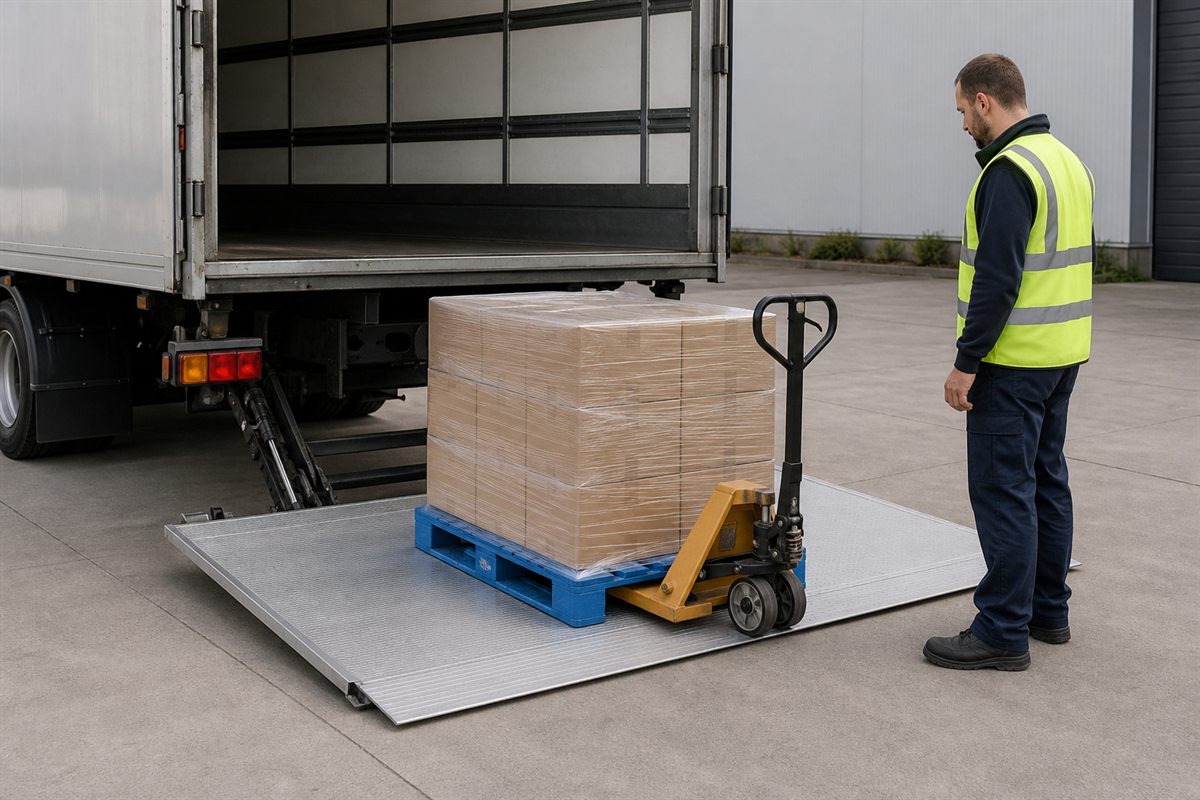
A pallet can work in the warehouse and still fail at the customer’s door. The loaded unit may fit the vehicle, yet leave no controlled wheel path on the tail-lift platform. The pallet truck may enter the pallet, yet strike a platform hinge or ground-transition plate. A lift may have enough stated capacity for the goods, while the complete lifted combination has never been calculated.
For deliveries without a loading dock, approve a delivery interface, not a pallet alone. The approval should bind one exact pallet revision to the representative load, restraint, pallet truck, vehicle tail lift, receiving surface, and unloading method. If one part changes, the earlier result may not transfer.
Begin at the receiver and work backward
Before asking a pallet supplier for a recommendation, obtain the facts that the supplier cannot define.
Start at the delivery point. Record the parking position, ground firmness and slope, kerbs or thresholds, pedestrian and vehicle traffic, weather exposure, clearance, final travel distance, and who controls the area. Identify whether the load is transferred at road level, in a private yard, or through another agreed arrangement. The receiver and carrier should decide whether that location can support a controlled unloading operation.
Then identify the actual vehicle and tail lift: manufacturer and model, platform configuration and usable dimensions, stated capacity, any load-position restriction, edge or roll-stop features, operating instructions, inspection status, and the configurations that may arrive on the route. A fleet label is too broad if vehicles carry different platforms.
Finally, identify the handling device and loaded unit: exact pallet-truck model, fork and finger-wheel geometry, steering envelope, pallet revision, finished footprint, greatest external dimensions, actual gross mass, load distribution, centre-of-gravity concerns, restraint, and damage-rejection criteria.
HSE’s loading and unloading guidance explains why these facts belong together. It calls for firm level ground, vehicle brakes and stabilisers, sound pallets, secured loads, checks for movement before restraints are removed, and advance agreement when more than one company is involved. It also identifies trapping hazards around vehicle tail lifts. The purchase brief should therefore include the carrier and receiver’s method, not only a pallet drawing.
Calculate the combination the lift will actually carry
Do not compare the tail lift’s stated capacity with the product weight alone. Build a mass statement for the complete configuration presented to the platform:
- actual gross mass of goods, packaging, restraint, and pallet;
- mass of the pallet truck or other handling aid placed on the platform;
- any operator or additional equipment permitted by the lift manufacturer and the responsible work method;
- the difficult but normal load distribution and position, not only a centred sketch.
The tail-lift manufacturer or responsible equipment owner must confirm how its rating applies to load position and platform configuration. Do not assume that every part of the platform carries the nameplate capacity, or that a person should ride with the load. If the instructions, actual mass, or permitted operating arrangement are uncertain, the comparison is not ready for a trial.
HSE lists vehicle tail lifts as lifting equipment and advises against lifting when the load’s weight or the equipment’s adequacy is in doubt. It separately notes that simple pallet trucks are not treated as tail lifts under the same lifting-equipment rule, but still need to be safe and maintained as work equipment. HSE guidance on lifting equipment .
This distinction matters commercially. A pallet supplier can describe the pallet under stated conditions. The tail-lift owner controls the lift rating and instructions. The pallet-truck owner controls that device. The carrier and receiver control the unloading method and site. One supplier’s statement cannot approve the whole combination.
Draw the wheel path through three transitions
Platform length and width are not the same as usable working space. Sketch the pallet, pallet truck, handle movement, wheel positions, edge protection, hinges, controls, and the operator’s permitted position at scale. Check the full sequence, not a still photograph.
Vehicle deck to platform. Confirm how the pallet truck’s load wheels cross the joint, whether the pallet remains level enough to stay controlled, and whether the handle can be used without forcing the operator toward an edge or trapping point. Include the loaded vehicle height and the tail-lift configuration actually used.
Platform during lift travel. Confirm where the pallet and pallet truck must stand, how unintended rolling is prevented, what clearances remain, and whether the load or handling device can contact gates, stops, controls, bodywork, or the platform edge. The responsible operator’s instructions decide whether anyone may occupy the platform and where.
Platform to receiving ground. Check the lowered platform’s transition plate, gap, local slope, kerb, drainage channel, surface damage, and the route required to clear the vehicle. Small pallet-truck wheels can stop abruptly at features that a vehicle tyre crosses easily. A controlled movement on the platform can become an uncontrolled push or pull at its edge.
HSE’s Pallet safety PM15 notes that pallet-truck finger wheels and unsuitable fork length can damage pallet base members and create danger. It also illustrates how ramps and uneven surfaces can jolt loads and damage pallet bases. Apply that principle to the exact plastic pallet underside and pallet truck: verify wheel exit, fork length, base clearance, and contact points rather than relying on “four-way entry” or nominal fork-pocket dimensions.
Use the separate pallet-jack compatibility guide for the internal fork-entry check. The tail-lift review adds platform edges, joints, travel position, and the receiving surface.
Approve the unloading sequence after transport, not before it
The load that reaches the receiver may not match the load photographed at dispatch. Restraint can loosen, cartons can settle, moisture can change the surface, or the pallet can be damaged in transit. The unloading method needs a decision point before doors or restraints release the unit.
The responsible teams should define who parks and stabilises the vehicle, who controls keys or another drive-away safeguard, who opens the vehicle, who inspects the pallet and load, who operates the tail lift, who moves the pallet truck, and who controls pedestrians and traffic. Agree communication and stop authority when the driver and receiver work for different organisations.
UK government guidance warns that kerbside delivery from a box-sided vehicle with a body-mounted tail lift carries a risk of the load or driver falling from height. Guidance on unloading box-sided vehicles . Do not turn this procurement article into an improvised operating procedure: the equipment instructions, trained operator, local risk assessment, and applicable law govern the real operation.
Keep transport restraint as a separate control. Before approving the unloading interface, verify that the load can arrive stable and be inspected before restraint is removed. The site’s load-shift prevention guide covers that transport problem in more detail.
Run a route trial with stop conditions already written
A useful trial reproduces a normal delivery under the control of the responsible carrier, receiver, and equipment owner. It does not create an overload or ask an operator to improvise.
Start with a document screen. Match the exact pallet, pallet truck, tail lift, load case, vehicle configuration, receiving point, instructions, inspection status, and trained roles. Then check the interfaces without a load where the responsible procedure allows. Only after the paper and empty-interface checks pass should the team use a representative secured load within every stated limit.
Follow the unit from its vehicle position, across the deck-platform joint, through the permitted lift arrangement, across the ground transition, and to the handoff point. Record actual mass, dimensions, load position, wheel path, contact or interference, stability, operator visibility and position, ground condition, and the decision owner.
Stop the trial if any of these appears:
- the complete mass, permissible load position, or capacity interpretation is uncertain;
- the pallet, pallet truck, or operator cannot remain inside the permitted envelope;
- a wheel, fork, pallet base, load, or control strikes or catches at a transition;
- the load rolls, leans, shifts, or needs someone to stand in an unsafe place to control it;
- the pallet or restraint is damaged, or the receiving surface and traffic cannot be controlled;
- the planned method conflicts with the equipment instructions or trained operator’s decision.
A pass belongs to the recorded combination. A different tail-lift model, pallet truck, pallet underside, load distribution, receiver, or unloading position requires review and may require another trial.
Send suppliers a route pack, not “tail-lift compatible”
Attach the route evidence to the RFQ. Give competing pallet suppliers the same finished load dimensions and mass range, contact pattern, distribution, restraint, pallet-truck geometry, tail-lift configurations, transitions, environment, trial method, and rejection criteria. Ask each supplier to identify the exact pallet revision, entry directions, underside drawing, tolerances, load evidence under the stated support and duration, inspection points, and change-notification process.
Use the plastic pallet category only after this operating envelope is clear. For a bounded supplier discussion, send the route pack, load case, pallet-truck details, tail-lift data, and trial criteria rather than asking for a universal compatibility promise.
The approval record should name one delivery system and its limits. That makes the last transfer visible before an order is placed—and prevents a warehouse-approved pallet from becoming a doorstep problem.