Industry Insights
Plastic Pallets for Conveyor Lines: Bottom Contact Checks
Specify plastic pallets for roller and chain conveyors by checking bottom contact, runner continuity, transfer gaps, deflection, and loaded trials.
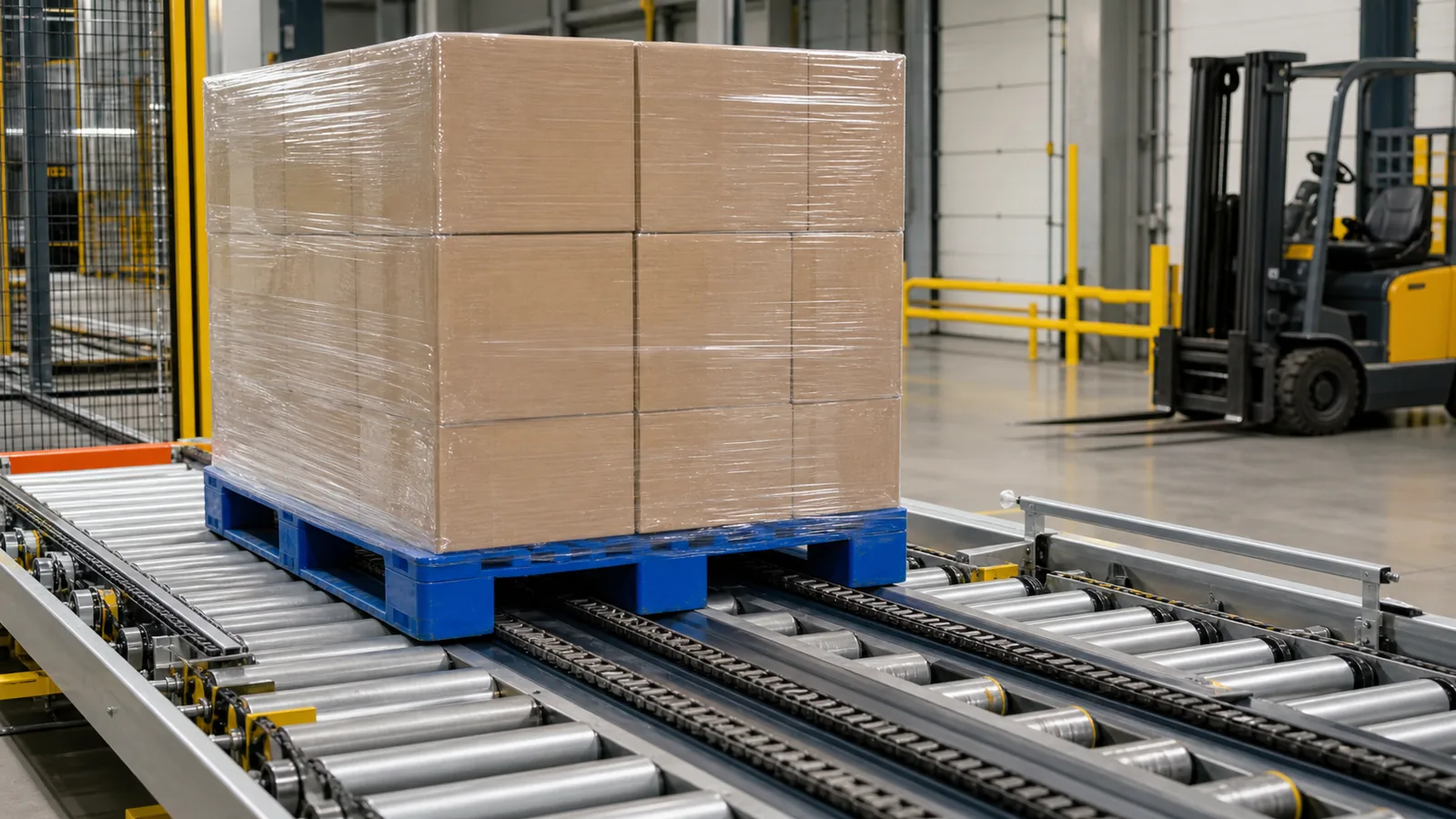
A plastic pallet is conveyor-ready only when its bottom surface stays supported, centered, and predictable. Forklift compatibility does not prove this. Roller pitch, chain-lane spacing, transfer gaps, orientation, load distribution, bottom wear, and loaded deflection all change how the pallet moves. For a low-speed line, procurement may need a sample trial with the real pallet, load, and equipment. For AS/RS infeed, palletizers, lift tables, or high-throughput conveyors, the specification should name the bottom contact zones, allowed deformation, transfer tests, and incoming inspection checks.
Conveyor fit starts under the pallet
Most pallet discussions start with the top deck: carton footprint, anti-slip surface, edge lips, hygiene, or load rating. Conveyor problems usually start underneath.
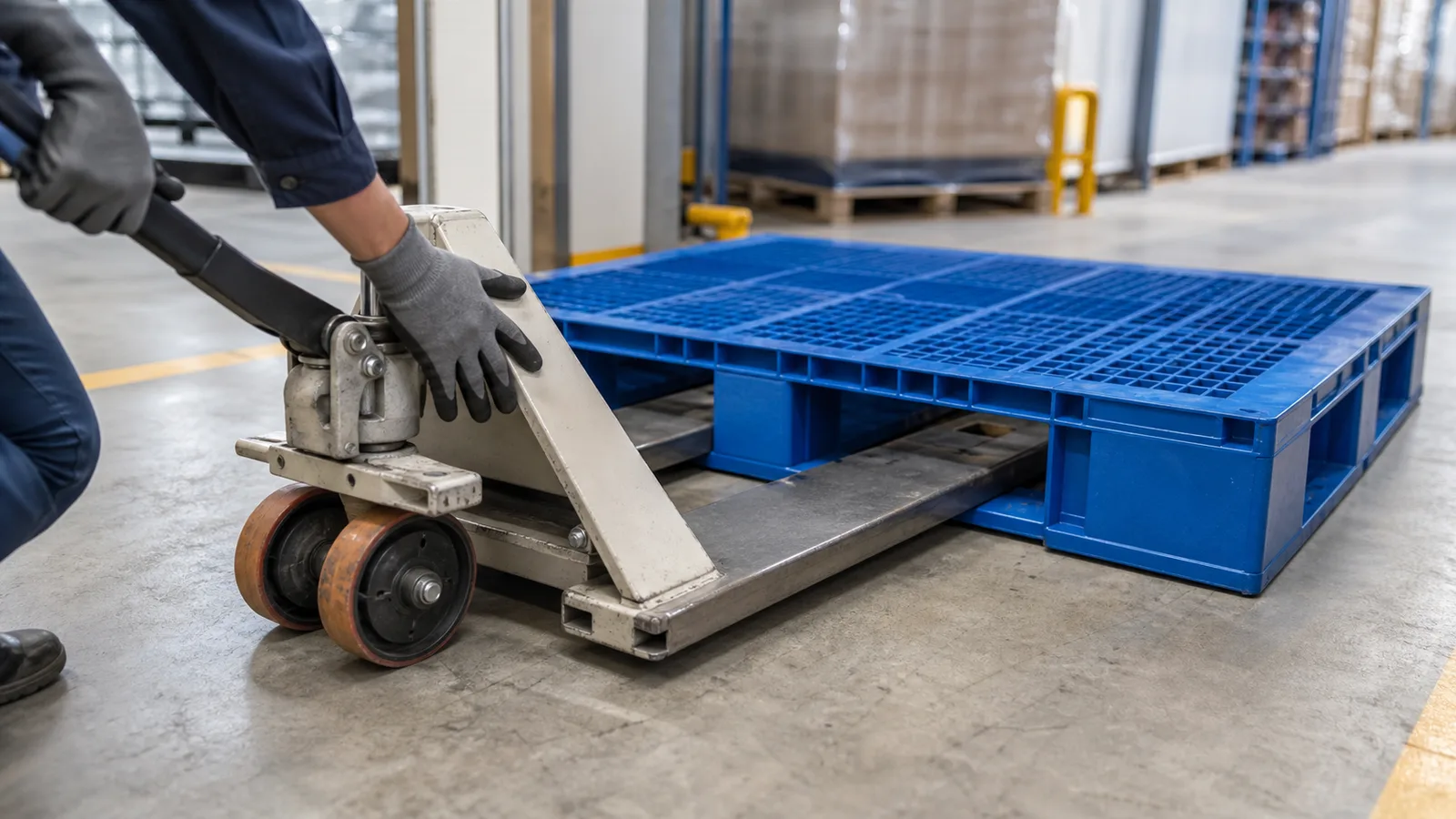
On a roller conveyor, the pallet must bridge from roller to roller without dropping, rocking, or dragging a weak rib. On a chain conveyor, the runners or base strips must sit on the intended chain lanes. At a 90-degree transfer, turntable, lift table, or infeed stop, the pallet can momentarily lose part of its support. If the bottom design is discontinuous, warped, or too flexible, the line may see skew, jams, damaged runners, missed sensor timing, or manual recovery work.
Use this as the mechanical layer beside the broader automation-ready plastic pallet specification . Sensor and scanning checks still matter, but they come after the pallet can physically travel through the line.
Record the conveyor support before asking for prices
Do not ask a supplier for “a conveyor pallet” without describing the conveyor. The same pallet may behave differently on close-pitch rollers, wide roller gaps, chain transfers, drag-chain lanes, turntables, and lift tables.
Use this baseline before comparing models:
| Conveyor input | What procurement should record |
|---|---|
| Conveyor type | Roller, chain, transfer, turntable, lift table, shuttle infeed, palletizer, wrapper outfeed, or mixed route |
| Support spacing | Roller pitch, chain-lane center distance, transfer gap, guide width, and unsupported transitions |
| Pallet orientation | Leading side, rotation, and whether long-side and short-side travel are both required |
| Bottom contact surface | Runner position, perimeter base, bottom deck, ribs, chamfers, lead-in edges, and wear zones |
| Load condition | Empty, typical loaded, peak loaded, partial, off-center, wrapped, or concentrated footprint |
| Line behavior | Speed, stops, accumulation pressure, reject lane, incline, wet area, cold transition, or dirty return |
| Pass/fail rule | No jam, unstable rocking, runner scraping, visible base damage, unsafe skew, or recurring manual recovery |
For ordinary low-speed transfer, this table can stay short. For AS/RS entry or palletizer integration, attach it to the RFQ and line-acceptance record.
Match the pallet base to the contact pattern
The best base design depends on how the conveyor supports the pallet.
Three-runner pallets often work well where the runner direction matches roller support, rack support, or chain lanes. A model such as the 1210 open deck 3-runner plastic pallet is the kind of structure buyers may review, but approval still depends on roller pitch, runner spacing, load, and orientation.
Perimeter-base and double-faced pallets can give more continuous contact in some routes, but they may limit pallet-jack access or catch at stops if the conveyor path does not match the base. Confirm the equipment path rather than assuming the stronger-looking base is always better.
Nestable nine-leg pallets save return space and suit some manual flows, but many conveyor systems need more continuous support than individual legs provide. Treat them as lane-specific choices and test loaded movement before approval.
Deflection can become a transfer problem
A pallet does not need to break to fail on a conveyor. It only needs to bend enough that one runner drags, one corner drops, or one transfer point loses support.
This is why load ratings should be read with conditions. Static load, dynamic load, and racking load do not automatically describe conveyor behavior. A pallet that carries the goods on the floor may still sag between rollers or twist at a chain transfer. A pallet that performs on a short support span may behave differently at a wider unsupported gap.
When the pallet will also enter rack storage, compare the conveyor review with the rack deflection acceptance guide . The same practical question appears in both places: does the pallet remain usable under the actual support, load, dwell time, and route?
Recognized test methods can improve language, but they do not replace line trials. ISO 8611-1:2025 covers test methods for new flat pallets and notes that specific load-capacity tests do not replace field tests on particular designs. Virginia Tech’s Center for Packaging and Unit Load Design also treats pallets as part of a broader material-handling system.
Test the loaded transfer, not the empty travel
An empty pallet may glide through a conveyor and still fail in production. The load changes the base shape, center of gravity, sensor timing, and recovery risk.
Before bulk approval, run these checks:
- Send the empty pallet through the full route in every required orientation.
- Repeat with the typical load and the heaviest normal load.
- Include partial, off-center, or wrapped loads if they occur in production.
- Stop and restart at normal accumulation or infeed points.
- Run through chain transfers, lift tables, turntables, or reject lanes, not only straight conveyors.
- Inspect the base for scraping, whitening, cracking, runner flattening, or localized wear.
- Repeat with more than one pallet from the sample lot if automation uptime is critical.
For automatic lines, connect this trial to the plastic pallet sensor detection guide . Detection tuning cannot fix a base that jams mechanically.
For slow, operator-attended conveyors with sealed cartons and moderate weights, the trial can stay short: confirm support spacing, test the real load, check every required orientation, inspect the bottom, and write down any direction or load limit. Escalate when the line is high speed, unmanned, linked to AS/RS, connected to palletizing or wrapping, used in cold or wet areas, or part of a larger warehousing and logistics network.
RFQ wording that prevents vague approval
A useful RFQ clause can be short:
Pallets shall be suitable for the buyer’s stated roller and chain conveyor route under loaded operation. Supplier shall confirm bottom contact zones, runner or base layout, lead-in edges, dimensional tolerance, expected deformation, and limits for roller pitch, chain spacing, transfer gaps, orientation, accumulation, cold/wet exposure, and sample trial acceptance. Final approval requires loaded testing on the buyer’s conveyor equipment.
Keep the sample record practical:
- the pallet runs in the required direction without jam, skew, dragging, or unstable rocking;
- runners or base strips remain supported at transfer points;
- stops and restarts keep the loaded pallet aligned;
- fork entries, bottom ribs, and lead-in edges show no early damage;
- production pallets match the approved base design, material route, and dimensional tolerance.
Approval rule
Approve a plastic pallet for conveyor use only when the bottom design, conveyor support, load condition, and operating route have been checked together.
Common case: a short loaded trial on the real line confirms that the pallet runs, transfers, stops, restarts, and leaves no early base damage.
Needs confirmation: AS/RS infeed, high-speed transfer, cold or wet operation, heavy or off-center loads, mixed pallet batches, and any route where operators cannot quickly correct a jam.
Not recommended: relying on “automation suitable,” “four-way entry,” or a general dynamic load rating without conveyor support details. Conveyor compatibility is a contact test between the pallet bottom and the equipment that moves it every shift.