Industry Insights
Food-Contact Plastic Pallets: RFQ Document Checklist
Specify when food-contact plastic pallets need declarations, resin/additive details, hygiene controls, sample checks, and market-specific confirmation.
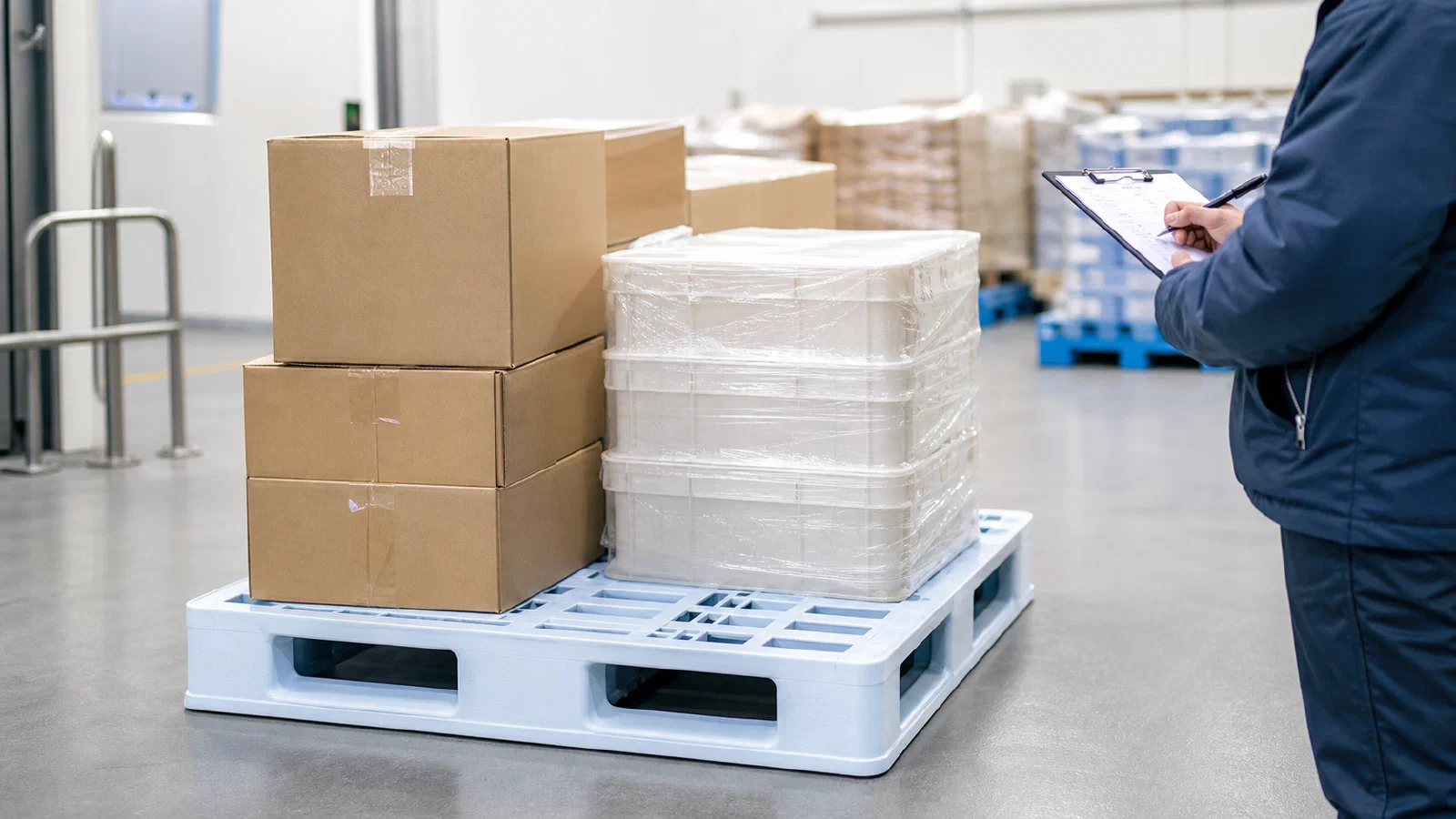
If a plastic pallet may enter a food handling area, do not approve it only because it is described as “food grade.” First define whether the pallet will touch unpacked food, contact primary packaging, support sealed secondary packs, or stay outside the hygiene zone. Direct food contact normally requires market-specific material and additive documentation. Packaged-food logistics usually needs a different package of controls: cleanability, segregation, damage inspection, traceability, and cleaning compatibility.
The RFQ should state the exposure class, resin and colorant expectations, cleaning method, temperature, pallet design, sample checks, and documents required for the destination market. Supplier statements should be treated as project documents to verify against current regulations and actual use conditions, not as universal approvals.
Classify the pallet exposure before asking for documents
“Food-contact pallet” is too broad for procurement. A pallet used under sealed cartons is not the same as a pallet used under unpacked dough trays, open produce, meat totes, or primary packaging film. The document request must follow the actual contact route.
| Exposure class | What the pallet may contact | Practical document and control baseline |
|---|---|---|
| Direct food contact | Unpacked food, exposed ingredients, or drained product that can touch the pallet | Require written confirmation for the exact market, resin, colorant, additive package, use temperature, cleaning chemical exposure, and intended contact condition. Ask whether applicable migration or food-contact declarations are available. |
| Primary-packaging contact | Bags, liners, trays, bottles, pouches, or other packaging that directly contacts food | Confirm whether pallet surfaces can touch the primary pack during normal handling. Request material and colorant disclosure sufficient for the buyer’s QA review, plus surface-cleaning and contamination-control rules. |
| Secondary-packaging logistics | Sealed cartons, wrapped cases, crates, or totes where food is not exposed | Focus on hygiene zoning, cleanability, damage control, foreign-material risk, odor transfer, and documentation needed by the receiving site or customer audit. |
| Food-area support only | Pallets used in corridors, docks, dry storage, or finished-goods staging without direct product or primary-pack contact | Define zone limits, color coding, cleaning frequency, inspection criteria, and rules preventing uncontrolled movement into higher-risk areas. |
For food and beverage sites, this exposure map should sit beside the broader food and beverage handling guidance . It prevents the RFQ from asking for either too little documentation for direct contact or too much irrelevant paperwork for sealed-carton logistics.
Use the regulation as a scope question, not a slogan
Food-contact rules are market-specific. The EU framework for food contact materials is summarized by the European Commission food contact materials guidance, and plastic materials intended to contact food are addressed in Commission Regulation (EU) No 10/2011 . Other destination markets may use different legal routes, positive lists, declarations, or importer responsibilities.
That means a pallet supplier should not be asked only, “Is this food grade?” A better question is:
For the stated market, use temperature, food or packaging contact condition, cleaning method, and expected life, what material declaration, additive information, test report, or compliance statement can you provide for this exact pallet model and color?
If the pallet will not directly contact food, do not invent a direct-contact requirement. Instead, document why the pallet is secondary-packaging or zone-support equipment and define the hygiene controls that make that boundary reliable.
RFQ baseline: what to ask the supplier to confirm
Use this baseline when a pallet may enter a food plant, beverage warehouse, cold-chain area, packaging hall, or distribution center with customer hygiene audits.
| RFQ item | Why it matters | What to request |
|---|---|---|
| Intended exposure class | Prevents overclaiming and under-documentation | Direct food, primary-packaging, secondary-packaging, or support-zone use |
| Pallet model and color | Declarations may not transfer across models, pigments, or recycled-content options | Exact model, size, color, material, and revision if applicable |
| Resin and recycled content | Virgin HDPE/PP, controlled recycled content, and mixed materials have different review paths | Resin family, whether virgin or recycled content is used, and any food-area restriction |
| Additives and colorants | Pigments, anti-static additives, UV stabilizers, or processing aids may affect documentation | Supplier statement for additives relevant to food-contact or hygiene review |
| Use conditions | Food-contact suitability is conditional, not universal | Temperature range, contact duration, dry/wet use, cleaning chemicals, and whether oily, acidic, or alcoholic foods are involved |
| Cleanability and damage control | A compliant material can still fail a plant hygiene audit | Surface design, drain/dry behavior, inspection points, and retirement criteria |
| Documents supplied | Procurement needs a record, not a verbal answer | Declaration, material statement, test report, batch traceability, or limitation note as appropriate |
A practical RFQ clause may read:
Pallets are intended for [exposure class] use in [market or destination]. Supplier must identify the exact pallet model, material, colorant/additive status, recycled-content status, cleaning limits, and any conditions or exclusions for food-contact or food-area use. Documents must apply to the supplied model and color, not only to a generic material family.
Match the pallet design to the hygiene boundary
Documentation does not replace physical design. A pallet with the right material statement can still be hard to clean, trap moisture, shed damaged fragments, or move between zones without control.
For food-area projects, review:
- whether a closed, smooth, or open deck is easier to verify after washing;
- whether ribs, corners, fork entries, and underside pockets trap residue;
- whether the pallet drains and dries before entering a clean zone;
- whether color coding separates allergen, raw, finished, rework, or external-return flows;
- whether labels, RFID tags, or engraved marks survive cleaning without becoming dirt traps;
- whether damaged pallets can be found and quarantined before returning to use.
If the route favors easy inspection and fast cleaning, compare the structure against the closed deck plastic pallet selection guide . If the site needs visible color control and clean handling in a defined zone, food-series options such as the 1210 white specialty pallet can be reviewed, subject to the actual documentation and use conditions for the project.
Sample acceptance criteria before bulk purchase
Do not approve a food-area pallet only from a catalog sheet. The sample check should test both documents and the real handling route.
| Acceptance point | Pass condition | Record to keep |
|---|---|---|
| Document match | Model, color, material, and exposure class match the RFQ | Supplier declaration or limitation note tied to the exact sample |
| Visual condition | No flash, sharp edges, cracks, loose inserts, odor concern, or visible contamination | Incoming sample inspection photos and notes |
| Clean and dry release | Pallet can be cleaned, drained, dried, and inspected under the site’s method | Cleaning trial record and release criteria |
| Product or pack interface | Pallet does not damage bags, trays, cartons, bottles, labels, or film under normal movement | Loaded sample observations |
| Zone control | Color, label, or traceability method supports the site’s hygiene map | QA approval for identification method |
| Reuse decision | Damage and retirement rules are clear before circulation starts | Inspection checklist and quarantine trigger |
For operations already building sanitation controls, connect this procurement review to the plastic pallet sanitation SOP for food warehouses . The pallet specification and the cleaning SOP should describe the same zones and release rules.
Risk boundaries that need human confirmation
Several conditions should trigger a QA, regulatory, or customer review before the pallet is treated as suitable:
- direct contact with unpacked food or ingredients;
- hot-fill, high-temperature washing, steam, or repeated thermal cycling;
- contact with oils, acidic foods, alcoholic products, strong flavors, or high-fat materials;
- use of recycled content in a zone where the customer requires virgin material;
- strong disinfectants, caustic cleaners, or chemical exposure outside the supplier’s stated limits;
- pallets returning from external logistics into clean production;
- any claim that a declaration for one color, resin, or model covers all versions automatically.
The goal is not to make every food-area pallet a direct-contact pallet. The goal is to define the exposure honestly, request documents that match that exposure, and create an acceptance record that QA, procurement, operations, and the supplier can all use.
Practical decision rule
Approve a plastic pallet for food-contact or food-area use only when four facts are clear:
- Exposure is classified. Direct food, primary packaging, secondary packaging, and support-zone use are not treated as the same risk.
- Documents match the supplied pallet. The model, color, resin, recycled-content status, additives, and limitations are tied to the actual order.
- Use conditions are stated. Temperature, cleaning chemicals, contact duration, moisture, product type, and market destination are not left implicit.
- Samples pass the site’s route. Cleaning, drying, inspection, loading, zone control, and damage quarantine work before bulk approval.
When those four points are documented, the buyer has a defensible specification. When one is missing, “food grade” remains an unsupported label rather than a usable procurement decision.