Industry Insights
Plastic Pallet Color Coding: How to Prevent Mix-Ups in Food, Pharma, and Multi-Zone Warehouses
A practical guide to building a plastic pallet color-coding system that reduces cross-contact risk, product mix-ups, and warehouse handling errors without slowing daily operations.
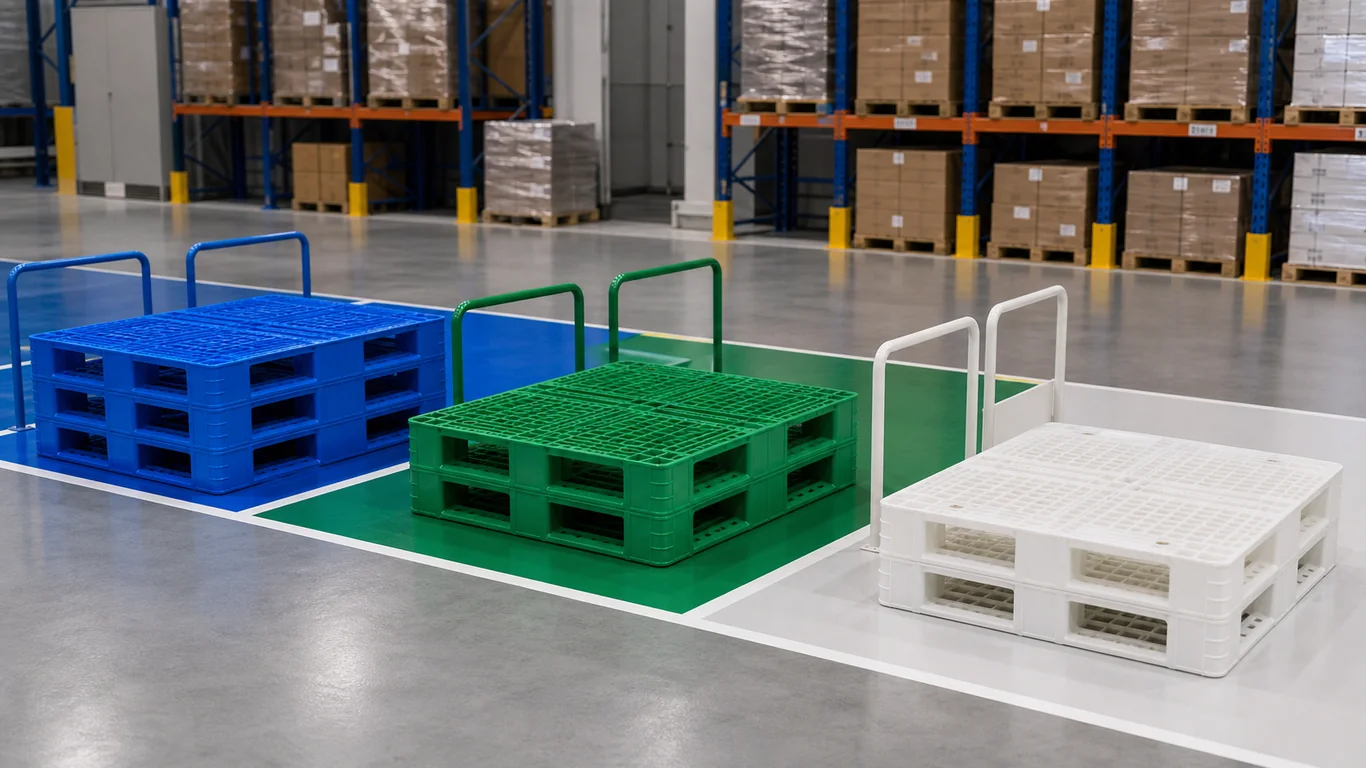
In many warehouses, pallet color is treated as a purchasing preference. One site buys blue pallets, another buys grey pallets, and a third chooses whatever is available fastest.
That approach works until the operation becomes more complex. Food and pharmaceutical zones need tighter hygiene control. Export staging areas must stay separate from domestic stock. Returned pallets need inspection before re-entering production. A single wrong pallet movement can create product mix-ups, sanitation failures, or unnecessary quarantine.
A well-designed plastic pallet color-coding system gives warehouse teams a simple visual control: workers can identify the right pallet family before scanning, loading, cleaning, or releasing goods.
The goal is not to make the warehouse look organized. The goal is to reduce decision errors at speed.
Where color coding creates real operational value
Color coding is most useful when pallet identity must be understood quickly by different teams: receiving, production, sanitation, forklift drivers, QA, and transport planners.
Common use cases include:
- separating raw materials from finished goods,
- keeping food-contact pallets away from non-food zones,
- identifying export-only or customer-dedicated pallets,
- marking quarantine, rework, or inspection-status pallets,
- separating allergen, pharmaceutical, or cleanroom-related flows,
- distinguishing returnable internal pallets from one-way outbound pallets.
The value comes from reducing ambiguity. If a worker has to read a long label every time, the system will slow down or be bypassed. If color gives the first decision signal and a label confirms the details, the process becomes much easier to follow.
For hygiene-sensitive environments, color coding should support—not replace—a formal cleaning and segregation process. This plastic pallet sanitation SOP for food warehouses provides a useful operating baseline before assigning colors to different zones.
Start with zones, not colors
A common mistake is choosing colors first. The better sequence is to map operational zones and then assign colors only where they help control risk.
Start by defining the flows that must not be mixed:
| Zone or flow | Typical risk if mixed | Color-coding purpose |
|---|---|---|
| Raw materials | contamination or stock confusion | keep inbound stock separate from production-ready stock |
| Finished goods | shipping error or customer complaint | protect released goods from non-released inventory |
| Food-contact area | hygiene nonconformance | identify pallets allowed in clean or high-care areas |
| Quarantine | accidental release | show that goods or pallets are not approved for use |
| Export staging | documentation and routing errors | separate export shipments from domestic orders |
| Customer-dedicated loop | pallet loss or wrong return | maintain closed-loop control |
Do not create a new color for every product line. Too many colors create training burden and purchasing complexity. In most B2B warehouses, three to six pallet colors are enough.
Build a simple color logic that workers can remember
The color rule should be easy to explain in one minute. If it requires a chart every time, it is too complicated.
A practical structure might look like this:
- Blue: food-contact or clean-zone pallets,
- Grey: general warehouse circulation,
- Green: returned pallets approved after inspection,
- Red: quarantine, rework, or blocked inventory,
- Black: waste handling, non-product areas, or maintenance use.
The exact colors can vary by company, but the meaning must remain stable across shifts and sites. Avoid assigning similar colors to flows that are often near each other. For example, light blue and dark blue may look different in the office but become difficult to distinguish under warehouse lighting or after surface wear.
If the system covers multiple locations, publish one group standard. Site-level variations should be limited to exceptional needs; otherwise, a pallet color that means “approved” in one warehouse may mean “quarantine” in another.
Match color with pallet design and surface requirements
Color alone is not enough. The pallet structure still needs to fit the application.
For clean zones, food processing, or pharmaceutical handling, buyers usually need pallets with:
- smooth surfaces that reduce residue retention,
- easy-to-wash deck design,
- minimal dirt traps,
- material suitable for repeated cleaning,
- consistent dimensions for conveyors, racking, or forklifts.
A blue food-grade pallet may be visually correct, but if the surface traps residue or the base design does not fit the handling equipment, color coding will not solve the operational problem.
For example, a smooth-deck 1210 food and medical plastic pallet can help teams connect color control with hygiene-focused pallet design. The selection should still be checked against load weight, temperature, rack use, cleaning method, and equipment compatibility.
Combine color coding with labels, not instead of labels
Color answers the first question: “Which flow does this pallet belong to?”
Labels answer the second question: “Which exact asset, batch, customer, or status does this pallet represent?”
For closed-loop operations, use both:
- color for zone or flow identity,
- barcode, QR code, or RFID for asset ID,
- printed text or icons for quick human confirmation,
- location codes for handover and return control.
This combination is especially important when pallets leave the main site. Once a pallet moves to a customer warehouse, 3PL, distributor, or co-packer, color helps the receiving team recognize the pallet family, while the label supports traceability and reconciliation.
If your network already needs asset-level tracking, align the color system with a broader plastic pallet traceability labeling system instead of managing color and labels as separate projects.
Control the weak points: cleaning, returns, and temporary storage
Most color-coding failures happen at process boundaries, not in the main storage aisle.
Cleaning area
After washing, pallets should return only to the color-approved zone. If clean pallets and unwashed returns share the same floor area, workers may rely on memory instead of status control.
Use clear floor markings, physical separation, or status racks to distinguish:
- dirty returns waiting for cleaning,
- cleaned pallets waiting for QA release,
- released pallets ready for production.
Return receiving
Returned pallets should not automatically re-enter normal circulation. Even if the color is correct, the pallet may be damaged, contaminated, or assigned to a customer loop.
A return receiving check should confirm:
- color and pallet model,
- visible contamination,
- cracks or deck damage,
- label readability,
- correct return quantity.
Temporary storage
Overflow areas create risk because they are often less controlled than primary zones. If red quarantine pallets are temporarily stored beside blue food-zone pallets, visual control loses its value.
For temporary storage, define a rule: color separation still applies even when space is tight.
Include color requirements in the RFQ
Color coding should be specified before quoting, not negotiated after production planning begins.
In the RFQ, include:
- required color names and, if needed, color references,
- quantity by color,
- whether colors must match across repeat orders,
- logo, text, barcode, or RFID requirements,
- expected cleaning chemicals or temperature exposure,
- whether recycled material is acceptable for each color group,
- packaging method that prevents mixed-color shipping errors.
For critical colors, ask the supplier to confirm material availability and minimum order quantity. Some colors may require larger production batches or longer lead times, especially when buyers require consistent shade across multiple shipments.
Color should also be linked to functional requirements. A quarantine pallet, for example, may not need the same smooth deck as a food-contact pallet. An export pallet may prioritize stackability or nestability. A rack-zone pallet must still meet racking and deflection requirements regardless of color.
Train by exceptions, not just by the color chart
A color chart is useful, but real compliance depends on how workers handle exceptions.
Training should answer practical questions:
- What should a forklift driver do if a red pallet is found in a released-goods zone?
- Can a blue pallet be used for non-food material during peak season?
- Who can release a cleaned return pallet back into production?
- What happens when a label is missing but the color appears correct?
- How are mixed-color stacks handled during trailer unloading?
Short exception rules prevent improvisation. They also help supervisors audit behavior on the floor without turning every issue into a long investigation.
A simple rule works well: when color and label disagree, stop the movement and escalate.
Measure whether the system is working
Color coding should be judged by operational outcomes, not by whether the warehouse looks tidy.
Track a small set of indicators:
- wrong-zone pallet findings per month,
- quarantine release errors,
- mixed-pallet incidents at receiving or loading,
- missing or unreadable labels by color group,
- sanitation holds linked to pallet misuse,
- emergency pallet substitutions by zone.
If wrong-zone findings rise after a busy season, the issue may be insufficient training, poor temporary storage control, or too many color categories. If one color group has high label damage, review label placement and cleaning exposure.
The system should become easier over time. If it requires constant manual policing, simplify the color logic or improve the physical separation between flows.
A practical rule for procurement teams
Plastic pallet color coding works best when it is treated as part of warehouse process design, not as a cosmetic product option.
Before ordering, define the flows that must stay separate, limit the number of colors, match each color group with the right pallet structure, and connect visual control with labels and inspection rules.
When color, pallet design, cleaning procedure, and traceability work together, warehouse teams can make faster decisions with fewer mistakes—and buyers can specify pallets that support real operational control rather than simply adding another SKU to manage.