Buying Guides
Stack-and-Nest Produce Crates: Test the Full Turn Cycle
Test filled stacking, empty nesting, handoff steps, vehicle restraint, and the real return route before approving stack-and-nest produce crates.
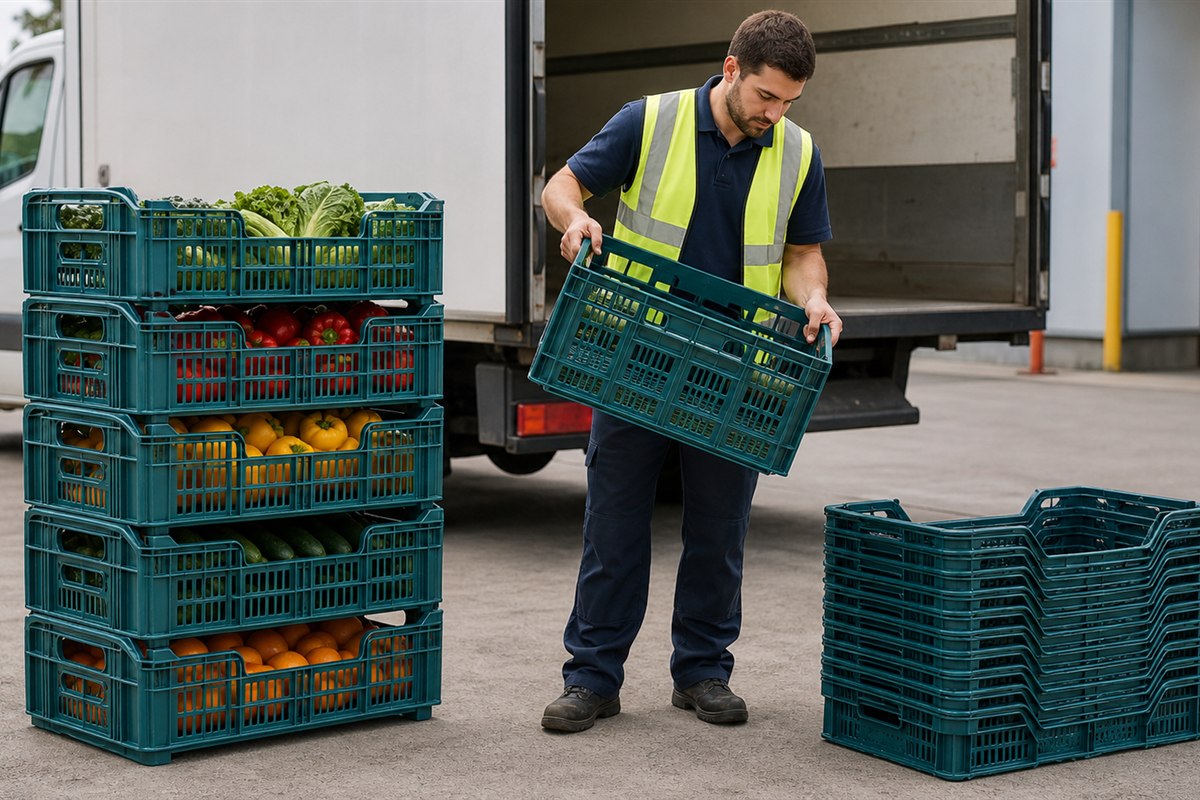
A stack-and-nest crate has two jobs that depend on its exact orientation. In the loaded position, its supports must carry the crate above without pressing the produce. In the empty-return position, the body must enter the crate below far enough to reduce volume without jamming. A crate can perform both jobs in a demonstration and still fail on a delivery route because the turn happens at the wrong place, the wrong person controls it, or mixed revisions do not engage alike.
Approve a turn pattern for the complete route, not the words “stack-and-nest.” Tie the decision to the exact crate revision, produce and fill condition, loaded stack, empty nest, vehicle arrangement, handoff sequence, cleaning status, and people who make each change. If one of those conditions changes, review whether the earlier result still applies.
Identify how this crate changes state
Do not assume every stack-and-nest crate uses the same movement. On some designs, rotating one crate 180 degrees changes it from stacking to nesting. Other designs use swing bars, covers, or separate support features. The responsible supplier should show the two positions on the exact production sample and provide a drawing or instruction that remains tied to its revision.
FAO’s postharvest handling guidance gives the basic distinction: empty plastic crates can nest to save storage or transport space, while filled crates of the illustrated type stack when alternate crates are turned to the required direction. FAO’s packaging guide also separates stacking, stack-nest, and collapsible designs and describes 180-degree and swing-bar mechanisms. FAO packaging design guidance .
Those examples explain the principle, not the geometry of a crate being quoted today. Ask the supplier to identify:
- the loaded stacking orientation and every support point that carries the crate above;
- the empty nesting orientation, required rotation or bar position, and expected nesting depth;
- features that prevent a partly turned crate from appearing seated when it is not;
- permissible stack conditions, including load, height, support, time, temperature, and damage limits;
- how operators distinguish compatible revisions if the pool contains old and new crates.
If the answer is only “turn it around,” the instruction is not complete enough for a trial.
Put the turn at a named handoff
Draw the route from filling to the next empty return. Mark every place where the crate is full, partly emptied, empty but not yet released, cleaned, stored, loaded into a vehicle, received, or handed to another organisation.
The route may pass through a field, packing area, precooler, cold store, dispatch bay, delivery vehicle, market or customer, empty-return zone, cleaning point, and storage area. Your route may use fewer steps. What matters is that each change of state has one owner and one observable result.
For each handoff, record four things:
- Incoming state: loaded stack, loose full crate, empty stack, dirty return, or released clean empty.
- Required action: unload, inspect, rotate, move a bar, nest, stack, restrain, segregate, clean, or release.
- Visible pass condition: supports fully engaged, nest seated to the agreed depth, no trapped produce, no damage, correct status, and no mixed incompatible crate.
- Stop owner: the person authorised to hold the crate or stack when the condition is wrong.
This prevents a common gap: the sender assumes the receiver will rotate the empties, while the receiver assumes the driver will return them already nested. The product may be capable, but the loop still ships air.
Prove the filled stack with the actual crop
The filled trial should use the real produce, pack pattern, fill height, liners or pads, temperature condition, and handling route, or a safe representative case agreed by the responsible team. Nominal crate volume does not show where produce touches the sidewalls or the crate above.
Watch the full stack as it is built and moved. Confirm that:
- every upper crate rests on its intended structural supports rather than on the produce, a liner, or a partly engaged rim;
- the lowest crate and floor, pallet, trolley, conveyor, or vehicle deck provide the support condition used for approval;
- vents remain meaningfully open when crates are aligned, and the route’s cooling method still works with the loaded pattern;
- handholds remain usable without fingers entering a pinch point between crates;
- the stack remains square through normal lifting, turns, thresholds, braking, and handoff movements;
- the agreed rejection rules catch cracked rims, distorted supports, jammed bars, damaged covers, or contamination before stacking.
Vent area alone does not prove cooling performance. The separate produce-crate precooling guide shows how crop, vent alignment, stack pattern, and the actual cooling route need to be tested together.
Do not borrow a stack height or load statement from a similar-looking crate. Ask for evidence tied to the exact design and stated support, duration, temperature, load distribution, and condition. The buyer, supplier, carrier, and site should then record the limit each part of the route can actually accept.
Measure the empty return after real use
An empty-return calculation should start with crates that have completed the loaded route. Measure the external height of a practical nested stack, not only the nominal nesting ratio in a brochure. Include any base pallet, cage, cover, restraint, or height limit used by the return vehicle.
Then observe the work needed to achieve that volume. Crates that nest smoothly when new may catch after rim damage, retained labels, dirt, warped bars, or mixed revisions. A deep nest is not a saving if workers have to strike crates apart or put hands into uncontrolled gaps.
Keep cleanliness status separate from geometry. A crate can be empty and correctly nested but not released for reuse. The reusable produce-crate return-to-use check covers inspection, cleaning, protection, and release. For route approval, define whether dirty returns may be nested, how they are segregated, and how standing water, trapped produce, pests, or cross-contact risks are controlled by the responsible food-safety plan.
Record at least two return figures:
- crates per permitted return stack and the measured stack height;
- complete return stacks per actual vehicle position after restraint and access space are included.
These are route results, not universal product properties. Change the vehicle, height restriction, restraint, or crate revision and the calculation may change.
Treat full and empty movements as different loads
The outbound loaded stack and the inbound nested stack have different mass, centre of gravity, stiffness, surface contact, and failure modes. Do not copy one vehicle arrangement to the other.
Current UK government load-securing guidance states that there is no single securing solution for every load and vehicle combination. It calls for the load to be stable before it is secured, for heavier items to be placed appropriately, and for lower items in a stack to support those above during braking, cornering, and acceleration. Use the applicable law, vehicle instructions, competent transport advice, and local risk assessment for the real route.
For both directions, give the carrier the stack footprint, height, mass, number of stacks, contact surfaces, permitted orientation, access need, and unloading sequence. Agree how gaps are controlled, what restraint may contact, what must not be crushed, and how the first stack will be released without destabilising the rest. HSE also advises senders, carriers, and receivers to exchange information in advance and agree safe unloading when more than one company is involved. HSE loading guidance .
Run one complete turn cycle before ordering volume
A useful pilot begins with loaded crates and ends only when the same crates are ready for the next fill. One successful outbound delivery is half a test.
Use identified samples and record their revision. Build the representative loaded stack, pass it through the normal cooling and handling route, load and restrain it in the actual vehicle arrangement, complete the delivery handoff, empty and inspect the crates, perform the required state change, build the return nest, secure and transport it, then separate and release the crates under the site’s process.
Write stop conditions before the pilot. Stop if:
- a crate sits on produce or on a partly engaged support;
- the required orientation cannot be recognised at the working position;
- a bar, cover, rim, handle, or support jams, releases, or creates an uncontrolled hand position;
- the stack leans, separates, slides, or requires an unplanned correction during normal movement;
- the planned restraint deforms crates, blocks safe unloading, or cannot control the actual vehicle load;
- mixed revisions engage differently or cannot be segregated reliably;
- dirty, damaged, or unknown-status returns can enter the released empty supply.
Record who observed each handoff, the loaded and empty stack dimensions, number of crates, actual mass where relevant, vehicle position, restraint, damage, cooling or produce observations, manual interventions, and the final decision. A pass belongs to that documented route.
Send suppliers the route, not a nesting-ratio request
Give each supplier the same crop, fill condition, loaded route, vehicle envelope, handoff map, empty-return plan, cleaning boundary, and rejection criteria. Ask the response to identify the exact model and revision, loaded and empty orientation, support geometry, nesting depth and tolerances, evidence for the proposed stack conditions, compatible accessories, inspection points, cleaning instructions, mixed-revision controls, and change-notification process.
Review the turnover-crate category only after the two states and route constraints are clear. For a bounded supplier discussion, send the crop, route map, stack conditions, return vehicle limits, and pilot criteria instead of asking whether a crate is simply “stackable and nestable.”
The purchasing decision is ready when both directions work without improvisation: produce moves in a supported loaded stack, empties return in a controlled nest, and every handoff knows when and how the state changes.