Buying Guides
Commercial Wheeled Bins: Test the Push Route Before Buying
Check filled condition, distance, slopes, thresholds, castors, brakes, visibility, and a loaded route trial before approving commercial wheeled bins.
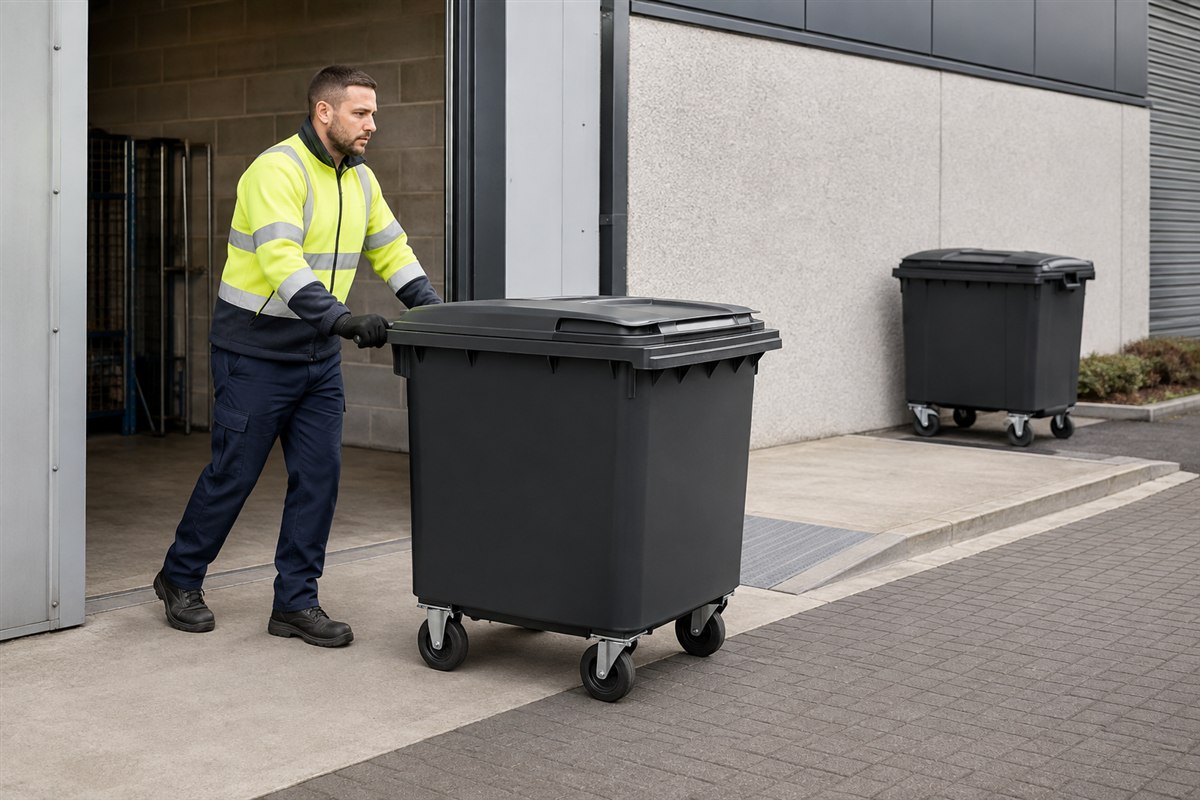
A commercial bin can match the collection vehicle and still be wrong for the site. The difficult part may be the 40 metres between the storage bay and the collection point, a narrow doorway, a drainage channel, or the return up a slope after emptying. Nominal litres do not describe any of those movements.
Treat the storage-to-collection route as part of the purchase specification. Approve one exact bin configuration only after the people responsible for the site have checked its representative filled condition, wheels, handles, brakes, clearances and control on the route that will actually be used. A change of waste stream, route, surface, collection point or bin revision can invalidate that result.
Make a route card before comparing bins
Walk from the normal storage position to the exact handover point and back. Do it at the time and in the conditions when the movement normally occurs, including gates, parked vehicles, deliveries or public access that can reduce usable space.
Record the route as a short card rather than “about 40 m on level ground.” It should identify:
- start, handover and return positions, including who releases and receives the bin;
- total distance, movement frequency and any peak-day change;
- every slope, ramp, kerb, threshold, drain, damaged patch or surface transition;
- the narrowest clear opening, tightest turn and places where the operator must reposition;
- visibility around and over the bin, lighting, blind corners, doors and crossing traffic;
- weather or contamination that can change grip or surface condition;
- places where the bin must stop and the means used to prevent unintended movement.
HSE’s traffic-route guidance says workplace traffic surfaces should be suitable for their purpose and not so uneven, potholed, sloped or slippery that people could slip, trip or fall. It specifically notes that gradients affect how easily wheeled objects such as waste containers can be managed. That supports a buyer-side conclusion: a catalogue comparison is premature until the actual route is visible.
Define the filled condition without inventing one “safe weight”
Mass matters, but it does not work alone. HSE explains that pushing and pulling risk depends on the force needed to move the load, which is affected by the equipment design and condition, wheels and handles, and whether the floor is smooth, level or sloping. HSE guidance on loads that are pushed or pulled .
Build the acceptance case from the waste that will really enter the bin. Record the empty bin mass from the supplier, then use an agreed method to establish representative and difficult-but-foreseeable filled conditions. Wet waste, glass, food waste, compacted material or uneven loading may produce very different mass distribution and movement from dry packaging waste at the same fill level.
Do not turn this into a universal maximum kilogram figure or a generic conversion from litres. The supplier must state the bin’s documented load conditions; the collector must state its service limit; and the employer or site duty holder must assess the manual movement. If the filled condition cannot be bounded reliably, change the collection frequency, loading control, route or handling method before choosing a larger bin.
Match castors, steering and brakes to the route
“Four wheels” is not a complete handling specification. Ask for the exact castor arrangement, wheel material and diameter, bearings, swivel or directional-control features, brakes, handles, replacement parts and inspection instructions. Then judge those features on the route rather than assuming that a larger wheel or a brake automatically solves it.
The trade-offs are practical. A configuration that turns easily in a bin room may wander on a long traverse. A wheel that rolls well on smooth concrete may react differently at a threshold or on rough paving. A brake may hold on one surface yet be hard to reach safely at the required stopping position. Handle height and usable grip can also change when the operator must steer through a door or see around a tall load.
HSE’s full pushing and pulling assessment checklist asks whether wheeled equipment is unsuitable for the load or floor, difficult to steer, damaged, hard to stop, fitted with poor brakes, or missing a maintenance regime. It also asks about high starting or sustaining forces, sudden manoeuvres, restricted vision, narrow doors, damaged or slippery floors, and ramps or uneven surfaces. These factors belong in one acceptance decision; checking them in separate supplier brochures misses their interaction.
Divide the route where control changes
One overall “pass” can hide the place where the bin becomes difficult to control. Break the walk into short control zones and state what must happen in each.
Leaving storage. Can the brake be released without reaching into a trapping area? Is there enough space to align the bin before pushing? Does opening a gate or door leave the operator controlling both the bin and the barrier?
Straight travel. Can the operator remain upright, see the route and keep the bin under control without repeated abrupt corrections? Are pedestrians and vehicles separated by the site’s traffic plan?
Turns and constrictions. Do the bin, operator and hands clear walls, posts, door leaves and parked equipment? If the bin must be pulled briefly or repositioned, that movement needs its own assessment rather than being hidden inside a general instruction to push.
Slopes and surface changes. Can the bin be started, kept moving and stopped under the difficult normal condition? A small threshold or drain can create a high starting effort or sudden movement even when most of the route is smooth.
Handover and return. Is there a stable, agreed place to park and apply the brakes? After emptying, does the return route change because a gate is closed, a vehicle occupies the collection point or the slope is now uphill?
This zoning is not a substitute for a risk assessment. It makes the purchasing trial observable and gives the site a precise place to change the route, surface, staffing or equipment when a problem appears.
Run an empty pass and a representative loaded pass
Use a competent site method and the applicable instructions. The first pass is an inspection and empty-bin route check. Confirm the model and revision, wheel and brake condition, clearances, stopping places and route condition. An empty pass can expose geometry and maintenance problems, but it cannot approve the filled movement.
The second pass uses a representative filled condition established without creating an overload or exposing anyone to an uncontrolled test. Observe the normal operator and worst credible route segment. HSE’s RAPP tool is designed to identify higher-risk whole-body pushing and pulling operations and to check whether risk-reduction measures work. The responsible assessor decides whether that tool, a full assessment or another competent method is appropriate.
Write stop conditions before the trial. Stop and change the plan if the bin cannot be started or stopped in control; needs forceful striking or repeated jerking; runs away or yaws on a slope; catches at a threshold; obscures the required view; traps hands or feet near a structure; requires an improvised second person; or shows wheel, brake, handle or body damage. Do not turn a failed route trial into coaching on how to force the bin through.
Record the bin identity, route version, surface and weather condition, filled condition and mass where reliably measured, operator observations, each failed or difficult zone, corrective action and retest result. The pass belongs to those recorded conditions, not to every site or every load.
Buy the route evidence with the bin
Send every shortlisted supplier the same route card and filled-condition envelope. Ask the response to identify the exact bin model and revision, empty mass, documented load conditions, external dimensions, castor and brake configuration, handle positions, inspection and maintenance instructions, replacement components, and notification process for design changes.
Keep two adjacent approvals separate. The existing bin lift-interface guide covers collector acceptance and vehicle engagement. The collection-day safety check covers access, unusual contents and escalation around collection. Passing either one does not prove that staff can move the bin along the storage route.
Only then compare the site’s plastic waste-bin category . For a bounded supplier discussion, send the route card, filled-condition range, collection requirements and trial record rather than asking whether a bin is “easy to move.”
The useful approval is specific: this bin, in this condition, can be controlled over this route under the site’s assessed method. That record turns wheels, brakes and handles from catalogue features into evidence the facilities team can maintain and recheck.